

What Is Operational Excellence? Methods, Programs and Why They Fade
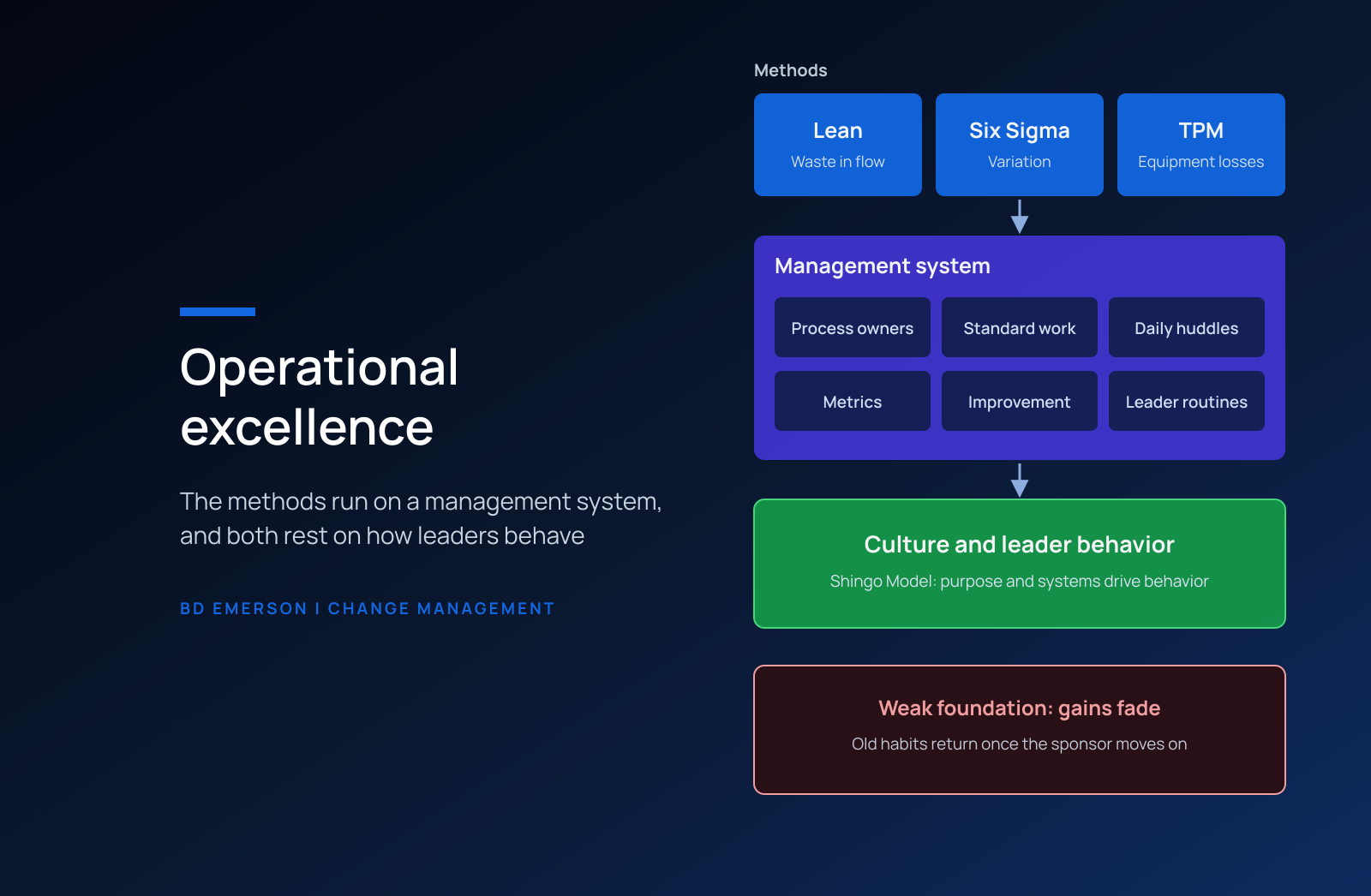
Operational excellence is the state in which a company runs its core processes the same way every time, at the cost, speed and quality its customers expect, and its own people find and fix problems as part of their daily work. Kevin Duggan gave a widely quoted definition in an April 2007 IndustryWeek article: operational excellence is when "each and every employee can see the flow of value to the customer" and can fix that flow when it breaks down. Companies build it with Lean, Six Sigma, Total Productive Maintenance and the Shingo Model, run through a management system of process owners, daily metrics and leader routines. The methods are well documented. Programs usually fail on leadership behavior, which is why culture decides whether the gains last.
What is operational excellence?
Operational excellence describes how an organization runs over years, so a single cost reduction project or one successful kaizen event proves little. The test is whether performance holds and improves after the consultants leave and the sponsor moves on.
An operationally excellent company shows four traits. Each core process has a named owner and a documented standard. Frontline teams see their performance against that standard every day, usually on a visual board. Problems surface quickly, and the people closest to the work solve them with a shared method. Leaders spend part of each week where the work happens, asking questions instead of handing down fixes.
The term started in manufacturing and spread to services because the logic transfers. A claims operation, a hospital pharmacy, a software release pipeline and a grocery distribution center each have a flow of work toward a customer, a defect rate, a cycle time and a cost per unit. Operational excellence applies the same discipline to each: define what the customer values, make the flow visible, and remove whatever interrupts it. It matters because the alternative is paying for the same problems repeatedly through rework, expediting and overtime.
Operational excellence methods and tools
Operational excellence programs draw on four main methods. They overlap, and mature programs borrow from all four.
| Method | What it targets | Signature tools and measures |
|---|---|---|
| Lean | Waste in the flow of value to the customer | Value stream mapping, standard work, pull systems, kaizen |
| Six Sigma | Variation that produces defects | DMAIC projects, statistical process control, 3.4 defects per million opportunities |
| Total Productive Maintenance | Equipment losses: downtime, changeovers, minor stops, speed losses, scrap and rework | Operator care routines, overall equipment effectiveness (OEE) |
| Shingo Model | The culture and behavior that keep the other three working | Ten guiding principles and published assessment guidelines |
The Lean Enterprise Institute summarizes lean thinking as five steps that James Womack and Daniel Jones proposed in 1996: specify value from the end customer's standpoint by product family, identify every step in the value stream, make the value-creating steps flow in tight sequence, let customers pull value from the next upstream activity, and repeat until perfect value is created with no waste.
Six Sigma attacks variation. Motorola created it in 1986, and ASQ defines Six Sigma quality performance as 3.4 defects per million opportunities. Projects follow DMAIC, which stands for define, measure, analyze, improve and control. ASQ calls Lean Six Sigma "a fact-based, data-driven philosophy of improvement," and it combines the two, using lean to speed the flow and Six Sigma to make each step predictable.
Total Productive Maintenance comes from Denso in the Toyota Group. The Lean Enterprise Institute describes it as a set of techniques to ensure that every machine in a production process can always perform its required tasks, and it puts operators in charge of routine care such as lubricating, cleaning, tightening and inspecting. Its headline measure is OEE, which multiplies availability, performance and quality. LEI's example shows why: a machine at 90 percent availability, 95 percent performance and 99 percent quality runs at 84.6 percent OEE, so three numbers that each look healthy combine into a loss of more than 15 percent of potential output.
The Shingo Model: principles behind the tools
The Shingo Model comes from the Shingo Institute, part of the Jon M. Huntsman School of Business at Utah State University. Its authors first published the model and its assessment guidelines in January 2008. The model addresses the behavior and culture that the other three methods depend on, and it groups its ten guiding principles under three headings.
| Principle group | Guiding principles |
|---|---|
| Cultural Enablers | Respect Every Individual; Lead with Humility |
| Continuous Improvement | Assure Quality at the Source; Improve Flow & Pull; Seek Perfection; Embrace Scientific Thinking; Focus on Process |
| Enterprise Alignment | Create Value for the Customer; Create Constancy of Purpose; Think Systemically |
The model rests on three insights: ideal results require ideal behaviors, purpose and systems drive behavior, and principles inform ideal behaviors. The second insight matters most for program design. The Shingo Institute observes that "most systems are designed to create a specific business result without regard for the behavior that the system drives." A supervisor bonus tied only to monthly output, for example, teaches supervisors to run equipment through warning signs, which undoes the operator care that TPM depends on. The model also separates tools from purpose. In the Institute's words, "Tools address 'how,'" and teams that learn tools without understanding why improvement matters "may become dependent on instructions."
What does an operational excellence program include?
A program is the management system that keeps the methods running after the first wave of projects ends. Six components show up in the programs that last:
- Process ownership: each value stream has a named owner with authority over its standard, its metrics and its improvement priorities.
- Standard work: the current best way to do each step is written down and used for training, so every improvement starts from a known baseline.
- Daily management: short tiered huddles let frontline teams, supervisors and managers review yesterday's performance, escalate what they cannot solve and assign an owner to each problem.
- A small metric set: safety, quality, delivery and cost are measured at the process level, alongside leading indicators such as problems raised and problems closed each week.
- Continuous improvement: teams fix small problems daily, run kaizen events for larger ones and reserve DMAIC projects for problems that need statistical analysis.
- Leader routines: managers spend scheduled time at the gemba, the place where the work happens, and coach supervisors on problem-solving instead of solving problems for them.
Most companies give one person the job of running this system. An operational excellence manager, sometimes titled continuous improvement manager, owns the method, trains facilitators and belts, manages the improvement pipeline and reports results to the executive team. The role works when that manager coaches line leaders to own their processes. It fails when the manager becomes the person who does all the improving, because the program then depends on one calendar.
An operational excellence strategy is mostly a question of sequence. Start with one value stream that matters to customers and has visible pain. Stabilize it with standard work and daily management, improve it, and then extend the management system to the next value stream. Programs that train hundreds of employees before one value stream works produce certificates and little change on the floor.
Operational excellence examples
Toyota publishes the most direct example because it documents its own system. It describes the Toyota Production System as resting on two pillars. Jidoka, which Toyota calls "automation with a human touch," lets a machine stop itself or an operator stop the line when an abnormality occurs, which Toyota says eliminates the outflow of defective products. Just-in-Time means "making only what is needed, when it is needed, and in the amount needed." Toyota traces jidoka to the automatic looms of Sakichi Toyoda, founder of the Toyota Group, including an 1896 power loom that stopped itself when a weft thread broke, and states that all employees implement daily incremental kaizen.
Service organizations apply the same ideas without machines. A claims team that posts its daily backlog and first-pass accuracy on a board, and swarms any claim older than its standard, is practicing jidoka. A hospital pharmacy that standardizes how medications are staged for each shift is practicing standard work.
Where automation and AI fit
Automation belongs inside operational excellence at a specific point in the sequence. Toyota's jidoka principle sets the pattern: the machine does the repetitive work and stops when something is wrong, and a person solves the problem. Automating a process before it is stable produces defects faster. Our business process automation guide makes the same point: define the goal and fix the process first, then automate it.
AI adds two capabilities to that pattern. It detects abnormalities a fixed rule would miss, such as a vibration signature that precedes a bearing failure or an invoice that does not match its purchase order history. It also predicts demand and workload, which feeds pull systems and staffing. In retail operations, the common uses are forecasting demand by store and item to drive replenishment, scheduling store labor against forecast traffic, and spotting likely out-of-stocks from shelf scans or gaps in point-of-sale data. Each of these works only when the underlying process has a standard. A forecast cannot repair a replenishment process that store teams override by feel, and a labor model cannot schedule tasks that nobody has timed.
Jidoka also settles the governance question: decide in advance which AI outputs act on their own and which stop and route to a person, and give that person the evidence to decide quickly.
Why do operational excellence programs fade?
Operational excellence programs fade for reasons that have little to do with the tools. The pattern is familiar: a strong launch, a year of kaizen events and belt projects, a reported savings figure, and then a slow return to old habits once the sponsor moves on. The Shingo Model's explanation is that results depend on behavior and behavior follows systems. If the performance review, the budget process and the promotion criteria still reward firefighting, people keep firefighting.
Leader behavior is the strongest of those systems. When a plant manager walks past a red metric on the huddle board without asking about it, the team learns the board does not matter. When a vice president asks for a root cause and then waits for the team to find it, the team learns that problem-solving is the job.
This is the lens Daniels Consulting Group brings to transformation work. Amy Daniels, Ph.D., an organizational psychologist with a doctorate in industrial and organizational psychology, founded DCG in 2002. DCG's strategy execution work starts from the observation that "breakdowns often occur as initiatives move from planning to implementation." Its method includes aligning leaders around the strategy, identifying the behaviors required from employees and measuring what matters most. Applied to operational excellence, that means naming the specific leader behaviors the program needs, such as attending huddles, asking before telling and recognizing people who raise problems, and then measuring whether those behaviors happen. The same discipline sits at the center of organizational change management, which handles adoption of the new way of working.
How to choose operational excellence consultants
Operational excellence consulting earns its fee when it leaves capability behind. Ask whether the firm will train your managers to lead daily management themselves, and how it will decide when to step back. Ask how it measures leader behavior in addition to savings. Ask how it ties the program to your strategy, so improvement goes after the constraints customers feel, which is the core of strategy execution consulting. Ask how it handles the people side, including role changes, resistance and the supervisors whose jobs change the most.
BD Emerson's organizational transformation consulting covers the people side of an operational excellence program. BD Emerson and Daniels Consulting Group both became part of Andersen Consulting in October 2026, and together we diagnose with evidence, align the leadership team, engage the organization, and measure and sustain the change, with DCG bringing its background in organizational psychology to the work on leader behavior and culture.

About the author
















