Network Penetration Testing: Scope, Method, and Cost
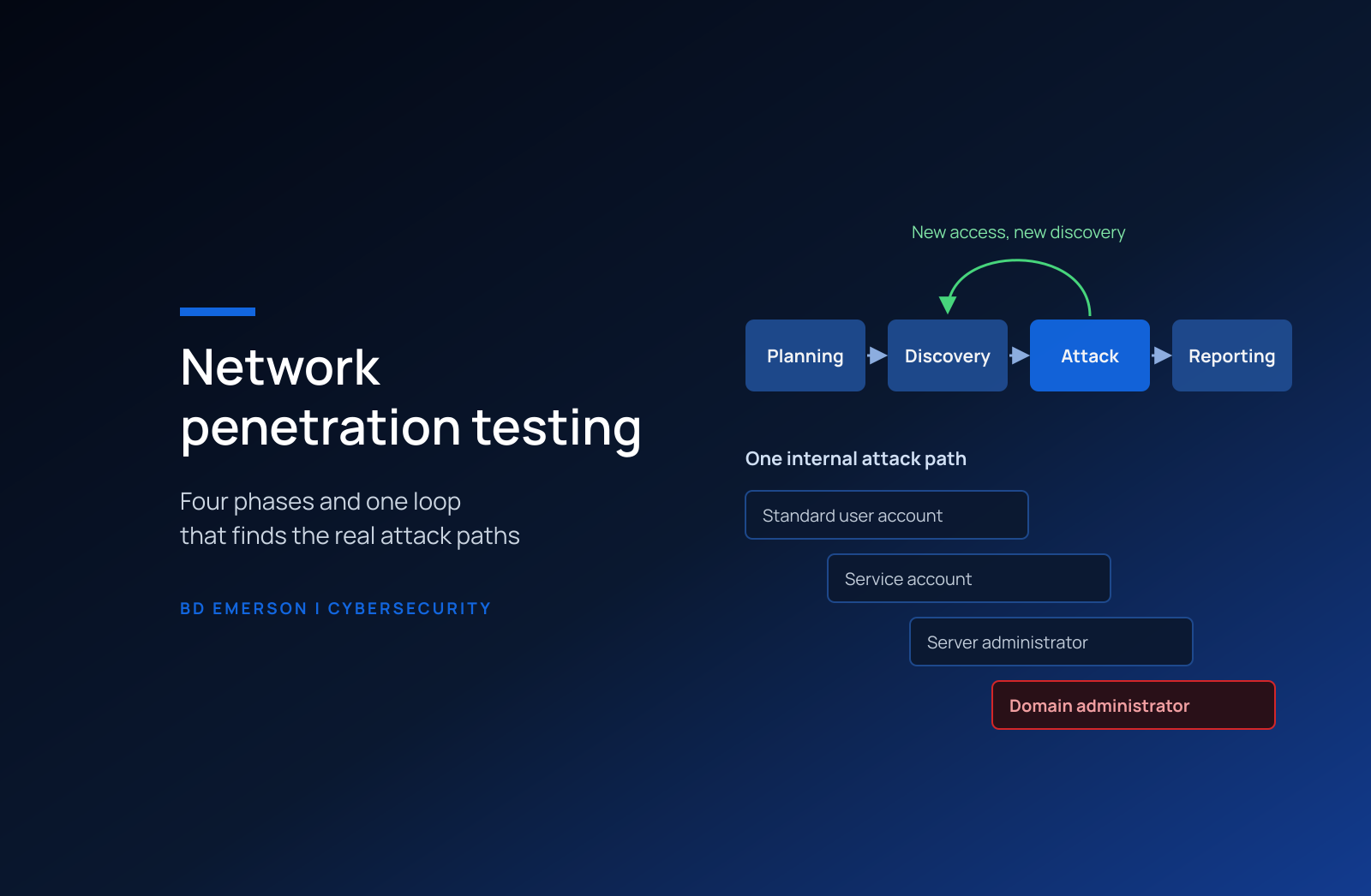
Network penetration testing is an authorized attack on your network infrastructure, carried out by a tester who uses the same techniques as an intruder and then reports how far they got. An external test targets what the internet can reach: firewalls, VPN gateways, mail servers, and exposed cloud services. An internal test starts from inside, usually from a standard user account or a device on the office network, and measures how far an attacker could move toward domain administrator rights and sensitive data. A test runs in four phases: planning, discovery, attack, and reporting. Most engagements take one to three weeks and cost $4,000 to $30,000, depending on how many live hosts, network segments, and sites are in scope. The deliverable is a report of exploited paths, each with evidence and a fix.
What does a network penetration test cover?
A network penetration test examines infrastructure: hosts, network devices, directory services, and the services they expose. It is a separate engagement from a web application test, which examines the logic of one application across its user roles. The two share tools and little else, and a quote that blends them usually shortchanges one.
The scope splits by where the tester stands. NIST SP 800-115, the federal Technical Guide to Information Security Testing and Assessment, describes external testing as viewing the security posture "as it appears outside the security perimeter," and internal testing as work performed "from the internal network." Each viewpoint answers a different question.
| Test | Starting point | Typical targets | Question it answers |
|---|---|---|---|
| External | The internet, with no credentials | Firewalls, VPN and remote access gateways, mail and DNS servers, exposed management interfaces, cloud edge services | Can an outsider get in? |
| Internal | A standard user account or a device on the internal network | Active Directory, file shares, servers, network segmentation, legacy protocols | How far does an intruder get after the first foothold? |
| Segmentation | A network that should be isolated from the target | Firewall rules and routing between zones, such as the path into a cardholder data environment | Do the boundaries hold? |
| Wireless | Radio range of your offices | Corporate and guest wireless networks, rogue access points | Can someone in the parking lot reach the internal network? |
Most organizations buy external and internal together, since an external test alone says nothing about what happens after a phished credential. Our comparison of internal and external penetration testing covers what each one finds and which to run first.
How does a network penetration test work?
NIST SP 800-115 lays out a four-stage methodology of planning, discovery, attack, and reporting, and most commercial methodologies follow the same shape.
Planning sets the rules of engagement. You and the testing firm agree on the address ranges and domains in scope, the testing window, the systems that are off limits, the contacts on both sides, and what happens if the tester finds evidence of a real intruder. Nothing is tested in this phase, and the quality of the test depends on it, because an incomplete scope produces a clean report about the wrong network.
Discovery maps the target. The tester enumerates live hosts, open ports, running services, and software versions, then compares them to known vulnerabilities. On an internal test, discovery also means reading Active Directory: users, groups, trust relationships, and the permissions that connect them.
The attack phase is what separates a penetration test from a scan. The tester tries to exploit what discovery found, gains access, raises privileges, and moves to other systems. Each success exposes new information, so the tester returns to discovery from the new position and repeats the cycle. An internal test often proceeds from one user's password to a service account, to a server administrator, and then to control of the domain.
Reporting documents each path with the evidence that it worked, rates the risk, and gives a specific remediation. A good report lets your engineers reproduce every finding.
What do network penetration tests find most often?
The findings are consistent enough that two federal agencies published them. In the advisory NSA and CISA Red and Blue Teams Share Top Ten Cybersecurity Misconfigurations, the agencies list the weaknesses their assessment teams encounter most in large networks, which they call "systemic weaknesses across many networks":
- Default configurations of software and applications
- Improper separation of user/administrator privilege
- Insufficient internal network monitoring
- Lack of network segmentation
- Poor patch management
- Bypass of system access controls
- Weak or misconfigured multifactor authentication (MFA) methods
- Insufficient access control lists (ACLs) on network shares and services
- Poor credential hygiene
- Unrestricted code execution
The advisory states that the list is not in priority order. Read it as a description of an internal test. Default settings and weak credentials give the tester a first account. Excess privilege and open file shares let that account reach more than it should. Flat networks let the tester move without crossing a firewall. Weak monitoring means nobody notices. Only two items on the list, default configurations and patch management, are things a vulnerability scanner reports well. The other eight are privilege, design, and monitoring problems that surface when someone tries to use them.
How is a penetration test different from a vulnerability scan?
A vulnerability scan lists known weaknesses on each host. A penetration test proves which of them can be used and what an attacker gains by chaining several together. The PCI Security Standards Council's Penetration Testing Guidance gives the purpose of a penetration test as to "identify ways to exploit vulnerabilities to circumvent or defeat the security features of system components."
The difference shows in the output. A scan of 500 hosts returns thousands of rows, most of them low risk in isolation. A penetration test of the same network might return 15 findings, and three of them will describe a complete route from a guest network to the finance file server. A scan is automated, runs in hours, and costs little. A test is manual work by a skilled person over days. A proposal priced near $2,000 for a network of any size is a scan with a cover page. Our article on vulnerability assessment versus penetration testing explains when each is the right purchase.
Which requirements call for network penetration testing?
PCI DSS is the most specific. Requirement 11.4 of version 4.0.1 requires internal and external penetration tests at least once every 12 months and after any significant infrastructure or application change. Where segmentation isolates the cardholder data environment, the segmentation controls must be tested every 12 months, and every six months for service providers. The same PCI guidance says testing "must include both application-layer and network-layer assessments," so a web application test alone does not satisfy the requirement.
SOC 2 and ISO 27001 name no penetration test. Auditors and enterprise customers expect one anyway, as evidence that vulnerability management works, and most security questionnaires ask for the date of the last test and a summary of results. Cyber insurers ask the same question at renewal. The practical cadence for most companies is one external and one internal test a year, plus a retest after a network redesign, a cloud migration, or an acquisition that joins two networks.
How do you scope a network penetration test?
Scope drives price, duration, and the value of the result, and five inputs define it. The first is the number of live hosts. Testing firms price on systems that respond, so a /16 address block with 300 live hosts is a 300-host test. The second is the number of network segments and sites, because each segment needs its own vantage point. The third is the number of Active Directory forests and domains, which sets the size of the internal attack surface. The fourth is the starting position for the internal test. An assumed-breach start, where you give the tester a standard user account and a workstation, spends the budget on what an intruder does after phishing succeeds. A start with no access spends part of the budget on getting that first foothold. The fifth is the testing window and any restrictions, such as production systems that can only be tested after hours.
Cloud networks add one step. Each cloud provider publishes a penetration testing policy that states which services you may test without notice and which activities are prohibited, such as denial of service. Confirm the current policy for each provider during planning and attach it to the rules of engagement.
Three scoping choices reduce the value of a test. Excluding systems because they are fragile leaves the weakest hosts untested. Allowing only a few days for a large internal network forces the tester to stop at the first path to domain administrator. Alerting the security operations team to the exact dates and source addresses removes the chance to learn whether monitoring would have caught the activity.
What does a network penetration test cost, and how long does it take?
These are BD Emerson's planning ranges for manual testing by an established firm in the US market.
| Engagement | Typical cost | Testing time | Main driver |
|---|---|---|---|
| External network | $4,000 to $15,000 | 3 to 5 days | Live host count |
| Internal network | $8,000 to $30,000 | 1 to 2 weeks | Active Directory size, segments, and sites |
| External and internal together | $12,000 to $40,000 | 2 to 3 weeks | Combined scope, with shared planning and one report |
| Retest of findings | 10 to 20 percent of the original fee | 1 to 3 days | Number of findings to verify |
Add one to two weeks after testing for the report. Ask whether the retest is included before you sign. A finding you cannot show as fixed is of little use in an audit or a customer security review. Our penetration testing cost guide covers the other test types and the pricing levers in more detail.
What should the report contain?
A network penetration test report should hold up in front of three readers. Executives need a one-page summary that states whether the tester reached the agreed objectives, such as domain administrator or the cardholder data environment, and how. Engineers need each finding with the affected hosts, the exact steps and commands that worked, screenshots or output as proof, a severity rating with its reasoning, and a remediation that names the setting or patch. Auditors need the scope, dates, methodology, and tester qualifications, and later an attestation or retest letter showing that the findings were closed.
The most useful section is the attack narrative: the sequence from first access to final objective, shown as a chain. It tells you which single fix breaks the most paths. Removing one over-privileged service account often closes more risk than patching 50 hosts.
Where BD Emerson fits
BD Emerson's network penetration testing service covers external perimeter and internal network testing, including the Active Directory attack paths that turn one workstation into domain-wide access, performed manually against a scope and rules of engagement we set with you. The report includes the attack narrative and reproducible findings in a format your auditor and your customers can rely on, and we agree the retest of your fixes at scoping. If you need the test as evidence for a SOC 2 examination, a PCI assessment, or a customer contract, tell us the deadline at scoping and we will plan the testing and retest dates around it.

About the author