

Agentic Software Development: How Enterprise Teams Ship With AI Coding Agents
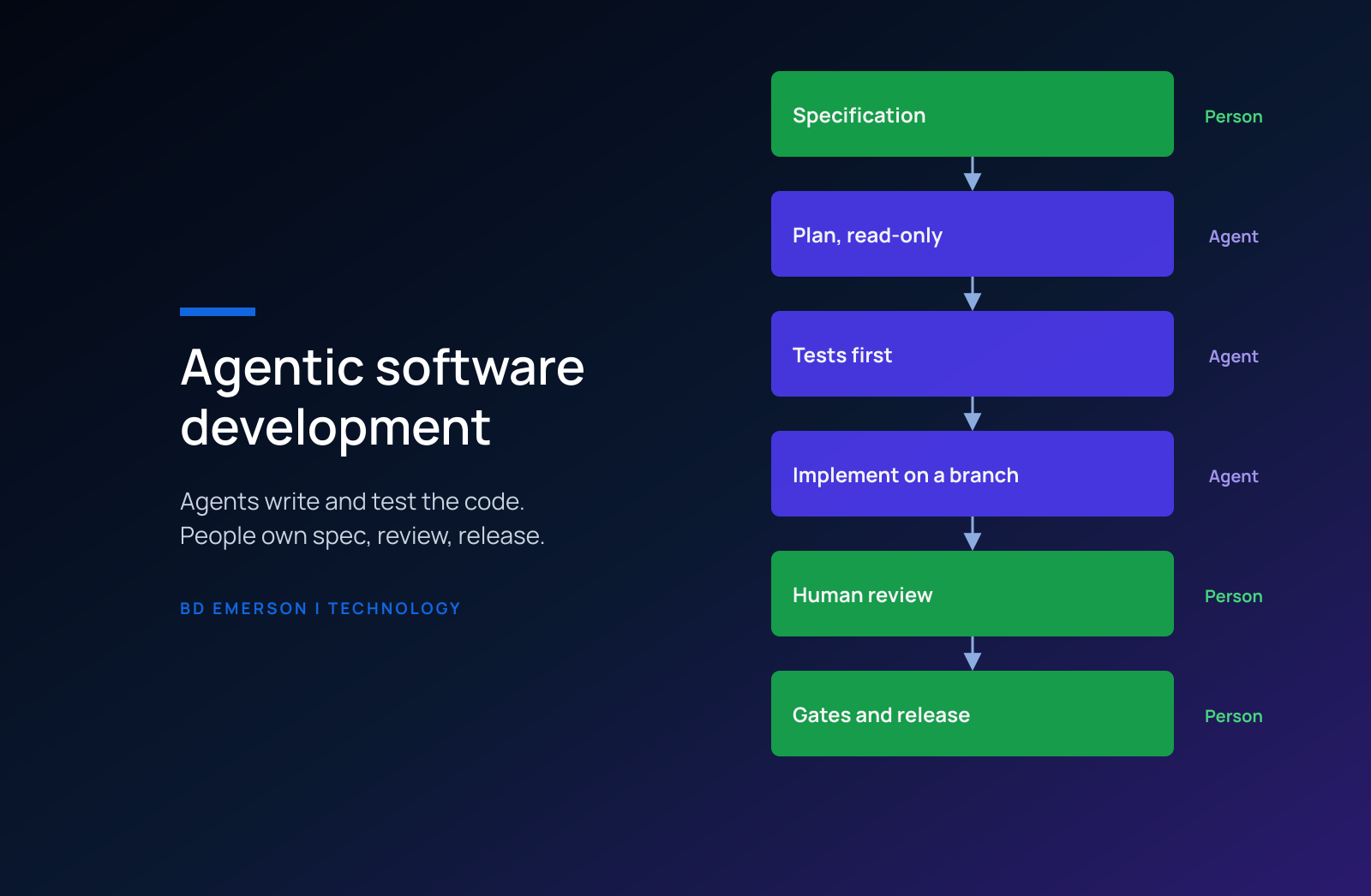
Agentic software development is a way of building software in which engineers direct AI coding agents that plan changes, write code, run tests, and open pull requests, while people own the requirements, the architecture, the review, and the release. It differs from autocomplete-style assistance because the agent works through a whole task, often across many files, and reports back with a change for a person to accept or reject. Done well, it shortens the time from a clear specification to a reviewed, tested change. Done badly, it produces more code than anyone can review. The difference comes from the delivery model around the agents: written specifications, tests first, small pull requests, strict review, and the same security gates as human code.
How is agentic development different from AI-assisted coding?
AI-assisted coding suggests the next line or function while a developer types, and the developer stays in control of every keystroke. Agentic development hands the agent a task, such as adding an endpoint, fixing a failing test, or migrating a module, and lets it read the codebase, edit files, run commands, and iterate until the tests pass. Tools such as Claude Code, Cursor's agent, and GitHub Copilot's coding agent work this way, in a developer's terminal or in a cloud environment that opens a pull request when the work is done.
The shift changes where engineering time goes. Less of it goes to typing code, and more goes to writing precise specifications, designing tests that define done, reviewing changes, and deciding what the system should do. Senior judgment becomes more valuable, because an agent will implement a poor design as quickly as a good one.
What does the research say about AI in software delivery?
Google's DORA research program surveyed nearly 5,000 technology professionals for its 2025 report on AI-assisted software development. It found AI adoption among software professionals at 90 percent, a median of two hours a day spent working with AI, and more than 80 percent of respondents reporting higher productivity. It also found AI adoption linked to higher software delivery throughput, a reversal of the previous year's finding.
Trust lagged use. Only 24 percent of respondents reported a great deal or a lot of trust in AI output, and 30 percent reported little or none. DORA describes AI as a mirror and a multiplier: in well-run teams it amplifies strengths, and in fragmented ones it highlights weaknesses. That finding is the practical case for investing in the delivery model before scaling the agents.
What does an agentic delivery model look like?
We run agentic development as a defined process with checkpoints people own. Each change moves through six steps:
- Specification. A person writes the requirement, acceptance criteria, and constraints in the ticket, including what the agent must not change.
- Plan. The agent reads the codebase in a read-only mode and proposes a plan, and an engineer approves or corrects it before any edit.
- Tests first. The agent or the engineer writes tests that encode the acceptance criteria, and they fail before the change.
- Implementation. The agent works on a branch with scoped permissions until the tests pass, keeping each change small enough to review in one sitting.
- Review. An engineer who did not write the specification reviews the pull request, the tests, and the agent's log of commands and files touched.
- Gates and release. Static analysis, secrets scanning, dependency checks, and the normal release process apply exactly as they do to human changes.
Claude Code's permission modes fit this process directly. Its plan mode lets the agent read and explore without editing source files, and its default mode asks for permission the first time it uses each tool, so the plan and implementation steps map to tool settings rather than to trust.
Where does agentic development work best?
It works best on well-tested codebases with clear module boundaries, where an agent can run the test suite and get a reliable answer. Typical wins include adding features that follow an existing pattern, writing and repairing tests, upgrading dependencies, migrating code from one framework or version to another, and building internal tools against documented APIs. Legacy modernization is a strong fit once a characterization test suite captures what the old system does, because the agent can then translate and refactor against a fixed target.
It works poorly where the problem is unclear, where the codebase has no tests, or where the change crosses many services with implicit contracts. In those cases the first job is to write the specification and the tests, and that job belongs to people. Regulated systems also need care: changes to code that calculates premiums, interest, dosage, or eligibility should carry a named human author for the logic, even when an agent writes the implementation.
Which controls keep agentic development safe?
The controls come in three layers. On the agent, enforce permission rules that deny access to secrets and restrict network commands, run cloud agents in isolated environments, and give each agent its own source control identity that cannot push to protected branches or approve its own work. In the pipeline, keep every security gate and require human review for every merge. In governance, keep an inventory of the agents in use, their settings, and the repositories they touch.
Watch for vendor limits. GitHub, for example, documents that Copilot content exclusion stops an agent from opening excluded files through Copilot's own tools but might not catch indirect access, and that it is no substitute for operating-system permissions. Our guide to AI code security covers each assistant's controls and limits in detail, and NIST's SP 800-218A adds AI-specific practices to the Secure Software Development Framework for policy work.
How do you measure whether it is working?
Measure delivery, quality, and review load together, because agents can move one at the expense of the others. On delivery, track lead time from an approved specification to a merged change, and deployment frequency, the same measures DORA has used for years. On quality, track the change failure rate, the share of agent pull requests that need rework after review, and defects found in production per release. On review load, track the time reviewers spend per pull request and the number of open pull requests waiting for review.
The review numbers are the early warning. If agents produce changes faster than reviewers can read them, pull requests pile up, reviewers skim, and defects reach production a few weeks later. When that happens, slow the agents down: tighten specifications, shrink the size of each task, and add tests before adding more agent capacity. Set a baseline from the last quarter of human-only delivery before you start, so the comparison rests on your own history rather than a vendor benchmark. Teams that track these measures from the first sprint can show leadership what the agents changed, and teams that skip them end up arguing from anecdotes.
What does agentic development change for buyers of custom software?
For a company commissioning custom software, the change shows up in three places. Delivery of well-specified work speeds up, so more of the budget goes to discovery, design, and testing, where the quality of the result is decided. Code volume rises, so ask any provider how they review AI-written code and what share of changes get a human review. And ownership questions sharpen: confirm that you own the code, that the provider's tool settings did not send your source to a service you did not approve, and that the handover includes the tests and specifications an agent needs to keep working on the system.
Ask providers for evidence rather than claims. A team that runs agentic development well can show you the specification template, the pull request log, the review rate, and the pipeline gates. Our list of the best custom software development companies sets out the other questions to ask a builder.
How BD Emerson builds with AI agents
BD Emerson builds custom software with AI coding agents inside the delivery model above, with security gates designed by our security practice and a named engineer accountable for every merged change. Clients get faster delivery on well-specified work and the documentation, tests, and code they need to own the system. For larger engineering programs, our Andersen Consulting colleagues at SPR add custom application development capacity.
If you are planning a build or a modernization and want it delivered with AI agents and the controls to match, our custom software development team can scope the work and show you the delivery model on your own codebase.

About the author
















