Change Fatigue and Change Saturation: Signs, Causes, and How to Measure Change Load
Change fatigue is the weariness and disengagement employees feel when they perceive that their organization is changing too much, too often. Change saturation is the condition that produces it: the volume of concurrent change exceeds the capacity of the affected groups to absorb it. Fatigue describes what people feel, and saturation describes the load they carry. The usual causes are too many overlapping initiatives, weak sponsorship, and no recovery time between changes. Leaders reduce change fatigue by measuring the change load on each group, cutting and sequencing the portfolio to fit capacity, and sponsoring the changes that remain.
What is change fatigue?
Change fatigue is a cumulative response. It builds across many changes, so the initiative that finally exposes it is often a small one. A team that absorbed a reorganization, a new performance system, and an office move can stall on a minor expense-tool update, and leaders who look only at the expense tool will misread the cause.
Researchers have measured the construct directly. In Change fatigue: Development and initial validation of a new measure, published in the journal Work & Stress in 2011, Bernerth, Walker, and Harris developed a six-item change fatigue scale using data from change consultants and from a US manufacturing company that had gone through several changes over three years. They found that change fatigue was associated with higher exhaustion, and that exhaustion was associated with lower organizational commitment and higher turnover intentions. The pattern links perceived change volume to exhaustion, and exhaustion to weaker commitment and a stronger intention to leave.
Change fatigue differs from resistance. Resistance is active and specific: a group objects to a particular change and says so. Fatigue is passive and general: people stop objecting, stop asking questions, and wait for the initiative to pass. Fatigue is the harder one to detect because it looks like compliance.
Change fatigue also differs from burnout. The World Health Organization's ICD-11 description of burn-out defines it as a syndrome resulting from chronic workplace stress that has not been successfully managed, with three dimensions: feelings of energy depletion or exhaustion, increased mental distance from one's job or feelings of negativism or cynicism related to one's job, and reduced professional efficacy. Burnout can come from any chronic workplace stress. Change fatigue has one named source, which is the amount of change, and that makes it something leaders can address directly.
What is change saturation?
Change saturation is the point at which a group has no remaining capacity to absorb another change while still doing its regular work. It is a property of the load and the capacity together. A change portfolio that one division absorbs comfortably can saturate another division that has fewer people, weaker managers, or a heavier operational calendar.
Eric Abrahamson described the organizational pattern in Avoiding Repetitive Change Syndrome, published in MIT Sloan Management Review in 2004. He lists the symptoms as initiative overload, change-related chaos, and employee cynicism and burnout. Initiative overload appears when organizations launch more change initiatives than anyone could reasonably handle. Change-related chaos is the upheaval that results when so many waves of initiatives have washed through the organization that people no longer know which change they are implementing or why. Abrahamson offers a rule of thumb: overload is severe when employees spend more than a third of their time carrying out change initiatives.
Saturation is local. It concentrates in the groups where many initiatives converge, and those groups are predictable. Frontline managers receive every initiative because every initiative needs them to brief, coach, and report. Shared functions such as finance, HR, and IT support every program while running changes of their own.
| Term | What it describes | Where it shows | How to measure it |
|---|---|---|---|
| Change fatigue | How people feel about the amount of change | Individuals and teams | Survey items on perceived change volume, plus behavior signals |
| Change saturation | Change load compared with capacity | Groups where initiatives converge | A portfolio inventory mapped by group and by period |
| Burnout | A syndrome from chronic, unmanaged workplace stress | Individuals | Validated burnout instruments and occupational health data |
What are the signs of change fatigue?
The signs are behavioral before they are numerical. Managers and HR partners usually see them first:
- Meetings about a new initiative go quiet, and the questions and objections that used to come up stop.
- Employees describe the initiative as one more program to wait out, and they refer to earlier initiatives that faded.
- Adoption starts and then reverses, and old spreadsheets and workarounds return.
- Routine work slips, with more errors, missed deadlines, and rework in teams that were reliable before.
- Frontline managers stop passing messages on, or pass them on without endorsing them.
- Pulse surveys show falling scores on workload, clarity of priorities, and confidence in leadership.
- Absence and resignations rise in the groups that carry the most change.
One sign on its own proves little. Several of them appearing together, in a group that sits under many initiatives, is strong evidence.
What causes change fatigue?
Volume and overlap of change
The main cause is arithmetic. Each initiative asks for time: training, meetings, testing, data cleanup, and the slower pace of doing familiar work in an unfamiliar way. A sponsor who sees only one initiative approves it on its own merits. Nobody adds up the demands that land on a single claims team or a single plant in the same quarter. Overlap makes the load heavier than the sum of its parts, because people have to switch between initiatives and reconcile instructions that conflict.
Weak sponsorship
Sponsorship determines how heavy a change feels. When a senior leader explains why the change matters, how it connects to the other changes under way, and what the organization will stop doing to make room, employees can place the change in a story that makes sense. When the sponsor announces the change and disappears, employees conclude that it is optional and temporary. A history of abandoned initiatives teaches people that the rational response to a new one is to wait.
No recovery time
People need a period of stability after a change to rebuild fluency and confidence in the new way of working. Organizations often skip that period. The project team disbands at go-live, the next initiative launches, and the previous change never reaches the point where it feels normal. Changes that are never finished keep drawing attention, so the load from old initiatives carries into new ones.
How do you measure change load?
Measurement starts with an inventory. List every change that will reach employees in the planning period, including the ones nobody calls a project: reorganizations, leadership changes, policy changes, system upgrades, new reporting requirements, and office moves. Central portfolio lists usually miss the changes that functions launch on their own, so ask each function directly.
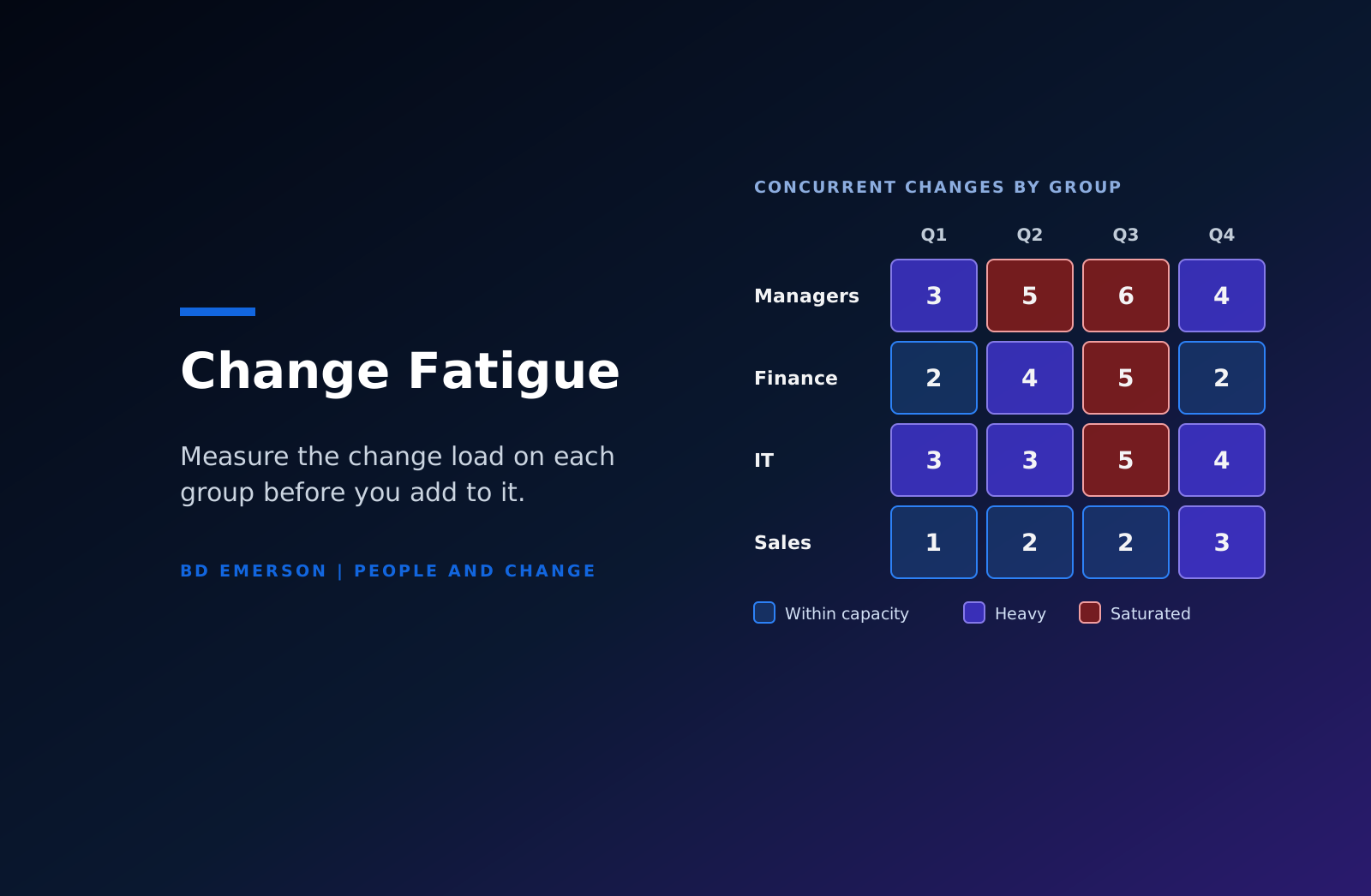
For each change, record the groups it affects, the period when its demands peak, and the size of the demand on each group. A simple three-level impact rating is enough to start, provided the rating reflects hours required and the degree of behavior change. Then build a grid with groups on one axis and periods on the other, and total the impact in each cell. The result is a heat map that shows which groups carry the heaviest load and when.
Next, compare load with capacity. Mark each group's operational peaks, such as quarter-end close in finance or peak season in a distribution center, and note staffing gaps and manager vacancies. A moderate change load during a peak can saturate a group that would absorb a heavier load at another time.
Finally, add the human measures. Short pulse surveys can track perceived change volume by group, and the six-item Bernerth scale is a published instrument for that purpose. Time data helps as well: Abrahamson's one-third threshold gives leaders a concrete figure to test against the hours that teams report spending on change work.
What do leaders do about change fatigue?
The first response is to reduce and reorder the load. With the heat map in front of them, executives can stop initiatives that no longer earn their place, defer initiatives that collide with an operational peak, and combine initiatives that ask the same group to learn related things. These decisions require a forum with the authority to make them, because individual sponsors will defend their own programs. Tying the portfolio to a short list of strategic priorities, which is the core of strategy execution, gives that forum a basis for choosing.
The second response is to assign an owner for the whole portfolio. One person or office should hold the inventory, update the heat map, and have a seat where new initiatives are approved. Abrahamson recommends a similar instrument: an organizational dashboard that tracks the pace of change and how much the organization can absorb.
The third response is to strengthen sponsorship. Sponsors should explain how the current changes fit together, say plainly what has been stopped or deferred, and stay visible until each change is established. Frontline managers need briefing before their teams and enough context to answer the question employees ask most often, which is why this change is happening now. A disciplined change management approach makes these commitments explicit for each initiative.
The fourth response is to build recovery into the plan. Close each change formally, confirm that it has been adopted, and tell people that it is finished. Protect a stabilization period for the groups that carried the most load before the next change reaches them. Leaders who tell a tired group that nothing new will arrive until a named milestone earn credibility that they can draw on later.
The last response is to keep measuring. Change load shifts every time an initiative slips or a new one is approved, so the inventory and the pulse survey need a regular cadence, and the results need to reach the forum that controls the portfolio.
BD Emerson delivers organizational transformation and change management work with our Andersen Consulting colleagues at Daniels Consulting Group, a firm of organizational psychologists and experienced business professionals. If change fatigue is slowing your programs, see our organizational transformation consulting service or book a consultation.

About the author