

What Is a Change Agent? Role, Skills and How to Build a Network
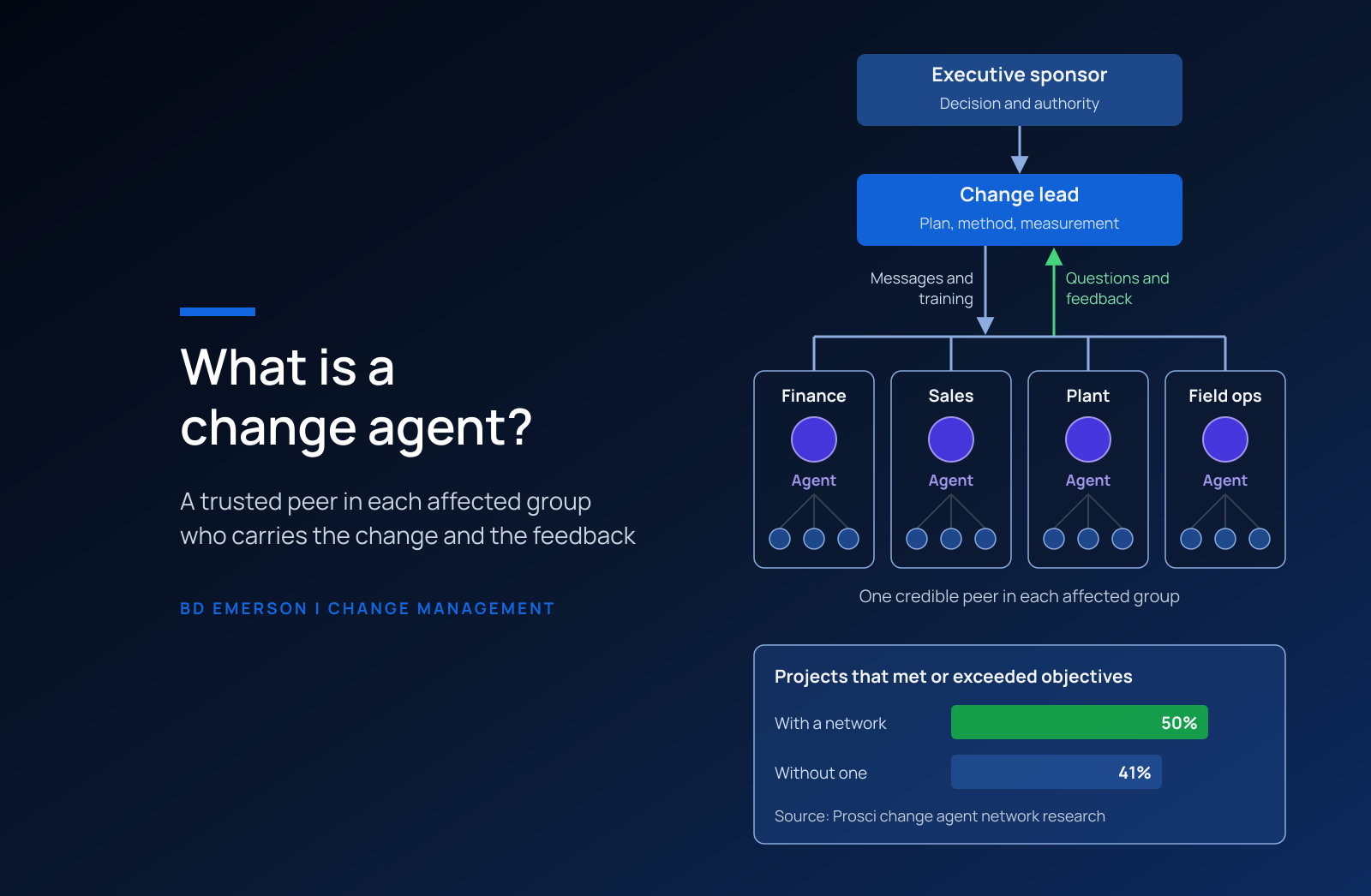
A change agent is a person who helps other people in an organization accept a change and start working the new way. Prosci, the change management research firm, defines the role as "a person who promotes and helps others in an organization accept and enact change." Prosci notes that change agents are also called change champions or change influencers, and that the phrase agent of change can also describe people who drive social change more broadly. Change agents can be insiders, such as respected employees who carry messages and feedback within their own teams, or outside consultants hired for one initiative. Large programs organize them into a network, with one or more agents in each affected group working part-time beside the sponsor and the change lead.
What is a change agent?
The role is defined by what the person does. Prosci describes a change agent as an extension of the change management team, and the person can be a leader, a manager or an influential employee. Inside a network, the role is a part-time assignment added to an existing job for the length of a program. ISO/TS 10020:2022, the ISO technical specification for organizational change management processes, names change sponsors, change agents, change team members and project managers as separate roles the standard applies to. Keeping those roles distinct matters, because a program that expects change agents to do the sponsor's job stalls when the first hard decision arrives.
| Role | What the role owns | Who usually holds it |
|---|---|---|
| Executive sponsor | The decision, the funding and the authority to remove obstacles | The senior leader accountable for the business result |
| Change lead | The change plan, the methods and adoption measurement | A full-time change management practitioner, internal or external |
| People manager | Explaining the change to direct reports and coaching them through it | Line managers of every affected team |
| Change agent | Local reach: carrying messages, collecting feedback, helping peers and modeling the new behavior | Credible employees inside each affected group, part-time |
The change agent contributes reach and trust. A sponsor can explain why the company is replacing its ERP system, but a planner on the second shift is more likely to ask a respected colleague whether the new screens work. Prosci reports that change agents are most often responsible for communicating about the change, followed by training others and providing implementation support, leading and role modeling the change, and general support for change management activities. That list works as a job description, and our guide to organizational change management shows where the role fits in the wider plan.
Change agent meaning and where the term comes from
The term predates corporate change management. Everett Rogers, then at Ohio State University, wrote in the first issue of the Journal of Cooperative Extension in 1963 that "all Extension workers are change agents." He described them as "professional persons who attempt to influence adoption decisions in a direction they feel is desirable," and he was writing about Cooperative Extension workers, the outreach staff of a partnership between federal, state and county governments that provides scientific knowledge and expertise to the public. The passage is quoted, with its page reference, in a University of Florida IFAS Extension publication on diffusion of innovations.
Rogers gave the change agent its own chapter in Diffusion of Innovations. In the fifth edition, published in 2003, chapter 9, "The Change Agent," covers change agents as linkers between a change agency and its clients, change agent empathy, credibility, the use of opinion leaders, and homophily, the degree to which people who interact are alike, which for a change agent means how closely they resemble the people being asked to change. Those ideas carry directly into how organizations pick change agents today. People take their cue on a change from peers who resemble them and whose judgment they already trust.
John Kotter's eight-step model makes the same point at enterprise scale. Step 2 is to build a guiding coalition and step 4 is to enlist a volunteer army, and Kotter's firm describes large-scale change as depending on "massive numbers of people" who "rally around a common opportunity." A change agent network is the organized, project-level form of that volunteer army.
Internal vs external change agents
Prosci separates internal change agents, meaning leaders, managers and influential employees who already work in the organization, from external change agents, meaning consultants or third-party practitioners brought in to facilitate a change initiative. Each type covers the other's weak spot, and Prosci treats the two as complementary.
| Factor | Internal change agent | External change agent |
|---|---|---|
| Main strength | Knows the culture, processes and goals and already has relationships and influence with colleagues | Brings a neutral outside view, experience across industries and added capacity without new headcount |
| Main limit | Carries a day job and sits inside the politics of the change | Leaves when the engagement ends and has to earn trust first |
| Best used for | Carrying the change inside each team and reporting what people say | Diagnosis, the change plan, and training the internal network |
A common pattern pairs an external change lead with an internal network. The outside team runs the readiness and impact assessments, writes the plan and prepares the internal agents, and the internal agents carry the work into teams the outside team never meets. An outside change management team earns its fee when the organization has no change practitioners of its own, when the program crosses many business units at once, or when the change is political enough that employees need someone with no stake in the outcome, as in an M&A integration where both companies' people are watching for favoritism.
What makes a good change agent?
Prosci names five skills for the role. Each one shows up in specific behavior you can look for when you choose people.
- Communication and influence. The person can explain the change in the team's own terms and get a hearing from colleagues who outrank them.
- Empathy and emotional intelligence. They notice what a change costs a colleague, such as a lost skill or a lost workaround, and they say so before arguing for the benefits.
- Strategic thinking and problem-solving. They connect a local complaint to its root cause and bring it back to the change lead as a fixable problem.
- Flexibility and resilience. They keep working when the go-live date moves or the design changes, and they tell peers what changed without spin.
- Collaborative, accountable leadership. They follow through on what they promise their team, which is what makes their next message believable.
Credibility outranks seniority. Prosci advises that selection include "an evaluation of their level of influence and credibility with their peers," along with communication skills, organizational knowledge and subject matter expertise, and that change leaders choose agents who represent the impacted groups in their own areas of responsibility. In practice, the best candidates are the people colleagues already ask for help. Include at least one respected skeptic, because colleagues who share the doubts will listen to someone who raised them first. The worst selection method is picking whoever has spare time, since spare time in a busy team often signals low influence.
How to build and support a change agent network
A change agent network is, in Prosci's words, "a group of individuals who extend the reach, influence and efforts of change leaders." Prosci's research found that organizations that deployed a change agent network met or exceeded project objectives 50% of the time, compared with 41% for organizations that did not use one. Prosci lists common reasons to build a network, including extending project support to speed up a change, extending its reach to regions across the organization, increasing the flow of information, and building ownership among impacted groups. Prosci adds that when an organization has a history of poorly managed change because impacted groups were not engaged in the design of the change, a network builds ownership by giving those groups more chances to engage.
Prosci recommends a business case for the network that states the number of change agents required from the impacted groups and an estimate of the time commitment involved. Write that estimate down and get each agent's manager to agree to it before the work starts, because an unwritten commitment is the first one cut when the quarter gets busy. Plan coverage by group: every affected team, site and shift needs a named agent, and a large or resistant group may need two.
Support decides whether the network works after launch. Brief change agents before the wider organization hears anything, so they never learn the news from the people they are meant to support. Train them on the change itself and on handling the hard questions, and give them a short reference they can use at a desk. Set up a two-way channel in which their feedback reaches the change lead every week and they see what happened to it. Give them direct access to the sponsor at least once during the program. Count the work in performance reviews, and set an end date for the assignment.
Mistakes that burn change agents out
Change agents burn out for predictable reasons, and nearly all of them come from how the program treats the role.
Adding the role on top of a full job
An agent with no released time does the change work in the evenings or lets it slide. Either outcome costs the program, and the first sign is missed network meetings. Reduce the agent's regular workload for the length of the assignment, or accept that the network exists only on paper.
Treating the network as a broadcast channel
When agents receive slides to forward and no way to send questions back, peers learn that asking them goes nowhere. The agent loses credibility with the team, and the program loses its best source of early warning. Every question an agent raises needs an answer or a clear "not yet, and here is when."
Leaving agents to absorb resistance alone
Change agents hear objections first. If the sponsor never answers those objections in public, the agent becomes the face of decisions they did not make. Route serious concerns to the sponsor quickly and have the sponsor respond in their own name. Our article on resistance to change covers how to diagnose those objections and answer them.
Picking the same people for every change
Reliable employees get chosen for every initiative, so a handful of people carry several programs at once while their colleagues carry none. Check the change portfolio before you recruit, and rotate the role. The same overload that drives change fatigue across a workforce hits change agents first, because they absorb every change twice: once as an employee and once as its advocate.
Giving the role no end and no credit
An assignment with no end date turns into permanent extra work that nobody recognizes. Close each agent's role formally when the change stabilizes, tell their manager what they contributed, and ask whether they want to serve on the next program.
Preparing change agents and the people who lead them
A change agent network works when the change lead, the sponsors and the managers around it share one method. BD Emerson's change management training builds that method inside your organization. We start by assessing how you manage change today, then deliver a documented methodology and toolkit your team owns, a practitioner curriculum on impact assessment, stakeholder analysis, communication, training design, resistance and adoption measurement that uses your own templates and current projects, and leading-change workshops for managers and executive sponsors. We also coach beside your team on projects already under way. We run this work with Daniels Consulting Group, our Andersen Consulting colleagues whose work draws on organizational psychology and business experience.

About the author
















