The Frontier Model Tax: What Frontier-First AI Costs an Enterprise
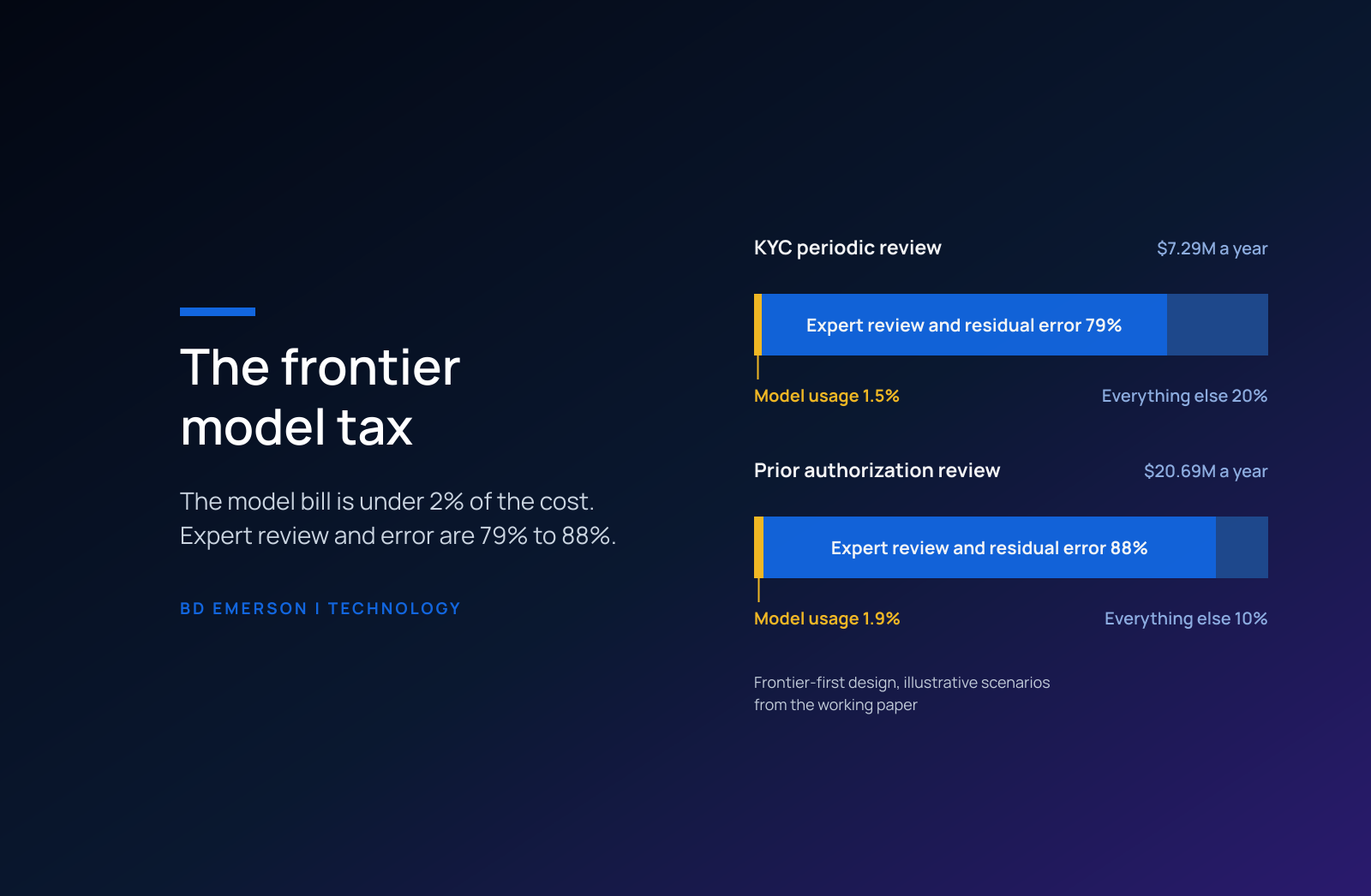
The frontier model tax is the full operating cost an enterprise takes on when a general-purpose frontier model becomes the default way to execute knowledge work. It has five parts: metered usage and seats, expert oversight and rework, governance and revalidation, supplier dependency, and reduced control over where data is processed. A November 2026 working paper by Drew Danner and Jason Strimpel of Andersen Consulting models that cost for two regulated workflows. In both, model usage is under 2% of the annual cost of a frontier-first design, and expert review plus residual error is 79% to 88%. Under the paper's assumptions, rebuilding the repeatable work as software costs 21% to 34% less.
Every figure in this article comes from the paper's two illustrative scenarios. The authors built them from stated assumptions, and the paper reports no client results, experiments, or measured comparisons. The full paper and its cost model are a free download, and the model lets you replace each assumption with your own number.
What is the frontier model tax?
A frontier model is the most capable general-purpose model a vendor sells, priced at the top of its range. The frontier model tax is what an enterprise pays, across the life of a workflow, for making that model the place where the work happens. The invoice for tokens and seats is one line of it. The paper defines five components, and they overlap in practice.
- Consumption and seats: metered usage and per-user licenses whose link to verified outcomes is hard to establish.
- Oversight and rework: the expert time spent checking sources, correcting output, and escalating, plus the capacity those experts need to carry real responsibility.
- Governance and revalidation: evaluating and re-testing a component that can change outside the enterprise's control.
- Supplier dependency: switching effort, exit cost, and continuity exposure.
- Data location: reduced control over where and how information is processed.
The paper treats the term as an analytical construct. Some of these burdens also apply to smaller and locally hosted models. The question for each workflow is which burdens the task requires and which ones follow from building the workflow around a model.
Where does the money go in a frontier-first workflow?
The paper prices two composites. The first is know-your-customer (KYC) periodic review in financial services: 250,000 cases a year, with an analyst at a loaded rate of $85 an hour. The second is prior authorization review in healthcare: 600,000 cases a year, with a clinical reviewer at $110 an hour. In the frontier-first design, a frontier model executes each case end to end and an expert reviews every result, for 12 minutes in the KYC scenario and 10 minutes in the prior authorization scenario.
| Annual cost, frontier-first design | KYC periodic review | Prior authorization review |
|---|---|---|
| Model usage | $108,000 (1.5%) | $396,000 (1.9%) |
| Expert review and QA | $4,250,000 (58.3%) | $11,000,000 (53.2%) |
| Residual error | $1,500,000 (20.6%) | $7,200,000 (34.8%) |
| Governance and evaluation | $600,000 (8.2%) | $900,000 (4.4%) |
| Build, run staff, and migration reserve | $830,000 (11.4%) | $1,190,000 (5.8%) |
| Total | $7,288,000 | $20,686,000 |
The model bill is the visible line, and it is the smallest line in both columns. Expert time and the cost of errors that survive review make up 79% of the KYC total and 88% of the prior authorization total. That is why token prices barely move the result. In the paper's sensitivity analysis, quadrupling the frontier token price raises the KYC saving for the local-model design from $1.54 million to $1.86 million. Cutting the price to a quarter lowers it to $1.46 million.
What does deterministic-first mean?
Deterministic-first is the operating model the paper proposes in place of the frontier-first default. It sets out who or what should do each kind of work, in four levels. Software with explicit inputs, state transitions, and tests executes repeatable, rule-bound work. Accountable experts make the consequential judgment calls, with the information, time, and authority to reject a result. Small, local, or purpose-built models handle bounded tasks such as extraction, classification, summarization, and drafting. Frontier models require a documented exception.
One rule connects the levels: a model's output is a proposal. It reaches a system of record only after the checks that apply to it, and for consequential decisions that includes approval by a named expert. A rejected proposal follows an explicit exception route and never becomes committed state.
In the two scenarios, the deterministic design sends 70% of KYC cases and 60% of prior authorization cases straight through on tested rules. Experts spend 20 and 14 minutes on each exception, and a 5% sample of straight-through cases gets a quality check. With a hosted small model handling the bounded tasks, the annual cost falls to $5.18 million for KYC and $13.58 million for prior authorization, a saving of 29% and 34%. Per case, that is $20.70 against $29.15, and $22.63 against $34.48.
When is frontier-first the cheaper design?
The paper states its own limits, and they matter for anyone planning a build. Deterministic software carries a higher fixed cost. The scenarios assume a build of $2.0 million to $3.6 million for the deterministic designs against $0.6 million to $0.9 million for the frontier-first ones, plus more engineering staff to run them. Volume has to absorb that cost. Under the paper's assumptions, frontier-first is cheaper below about 48,000 KYC cases or 57,000 prior authorization cases a year when the small model is hosted, and below 103,000 or 118,000 when it runs on local infrastructure.
Hosting is a separate decision from architecture. The hosted small-model design costs less than the local one in both scenarios, by $0.57 million and $0.80 million a year. Local hosting needs its own justification on resilience, data control, or supplier concentration grounds.
The result also rests on one assumption that every reader should test: that a workflow run end to end by a frontier model needs an expert to check every case, while a rule-bound workflow can pass most cases on tested rules and sample the rest. Halving the frontier review time turns the KYC saving into a $0.59 million loss. The paper also runs a joint adverse case that halves frontier review time, sets the two error rates equal, doubles the build cost, and cuts the straight-through share by 20 points. In that case the local deterministic design costs $3.27 million more a year for KYC and $6.26 million more for prior authorization. Review minutes and error rates are the first numbers to measure in your own workflow.
Where do frontier models earn their cost?
The paper reverses a default and keeps frontier models in the toolkit. It names four kinds of work where their capability pays for itself: novel research, ambiguous synthesis, rapid prototyping, and open-ended reasoning. In production, each use carries a documented exception with a named owner, one of the four categories, evidence that a smaller model fails the task, the data classification and residency, a tested fallback and exit plan, and a review date. An exploratory result that later feeds a system of record goes through the same verification as any other proposal.
What does blanket access cost?
The same logic applies to seats. The paper prices a workforce of 10,000 knowledge workers. Giving everyone a premium frontier seat at $100 a month costs $12.0 million a year. A tiered model gives 10% of staff an approved frontier seat with a $40 monthly metered allowance, 60% a small-model assistant at an assumed $8 a month, and 30% only the AI embedded in their workflows. That costs $2.26 million a year, a difference of $9.74 million. The allocation and prices are the authors' assumptions and no vendor quoted them. An AI governance program is where the access tiers, the workflow inventory, and the exception register live.
What should an enterprise do first?
The paper puts inventory and classification ahead of any change to production access. Inventory the workflows and seats that depend on AI today, with their users, data, models, providers, and downstream systems. Classify each workflow step as rule-bound execution, expert judgment, a bounded model task, or a frontier exception. Then measure the inputs the cost model is most sensitive to for the two or three highest-volume workflows: annual case volume, expert review minutes per case, and the error rate after review.
Those measurements settle whether a workflow clears the break-even volume and what a rebuild is worth. They feed the same kind of cost model a build vs buy analysis uses, applied to a workflow that a model currently executes.
Get the paper and the cost model
The download has two files. The working paper runs 25 pages and covers the literature, five testable propositions, the cost equations, both scenarios, the sensitivity and break-even analysis, and eight governance actions with their owners and evidence. The workbook holds both scenarios and the seat example with live formulas. Every input is a replaceable cell, including volume, labor rates, review minutes, error rates, token prices, build cost, and staffing.
BD Emerson designs and builds the software this operating model calls for: the deterministic workflow core, the verification gates, and the bounded model tasks inside it. Our custom software development service covers that work, from scoping a single workflow through build and support.

About the author