Organizational Change Management (OCM): Definition, Activities, Ownership, and Measures
Organizational change management (OCM) is the discipline that plans and runs the people side of a change, so that employees adopt a new system, structure, or process and the organization gets the result it paid for. Its core activities are impact and readiness assessment, sponsorship, stakeholder engagement, communication, training, and reinforcement. The executive sponsor owns the outcome, a change lead owns the plan, and line managers carry the change to their teams. OCM is measured by adoption, by proficiency, and by the business results the change was meant to produce.
What is organizational change management?
Organizational change management is a structured way to move people from how they work today to how they need to work after a change. The Association of Change Management Professionals (ACMP) defined change management in its 2012 statement of scope as the application of knowledge, skills, abilities, methodologies, processes, tools, and techniques to transition an individual or group from a current state to a desired future state, such that the desired outcomes or business objectives are achieved. The last clause carries the weight. OCM exists to deliver an outcome, and a communication plan or a training calendar is a means to that end.
The discipline now has a formal process reference. ISO/TS 10020:2022, a technical specification published by the International Organization for Standardization in August 2022, specifies processes that can be used to govern, manage, and implement OCM for organizations, projects, or smaller activities. ISO addresses the document to change sponsors, change agents, change team members, and project managers, which is a fair summary of who does the work.
Three neighboring terms cause confusion.
Change management and organizational change management mean the same thing in most business settings. The word "organizational" separates the discipline from the IT practice described below.
IT change management, also called change control or change enablement, governs how technical changes are approved and released into production systems. It protects system stability. OCM protects adoption. A software release can pass every change control gate and still fail because nobody uses the new feature.
Project management delivers the solution on scope, schedule, and budget. OCM gets the solution used. The two share one plan on a well-run program, because training dates depend on the build schedule and the go-live date depends on whether people are ready.
What are the core activities of OCM?
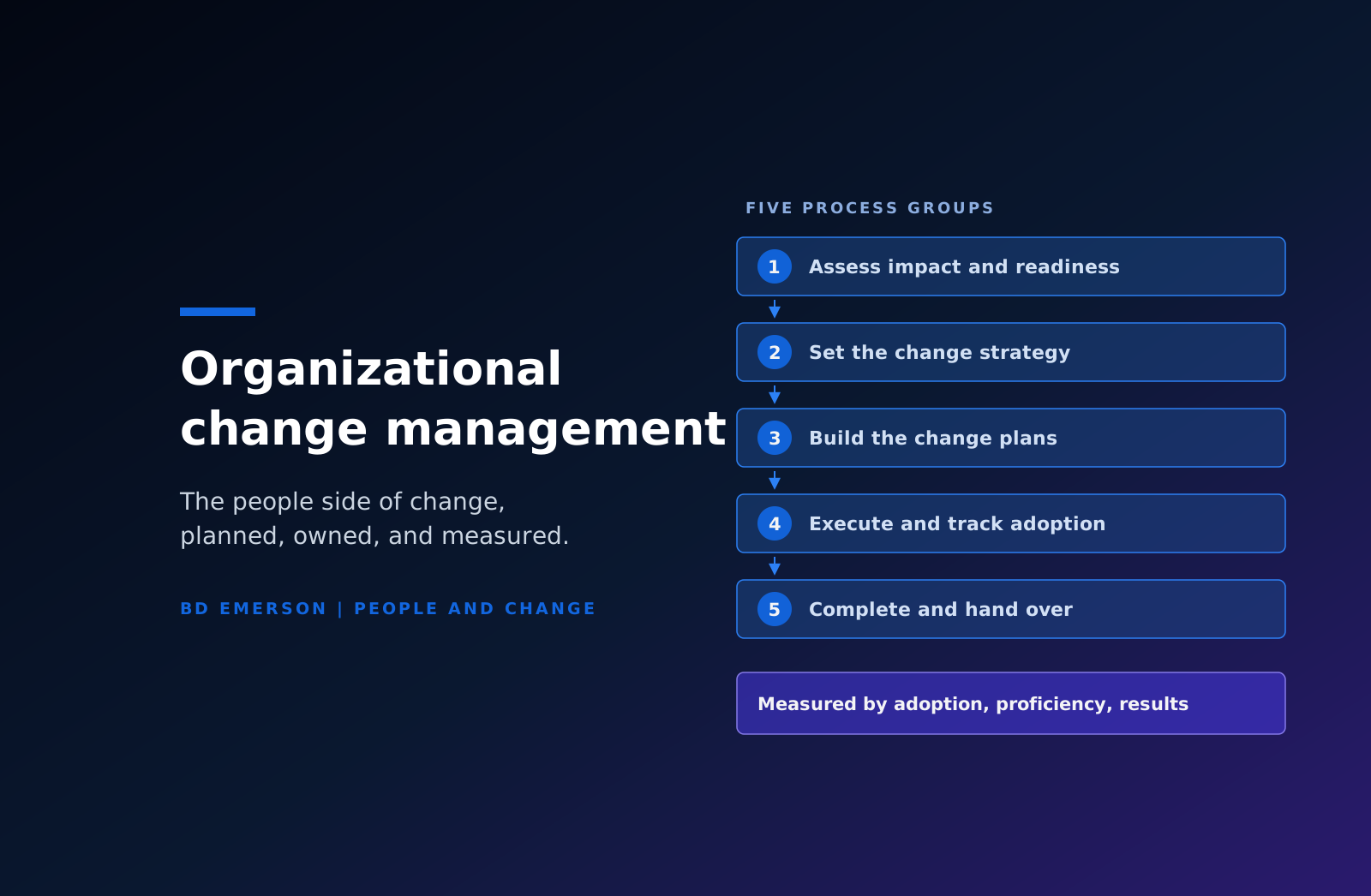
ACMP organizes the work into five process groups, and most OCM methods follow the same order under different names. The table shows what happens in each group and what it produces.
| ACMP process group | What happens | Main output |
|---|---|---|
| Evaluating change impact and organizational readiness | Role-by-role impact analysis, stakeholder identification, and a readiness survey of the affected groups | Impact assessment and readiness baseline |
| Formulating change management strategy | Decisions on sponsorship, governance, the scale of the effort, and the main risks to adoption | Change strategy |
| Developing change management plans | Plans for sponsors, communication, training, resistance, and measurement, tied to the project schedule | Integrated change plan |
| Executing change management plans | Delivery of communication and training, coaching for sponsors and managers, go-live support, and adoption tracking | Adoption reports and an issue log |
| Completing the change management effort | Measurement of outcomes against objectives, handover to operations, and lessons for the next change | Closure report and handover |
Five activities inside those groups do most of the work.
Impact and readiness assessment. The assessment identifies which roles change, how much they change, and how prepared each group is. It gives the program a baseline, and every later measurement reads against that baseline.
Sponsorship. A sponsor explains why the change matters, makes decisions when groups conflict, and shows up when the work gets hard. OCM defines what the sponsor needs to do and say, and it prepares the sponsor to do it.
Stakeholder engagement and communication. Each audience needs to know what is changing for it, when, and why. Good communication is specific to the audience, comes from someone the audience trusts, and gives people a way to answer back.
Training. Training builds the skills the new way of working requires. It works best when it is built around what each role does differently on the first day and when people get time to practice before go-live.
Reinforcement. Adoption fades when the old process stays available and nobody checks. Reinforcement removes the old path, recognizes the people who use the new one, and keeps measuring after the project team leaves. Our article on the change management plan template shows how these activities fit into one document.
Who owns organizational change management?
Ownership of OCM is shared across five roles, and the most common failure is a gap between them. The U.S. Government Accountability Office studied mergers and large transformations and identified nine key practices. The first is to ensure top leadership drives the transformation, the fifth is to dedicate an implementation team to manage the transformation process, and the eighth is to involve employees to obtain their ideas and gain their ownership. Those three practices describe the ownership model in one line: leaders drive, a team manages, and employees take part.
- Executive sponsor. The sponsor is accountable for the outcome. The sponsor sets the reason for the change, secures the resources, and resolves conflicts between functions. This role cannot be delegated to the project team.
- Change lead and change team. The change lead owns the OCM plan, runs the assessments, builds the communication and training plans, coaches sponsors and managers, and reports adoption.
- Project or program manager. The project manager owns the delivery plan and integrates the change plan into it, so that people readiness sits beside technical readiness in every go-live decision.
- Line managers. Managers translate the change for their teams, answer the questions that town halls miss, and hold people to the new way of working. They need preparation before their teams hear the news.
- Human resources, communications, and learning teams. These functions supply the channels, job design, and training delivery that the plan depends on.
Where the change team sits varies. Some organizations place OCM in a project management office or transformation office, some place it in HR, and some build a small center of expertise that supports every major program. The location matters less than two conditions: the change lead needs direct access to the sponsor, and the change plan needs a place in the program's governance.
Organizations that run change often build the capability in house. Daniels Consulting Group has published a client story about that kind of work, in which the deliverables were a change readiness assessment, a standardized OCM methodology and toolkit, an integrated change plan framework, and a custom OCM training curriculum. Those four items are a reasonable definition of an internal OCM capability.
How is organizational change management measured?
OCM is measured at three levels, and a credible program reports all three.
Activity measures count what the change team delivered: communications sent, sessions held, and training completed. They show that the plan is on schedule. They say little about whether anything changed, so they should never be the only numbers a steering committee sees.
Adoption measures show whether people are working the new way. System usage rates, the share of transactions that follow the new process, proficiency scores, help desk volumes, and pulse survey results against the readiness baseline all belong here. Adoption measures need to be broken out by team, because an average can hide a department that never moved.
Outcome measures show whether the change delivered its business case. Cycle time, error rates, cost per transaction, revenue per representative, and attrition in the affected teams are typical. ACMP places the measurement of desired outcomes and business objectives in the final process group, and it lists change performance measurement, which covers success measures, monitoring progress, and sustaining the change, among the discipline's knowledge areas.
Two rules make the measures useful. Set the baseline before launch, because a result with no starting point proves nothing. Name the owner of each measure after the project closes, because outcomes usually arrive after the project team has disbanded.
One number does not belong in the business case for OCM. The claim that 70 percent of change initiatives fail appears in many presentations. A review in the Journal of Change Management examined five published instances of the figure and found no valid and reliable empirical evidence to support it. An organization's own adoption data makes a stronger case than a borrowed statistic.
When does a change need formal OCM?
A change needs formal OCM when many people have to work differently and low adoption would erase the benefit. Four questions settle it. How many people's daily work changes? How different is the new behavior from the old? How many other changes are landing on the same teams? What happens to the business case if half the users keep the old process?
A minor policy update needs a clear message from a manager. An ERP implementation, an AI rollout that moves decisions from people to tools, a reorganization, or a move to shared services needs the full set of activities above. Mergers add a second workforce and a second culture, which is why deal work runs through a dedicated M&A change management practice.
Timing matters as much as scale. OCM that starts after the design is frozen can only explain decisions, while OCM that starts during design can shape them. The size of the effort and the timeline depend on the number of roles affected, the depth of the behavior change, and how much change the organization is already carrying.
What goes wrong with OCM?
Four failure points recur. The first is treating OCM as communications, which produces well-written announcements and no change in behavior. The second is a sponsor who launches the program and then hands it to the project team. The third is stopping at go-live, when adoption is at its most fragile and the support has just left. The fourth is reporting activity as if it were adoption, which lets a steering committee believe a change has landed when the usage data says otherwise.
BD Emerson delivers organizational change management with our Andersen Consulting colleagues at Daniels Consulting Group, a firm of organizational psychologists and experienced business professionals founded in 2002. OCM is one part of our organizational transformation consulting work, which also covers strategy execution, culture, leadership, and talent. To plan the people side of a specific program, see our change management consulting service or book a consultation.

About the author