

NCA ECC: Scope, Controls and Compliance Under ECC-2:2024
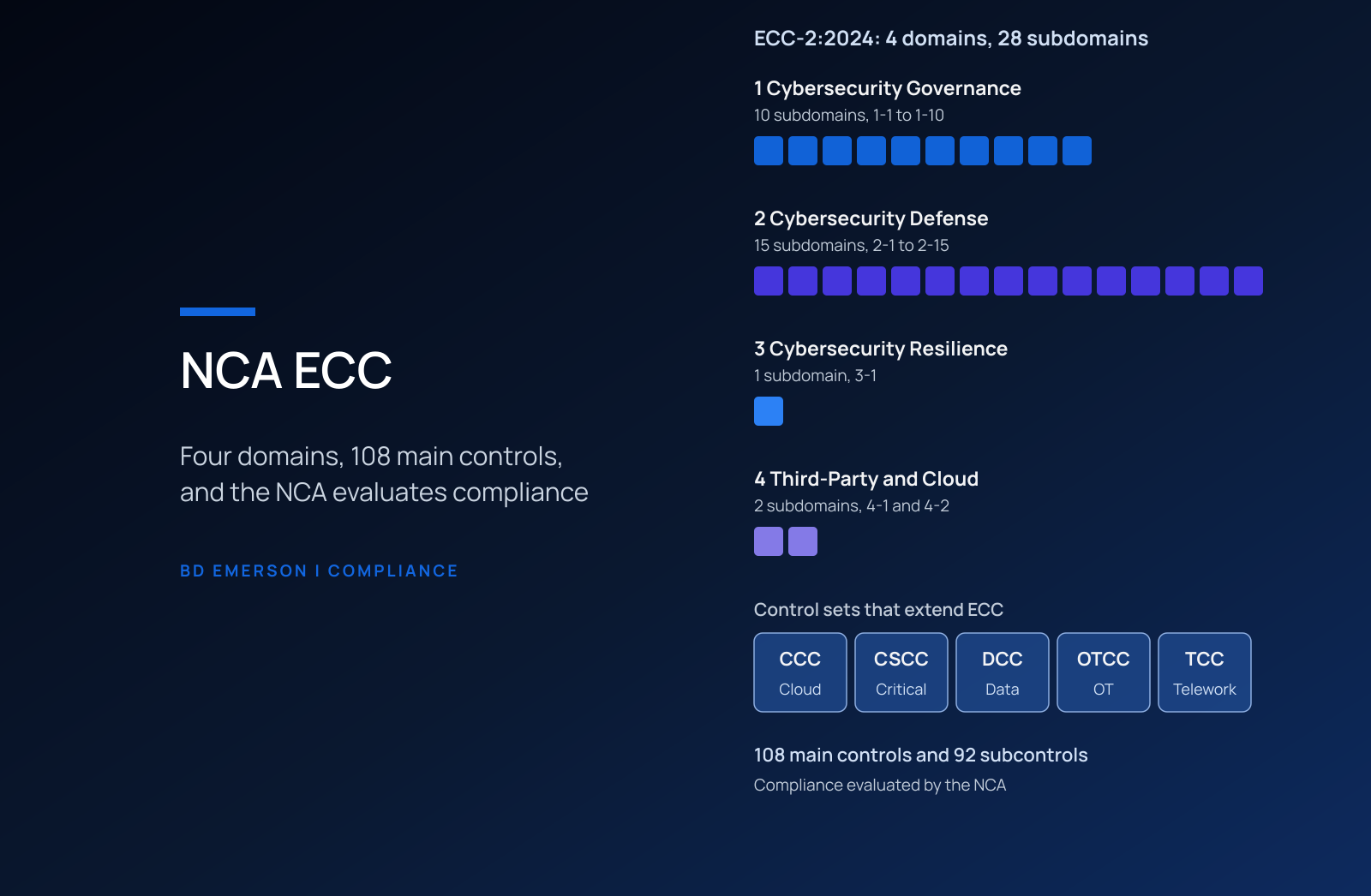
NCA ECC is the Essential Cybersecurity Controls, the minimum cybersecurity baseline that Saudi Arabia's National Cybersecurity Authority (NCA) sets for government agencies, their affiliated companies inside and outside the Kingdom, and private sector entities that own, operate or host critical national infrastructure. The current version is ECC-2:2024, which replaced ECC-1:2018. It contains 4 main domains, 28 subdomains, 108 main controls and 92 subcontrols, and an entity in scope must comply with every control that applies to it. The NCA evaluates compliance through means such as self-assessment, periodic reports from its compliance tool and field audit visits. The Arabic text is the binding version of the controls.
What is NCA ECC?
The NCA published the first Essential Cybersecurity Controls as ECC-1:2018, with 5 main domains, 29 subdomains and 114 main controls. The second edition, ECC-2:2024, is the version the NCA lists as current on its Essential Cybersecurity Controls page, which the NCA last updated on July 19, 2026. ECC-2:2024 cites Article 10(3) of the NCA's statute and High Order No. 57231, dated 10/11/1439H, as the basis for requiring national entities to maintain ongoing compliance. The NCA built the controls after studying national and international cybersecurity standards, frameworks and controls, the requirements of relevant national legislation, regulations and decisions, cybersecurity best practices, and previous incidents and attacks against government agencies and other critical entities.
ECC is a control set, so it tells an entity what to do in specific terms. It requires a cybersecurity department that is independent of the IT department, names DMARC as a required email control, and requires incidents to be reported to the NCA. Each requirement has an identifier that follows the pattern of domain, subdomain, control and subcontrol. For example, 2-2-3-2 is the second subcontrol of the third control in subdomain 2-2, Identity and Access Management. People search for the framework as both "NCA ECC" and "ECC NCA", and both names refer to this document.
Who must comply with the NCA ECC?
The scope section of ECC-2:2024 names three groups: Saudi government agencies, the companies and entities affiliated with those agencies whether they sit inside or outside the Kingdom, and private sector entities that own, operate or host critical national infrastructure (CNI). The 2024 edition made the affiliated-entity language explicit, so an agency's affiliated company that operates outside Saudi Arabia is still in scope. The NCA also strongly encourages every other entity in the Kingdom to use the controls.
Cloud use adds a layer. Subdomain 4-2, Cloud Computing and Hosting Cybersecurity, binds any in-scope entity that uses or plans to use cloud or hosting services. Suppliers come into ECC through contracts. Control 4-1-2 requires agreements with third parties to include non-disclosure and secure removal of the entity's data at the end of service, procedures for communicating a cybersecurity incident, and an obligation to follow the entity's cybersecurity requirements, policies and applicable laws. A managed service provider or software vendor serving a Saudi agency therefore carries ECC obligations through its contract, and cloud providers serving in-scope tenants also fall under the Cloud Cybersecurity Controls covered below.
The four ECC domains and 28 subdomains
ECC-2:2024 organizes its 108 main controls into four domains. The 2018 edition had a fifth domain for industrial control systems, which the NCA moved into the Operational Technology Cybersecurity Controls (OTCC).
- Cybersecurity Governance, subdomains 1-1 to 1-10: strategy, cybersecurity management, policies and procedures, roles and responsibilities, risk management, cybersecurity in IT project management, compliance with standards and laws, periodic review and audit, cybersecurity in human resources, and awareness and training.
- Cybersecurity Defense, subdomains 2-1 to 2-15: asset management, identity and access management, protection of information systems and processing facilities, email protection, network security, mobile devices, data and information protection, cryptography, backup and recovery, vulnerability management, penetration testing, event logs and monitoring, incident and threat management, physical security, and web application security.
- Cybersecurity Resilience, subdomain 3-1: the cybersecurity aspects of business continuity management.
- Third-Party and Cloud Computing Cybersecurity, subdomains 4-1 and 4-2: third-party cybersecurity, and cloud computing and hosting cybersecurity.
A handful of governance controls change how an entity is organized, which makes them harder to close than a configuration gap. Control 1-2-1 requires a cybersecurity department independent of the IT and communications department and recommends that it report to the head of the entity. Control 1-2-2 requires every cybersecurity position to be filled by full-time, qualified Saudi professionals. Control 1-2-3 requires a cybersecurity supervisory committee that includes the head of cybersecurity. Control 1-5-3 requires a risk assessment at the early stages of projects, before major infrastructure changes, when planning to use third-party services, and before releasing new technology services or products. Control 1-8-2 requires the implementation of the controls to be reviewed and audited by parties other than the cybersecurity department, following generally accepted auditing standards.
The defense domain is more technical. Subcontrol 2-2-3-2 requires multi-factor authentication for remote access and privileged accounts, with the factors chosen from an impact assessment of authentication failure and bypass. Subcontrols 2-11-3-1 and 2-11-3-2 require periodic penetration testing scoped to all services the entity provides over the internet and their technical components. Subcontrols 2-13-3-3 and 2-13-3-4 require the entity to report cybersecurity incidents to the NCA and to share incident notifications and threat intelligence with it.
What changed in ECC-2:2024
Appendix C of ECC-2:2024 lists each update from the 2018 edition, and most entries clarify wording or definitions. In our reading, five of the changes alter what an entity has to do. The industrial control systems domain moved to the OTCC. Control 1-2-2 extended the Saudi staffing requirement from the head of the function and its supervisory and critical positions to all cybersecurity positions. Subcontrol 2-4-3-5 added DKIM and DMARC to the existing SPF requirement for validating the entity's email domains. A new subcontrol, 2-5-3-9, requires protection against distributed denial of service (DDoS) attacks. Subcontrol 4-2-3-1 now requires the entity's cloud and hosting arrangements to have the provider protect data according to its classification level and return it in a usable format.
Three deletions hand topics to other authorities or retire them. The NCA removed the 2018 control requiring compliance with national cybersecurity laws, citing regulatory maturity. It also removed the minimum items for data ownership, classification, labeling and privacy in control 2-7-3, because the National Data Management Office (NDMO) now governs them. The in-Kingdom hosting and storage requirement in subcontrol 4-2-3-3 went the same way, and the NCA directs entities to consult the NDMO on data localization.
How does NCA assess ECC compliance?
The NCA evaluates ECC compliance itself. The Implementation and Compliance section of ECC-2:2024 requires entities in scope to take all necessary measures to ensure ongoing and continuous compliance, and states that the NCA evaluates compliance through multiple means, such as self-assessment by the entity, periodic reports from the compliance tool, and field audit visits. The document also names an ECC-2:2024 Assessment and Compliance Tool as the NCA's means of organizing assessment and compliance measurement.
Self-assessments run through Haseen, the NCA's online services platform. The NCA's Self-Assessment Process service is offered to national entities on Haseen and lets them view current and past compliance results and track the regulations assigned to them and their submission status by period. The NCA's related Cybersecurity Assessments service, also on Haseen, states that the entity must be registered on the platform, so registration and a named owner for submissions belong at the start of the program.
The ECC document describes evaluation by the NCA and sets up no certification scheme. A consultant's gap assessment, including ours, helps an entity prepare its self-assessment, and the compliance decision stays with the NCA. The most useful outside work maps to control 1-8-2: a periodic review by a party outside the cybersecurity department, organized by the same control identifiers the ECC uses.
ECC and the other NCA control sets
ECC is the base layer. The NCA publishes several control sets that extend it for specific technologies, systems or ways of working, and an entity covered by one of them still has to meet ECC. The Cloud Cybersecurity Controls (CCC-2:2024) say so directly: cloud service tenants and cloud service providers must comply with both ECC and CCC, and a provider must do so whether or not it falls inside the ECC scope itself.
| Control set | Current version | What it covers |
|---|---|---|
| Cloud Cybersecurity Controls (CCC) | CCC-2:2024 | Cloud providers (37 main controls, 94 subcontrols) and cloud tenants (18 main controls, 26 subcontrols) |
| Critical Systems Cybersecurity Controls (CSCC) | CSCC-2:2026, published in Arabic | Systems that meet the NCA's criteria for critical (sensitive) systems, with 32 main controls and 73 subcontrols |
| Data Cybersecurity Controls (DCC) | DCC-1:2022 | Protection of data across its lifecycle |
| Operational Technology Cybersecurity Controls (OTCC) | OTCC-1:2022 | Industrial control systems, including the former ECC domain 5 |
| Telework Cybersecurity Controls (TCC) | TCC-1:2021 | Secure remote work |
In practice, the layers stack. A cloud provider hosting a Saudi agency's workloads meets ECC plus the provider controls in CCC. An entity that runs industrial control systems adds OTCC, and an entity that operates a system meeting the NCA's critical systems criteria adds CSCC. The NCA has published CSCC-2:2026, the update to CSCC-1:2019, in Arabic on its CSCC page. The NCA publishes its own assessment and compliance spreadsheets for several of these sets, including DCC, OTCC and TCC.
How ECC maps to ISO 27001 and NIST CSF
An organization that already runs an ISO/IEC 27001:2022 information security management system or a program built on NIST CSF 2.0 already covers much of ECC's subject matter. The NCA's ECC page lists no crosswalk to either framework among its downloads, so the table below is our practitioner view at the domain level. Map at the subcontrol level before relying on existing evidence. For background on how the two reference frameworks differ, see our comparison of ISO 27001 and NIST.
| ECC domain | ISO/IEC 27001:2022 | NIST CSF 2.0 |
|---|---|---|
| 1. Cybersecurity Governance | Clauses 4 to 10: context, leadership, risk assessment and treatment, internal audit, management review | Govern (GV.OC, GV.RM, GV.RR, GV.PO, GV.OV) and Identify (ID.RA) |
| 2. Cybersecurity Defense | Annex A controls selected in the Statement of Applicability | Protect (PR.AA, PR.DS, PR.PS), Detect (DE.CM, DE.AE) and Respond (RS.MA) |
| 3. Cybersecurity Resilience | Annex A business continuity controls | Recover (RC.RP) and PR.IR, Technology Infrastructure Resilience |
| 4. Third-Party and Cloud Computing | Annex A supplier and cloud service controls | GV.SC, Cybersecurity Supply Chain Risk Management |
The gaps sit in ECC's national requirements. Neither ISO 27001 nor NIST CSF names Saudi staffing (1-2-2), a cybersecurity department independent of IT (1-2-1), incident reporting to the NCA (2-13), DMARC on email domains (2-4-3-5) or the NCA's National Cryptographic Standards, which control 2-8-3 references. ISO 27001 lets an organization select and justify its Annex A controls through risk treatment in clause 6.1.3, while ECC makes its controls mandatory for entities in scope, so a control an ISO program excluded can still be required. An ISO 27001 certificate comes from an accredited registrar, since ISO itself performs no certification, and the evidence behind it can be reused in an ECC self-assessment where the controls overlap. Our guide to cybersecurity standards and frameworks covers 16 other frameworks, including ISO 27001, NIST CSF and the CIS Controls.
BD Emerson, part of Andersen Consulting since October 2026, runs NCA ECC readiness work through our cybersecurity compliance practice. We perform the gap assessment against the 108 main controls and 92 subcontrols, write the policies, risk methodology and third-party contract clauses the governance and third-party domains require, map an existing ISO 27001 or NIST CSF program to ECC at the subcontrol level so current evidence is reused, and support the periodic review under control 1-8-2 as a party outside your cybersecurity department. We work alongside your full-time Saudi cybersecurity staff, who hold the positions control 1-2-2 reserves for them. We prepare the evidence and the NCA evaluates compliance, so the firm that prepares you has no stake in the outcome.

About the author
















