Guidewire Implementation: Timeline, Team, Cost Drivers, and Why Programs Run Long
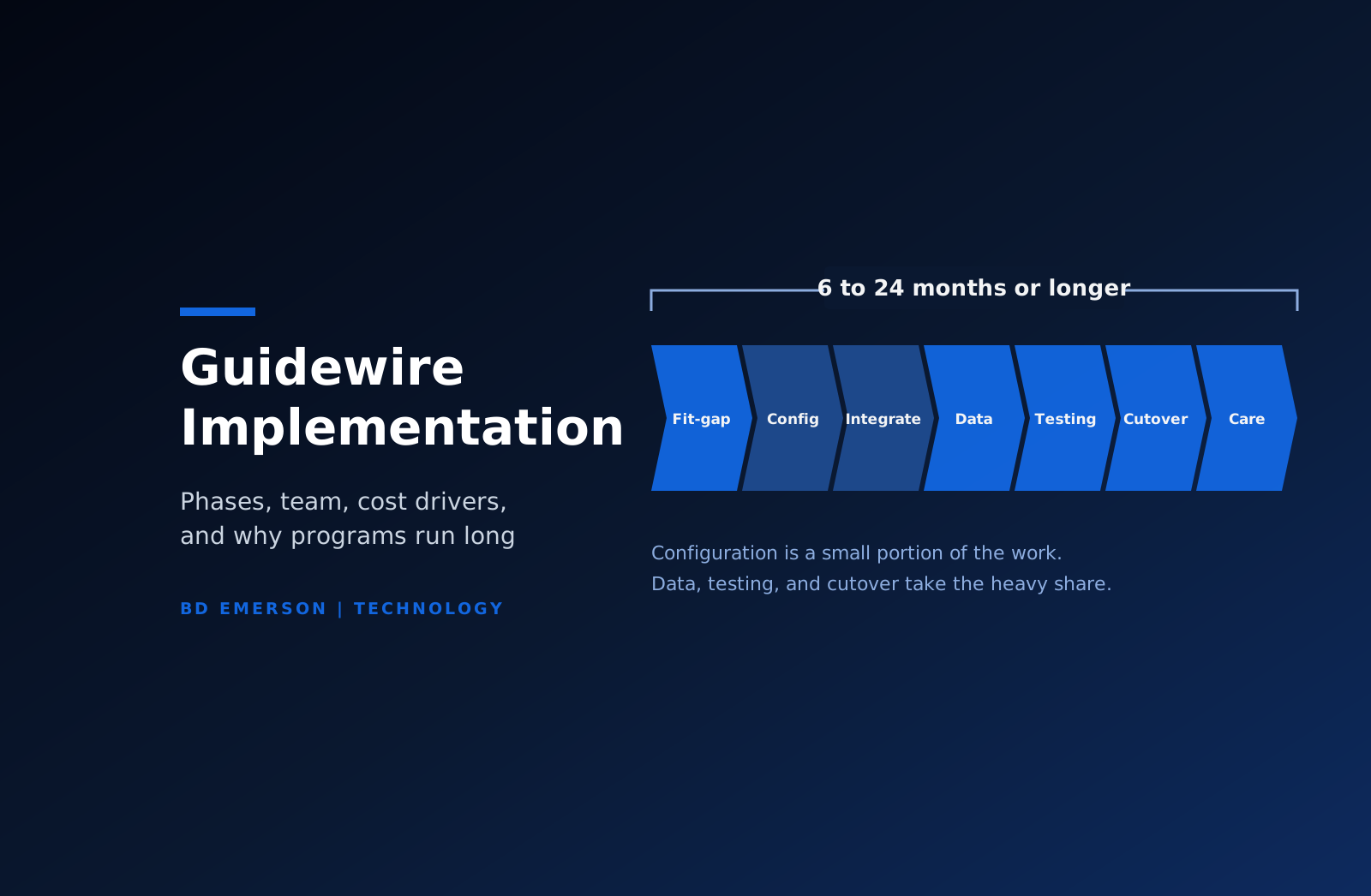
A Guidewire implementation is the program that configures Guidewire InsuranceSuite for a carrier's products, connects it to the systems around it, converts the carrier's policy, billing, and claims data, and moves production onto it. Guidewire's fiscal 2026 Form 10-K states that "The implementation and testing of our products by our customers typically lasts six to 24 months or longer." Where a program lands in that range depends on how many applications, lines, and states it covers, how many integrations it needs, whether it converts in-force policies and open claims, and how far the configuration departs from the base product. Configuration is the smaller share of the effort: McKinsey reports that in most insurance migrations, rewriting code or configuring the target platform "is only a small portion of the work."
Guidewire is the market leader in property and casualty (P&C) core systems. It reported $1,242 million in annual recurring revenue (ARR) at July 31, 2026, and more than 570 insurers in 44 countries rely on its products, according to its fiscal 2026 results. Our insurance team includes people who helped lead a Guidewire implementation practice of thousands of professionals at a Big Four firm. We do not implement Guidewire, so this guide has no implementation partner to sell you.
What a Guidewire implementation covers
The 10-K lists five InsuranceSuite applications that "can be subscribed to separately or together": PolicyCenter, ClaimCenter, BillingCenter, PricingCenter, and UnderwritingCenter. Guidewire sells them as a cloud subscription on Guidewire Cloud Platform, which it hosts on Amazon Web Services (AWS), and it offers term licenses "primarily for existing on-premise customers." A Guidewire cloud implementation therefore works inside Guidewire Cloud Standards and Guidewire's release calendar from the first sprint. Our Guidewire overview covers the product line.
The 10-K adds that implementation "typically involves integration with our customers' and third parties' systems and creating or updating the digital experience, as well as adding customer and third-party data to our platform." Those are three workstreams, and configuring the carrier's products, rating, and rules is the fourth.
Guidewire implementation phases and where the time goes
A Guidewire program moves through seven phases that overlap but keep their order.
| Phase | What happens | What consumes the time |
|---|---|---|
| Inception and fit-gap | Workshops compare the carrier's products, processes, and rules with the base configuration and with Guidewire GO, Guidewire's "library of pre-packaged product definitions." Each gap becomes a decision to change the process or extend the software. | Rules that live only in legacy code, and gaps the business closes with custom work |
| Product and rating configuration | Teams build product models in Advanced Product Designer, then rating, underwriting rules, forms, and screens. | Rate tables, rules, and forms for every line and state in scope |
| Integrations | Developers connect InsuranceSuite to payments, document production, the general ledger, third-party data, agency portals, and the data warehouse. | Legacy systems with thin documentation, and other owners' test windows |
| Data conversion | The conversion team maps, cleanses, loads, and reconciles in-force policies, open claims, and billing accounts. | Source data quality and repeated reconciliation |
| Testing | Testers run integration, acceptance, and performance tests and compare rating results with the legacy system. | Defect cycles, plus regression testing for each Guidewire Cloud release during the program |
| Cutover | The team rehearses, loads production data, and switches new business, renewals, or claims to InsuranceSuite. | Data volume and the length of the cutover window |
| Hypercare | The delivery team stays on standby after go-live to fix defects and tune performance. | Defects that appear only at production volume |
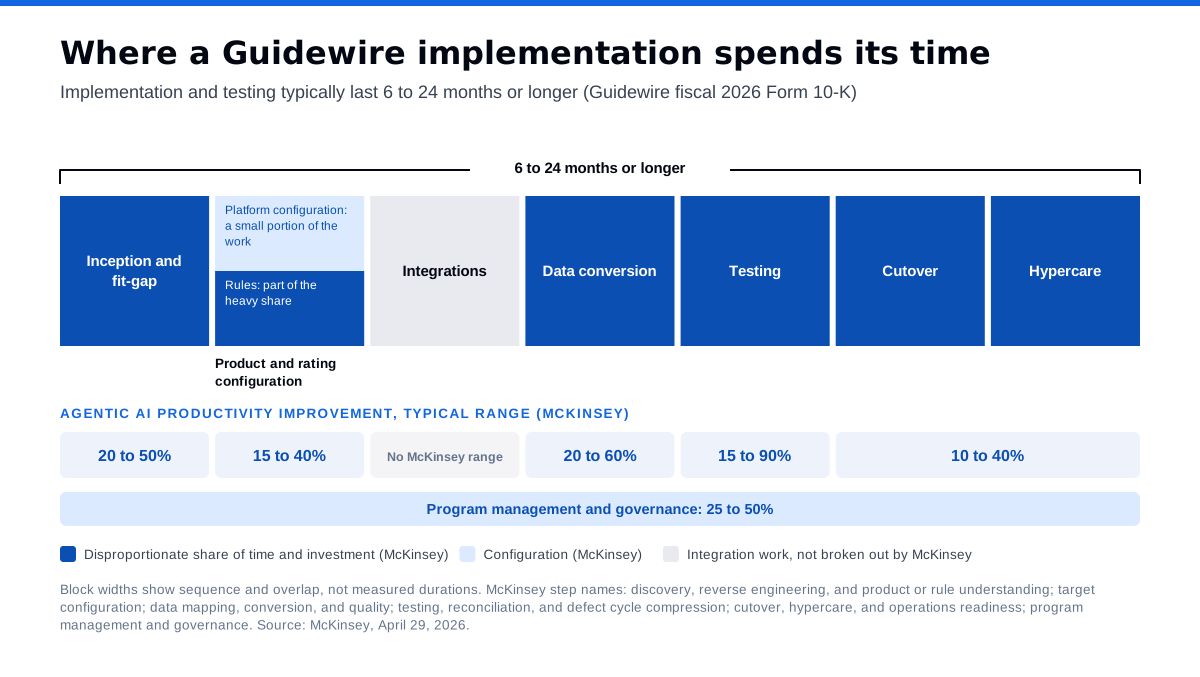
McKinsey puts the weight in the phases around configuration: "A disproportionate share of time and investment often sits in understanding and configuring the rules, data conversion, quality control, reconciliation, operational readiness, and postmigration stabilization." For that reason, we recommend staffing data conversion and test automation from inception.
The Guidewire implementation team
Three parties staff a Guidewire program. The carrier supplies the sponsor; product owners for underwriting, claims, and billing; actuarial staff for rating; an owner for each connected system; conversion and test teams; and change management. Guidewire runs the cloud platform and sells its own "implementation, cloud migration, and integration services." A systems integrator (SI) supplies configuration developers, integration developers, and testers, and the 10-K says Guidewire works with SI partners "to facilitate new sales and implementations of our products."
The scarce skills sit with the SI. Developers configure InsuranceSuite in Gosu, which Guidewire describes as an open-source language on the Java Virtual Machine "used in 700+ P&C core implementations." Guidewire certifies developers as Certified Associate or Certified Ace, and it calls Ace the "highest level of certification" and says it "is required for Cloud leads." Its N-3 policy requires anyone who falls more than three releases behind to retake the proctored exams. Guidewire counts "over 25,000 consultants worldwide who have been trained or are experienced in Guidewire products," per its October 2024 partner update. In our experience, the constraint is the much smaller group of Ace-certified leads who have converted a book of business like yours, so we recommend naming them in the contract.
Guidewire implementation cost drivers
We know of no public source that gives a reliable price for a Guidewire implementation, and a single figure would mislead because cost follows scope. Two parts of the cost have public anchors. Guidewire prices core product subscriptions on the direct written premium (DWP) managed on its platform, with initial agreements "generally five years in duration." On average, $1,242 million in ARR across about 550 customers comes to about $2.3 million per customer per year ($1,242 million divided by 550), and each carrier's figure moves with its premium. Guidewire bills most of its own professional services on time and materials, and the 10-K notes that Guidewire has agreed to "ramps that delay reaching fully ramped ARR," so we recommend tying any ramp to go-live. Our Guidewire pricing guide covers the subscription in detail.
In our experience, eight drivers decide where a program lands within, or beyond, the 10-K's 6 to 24 months.
| Cost driver | Keeps cost at the lower end | Pushes cost to the upper end |
|---|---|---|
| Applications in scope | One application, such as ClaimCenter | PolicyCenter, BillingCenter, and ClaimCenter together, plus digital portals |
| Lines and states | One personal line in a few states | Several commercial lines across many states |
| Configuration | Base product and Guidewire GO content with few extensions | Extensive custom Gosu, screens, and rules |
| Integrations | Marketplace apps and standard Cloud API patterns | Custom integrations to legacy systems with thin documentation |
| Data conversion | Policies move to the new system as they renew, with no bulk load | Bulk conversion of in-force policies, open claims, and billing history |
| Testing | Automated regression and rating comparison built early | Manual testing repeated for each release |
| Team | Named Ace-certified leads committed for the full program | Rotating staff and late hiring |
| Legacy overlap | Legacy systems retired within months of cutover | Years of paying for both systems |
The last row is easy to leave out of a budget. McKinsey describes "costly 'double-bubble' periods in which insurers pay to run the legacy stack while funding the change program," and each month a program slips adds a month of both bills.
Guidewire integration: Integration Gateway, Cloud API, and App Events
Guidewire integration on the cloud runs through three tools. Integration Gateway is "a cloud-managed service that supports integrations between InsuranceSuite and third-party or internal applications," built on Apache Camel, and it moves integration logic out of the core, "eliminating Gosu code in the InsuranceSuite applications." Cloud API gives RESTful access to policy and claims transactions and data, and App Events sends messages when business events occur, by webhook or through Integration Gateway.
The Guidewire Marketplace shortens the build list: at July 31, 2026, it held "over 415 partner-developed integrations that have been certified Ready for Guidewire," according to the 10-K. The expensive integrations are the ones no Marketplace app covers, such as a custom agency portal or a general ledger with its own file formats, because each needs its own design, build, and test window. Guidewire certifies integration developers in a separate track, so ask for that certification by name.
Why Guidewire programs run long
Guidewire's 10-K is direct about the risk: implementation "can be complex, time consuming, and expensive for our customers and can result in delays." In our view, four causes explain most overruns.
The first is the legacy rulebook. McKinsey describes a legacy core as "a living socio-technical system that may comprise several decades' worth of sparsely documented embedded business rules, batch windows, custom interfaces, and data semantics." Fit-gap surfaces the rules people remember, and testing surfaces the rest when InsuranceSuite calculates a different premium than the legacy system.
The second is customization. Every gap the business declines to close by changing a process becomes Gosu code, a custom screen, or a modified rule, and each one adds build, test, and update effort. Guidewire's guidance for project consultants says insurers "are choosing to stay as close to out-of-the-box as possible to accelerate time to market and minimize technical debts," and the technical debt a program accepts in fit-gap is debt it services at every release.
The third is the release calendar. Guidewire's cloud migration page states that "Guidewire Cloud delivers automatic updates three times a year," and its platform guide recommends that customers "plan several weeks" for each update, with most of that time spent on their own validation. A 24-month program absorbs about six releases, each with its own regression cycle.
The fourth is people. A program that loses its named Ace-certified leads, or hires its conversion team after configuration starts, slips by the length of the gap. Agentic tools now compress parts of the work: McKinsey reports productivity improvements of 10 to 90 percent depending on the step, and Guidewire says the developer assistants in its August 2026 Qusar release help teams deliver more than 40 percent faster than generic coding assistants, based on its internal benchmarks. Neither changes the order of the work or the decisions only the carrier can make in fit-gap.
How to choose a Guidewire implementation partner
The Guidewire partner market is deep. ISG's 2025 Provider Lens study of Guidewire services named nine Leaders, among them Accenture, Capgemini, Cognizant, Deloitte, PwC, and TCS. Guidewire's PartnerConnect consulting program places Guidewire partners in four tiers, Global Strategic, Global Premier, Advantage, and Select, and awards specializations by product and region "as validated by Guidewire certification achievements and references."
Tier and analyst rank measure a firm's scale. These questions test the team you will get:
- Which PartnerConnect specializations do you hold for our applications and region, and which programs earned them?
- Which Guidewire Certified Aces will lead our program, by name, and what share of their time does the contract commit?
- Which carrier with our lines and states can we call, and is it live on a current Guidewire Cloud release?
- Who owns data conversion and reconciliation, and how many dress rehearsals come before cutover?
- How did your last program perform in Guidewire's automated Cloud Assurance build?
- Which phases are fixed fee, and what acceptance criteria release each payment?
- Where do you use AI tools, and where does the saving show up in the price?
The alternative: replace product by product
A suite program implements policy, billing, and claims together and cuts over in a few large events. Because Guidewire's applications can be subscribed to separately, a carrier can instead sequence by application, line, or state. McKinsey makes the broader case for treating modernization as "a coordinated portfolio of opportunities across the full technology estate," because agents built for one product cost less to reuse on the next.
The same logic applies to what comes after Guidewire. A carrier can move one product at a time onto a new core, run it in production, retire that product's share of the legacy footprint, and decide on the next product with real numbers. Each double-bubble period then covers one product, and the carrier can stop after any product if the numbers turn. Our Guidewire alternatives guide compares the packaged options.
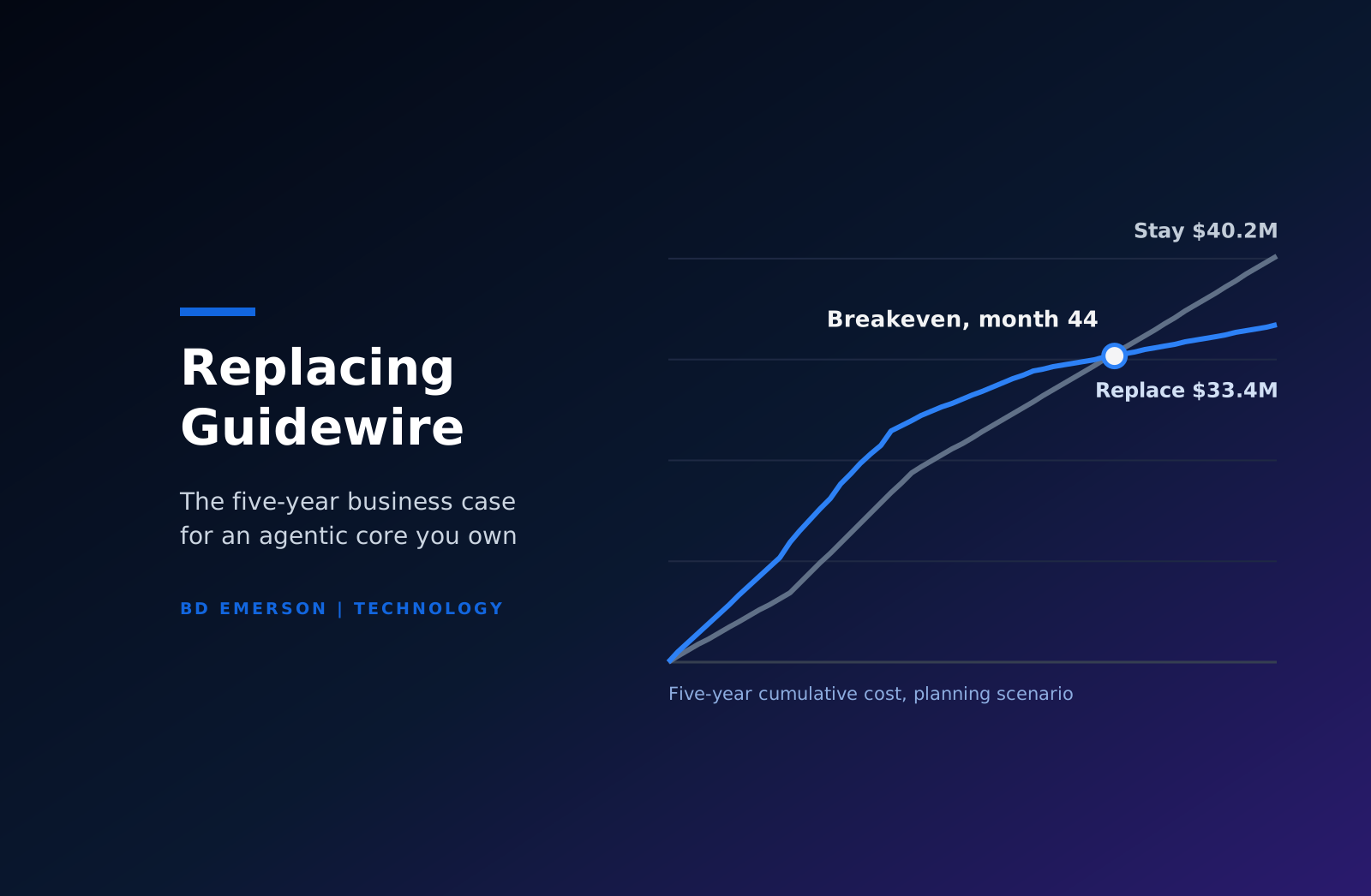
Replacement is the work we do. We replace Guidewire InsuranceSuite implementations with custom, agentic core systems when the five-year numbers favor replacement, and we recommend staying when they favor Guidewire. The first deliverable is that five-year math plus a working prototype of one of the carrier's own products on the new core.
Frequently asked questions
How long does a Guidewire implementation take? Guidewire's 10-K says implementation and testing "typically lasts six to 24 months or longer." A single application for one line in a few states sits at the short end, and programs that combine several applications, bulk conversion, and many custom integrations run to the long end or beyond.
How much does a Guidewire implementation cost? The cost has three parts: a subscription priced on direct written premium, which averages about $2.3 million per customer per year across Guidewire's customer base; services from Guidewire and the systems integrator; and the carrier's own team and legacy run costs. Services and internal costs scale with applications, lines, states, integrations, and conversion scope.
Who are the main Guidewire implementation partners? ISG's 2025 study named nine Guidewire services Leaders, including Accenture, Capgemini, Cognizant, Deloitte, PwC, and TCS, and named GFT a Rising Star. In our view, the partner's named, certified team matters more than its tier or rank.
What is Guidewire Integration Gateway? Integration Gateway is Guidewire's cloud-managed integration service, built on Apache Camel, that connects InsuranceSuite to third-party and internal applications. It keeps integration logic outside the InsuranceSuite applications, and it works alongside Cloud API and App Events.
Is Guidewire hard to learn? Gosu, Guidewire's configuration language, is Java compatible, so developers can use Java types and libraries. In our experience, the harder part is the insurance domain and Guidewire's data model. Guidewire reserves its Certified Ace level for experts who can design and lead Guidewire solutions, and it requires Ace for cloud leads.
If your carrier is weighing a Guidewire implementation, an expansion, or what comes after one, our Guidewire replacement practice will run the five-year numbers with you and tell you which path they favor, including when that path is Guidewire.

About the author