Guidewire Cloud Migration: What Changes, What It Costs, and When to Replace Instead
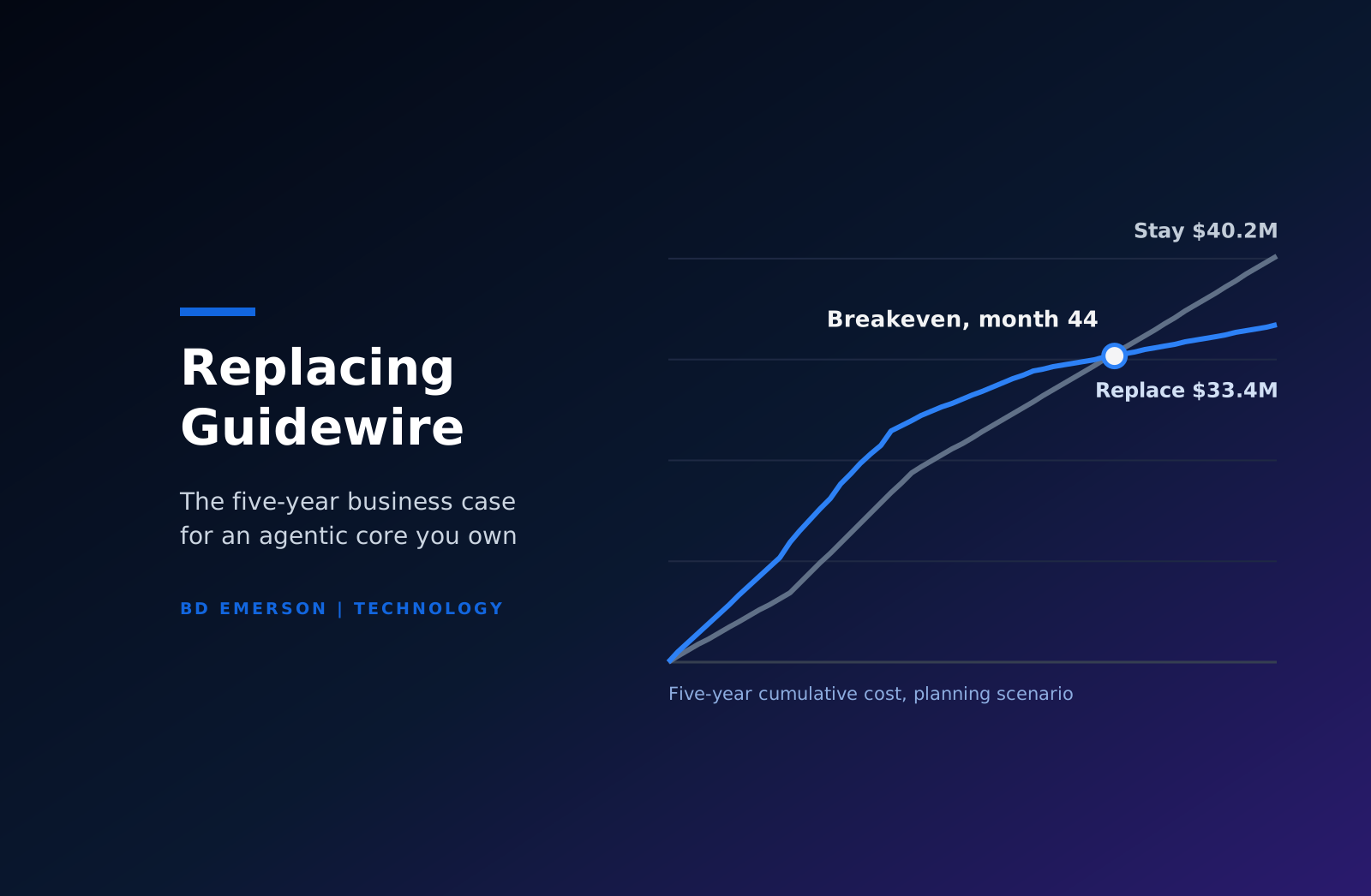
A Guidewire cloud migration moves self-managed InsuranceSuite onto Guidewire Cloud Platform, which Guidewire runs on Amazon Web Services (AWS) with each carrier's InsuranceSuite core in a single-tenant instance. Guidewire takes over hosting, operations, and upgrade delivery. The carrier accepts three automatic updates a year, Guidewire Cloud Standards on every customization, integrations reworked around Integration Gateway, Cloud API, and App Events, and a subscription priced on direct written premium (DWP) instead of a term license. The cost sits in the technical upgrade, integration rework, data migration, paying for both systems, and regression testing on every release. When those costs plus five years of subscription exceed the cost of replacing the products you write, replacement is the better use of the budget.
In our view, the migration is the right call for many carriers. Guidewire delivers its newest capabilities, including the Agentic Framework in its Qusar release, on Guidewire Cloud Platform, and ISG's 2025 Guidewire services study says Guidewire "prepares to end support for its on-premises versions." Staying on premise is therefore a time-boxed choice. This guide builds on our Guidewire implementation guide.
What Guidewire Cloud is
Guidewire Cloud Platform (GWCP) is "a Guidewire-developed infrastructure layer enabled by and hosted on Amazon Web Services," according to Guidewire's fiscal 2026 Form 10-K. The 10-K describes three layers: cloud infrastructure services and tools, a data platform, and an app platform of cloud-native services decoupled from the InsuranceSuite core. Guidewire delivers both InsuranceSuite and InsuranceNow, which it positions for "regional and super-regional U.S. P&C insurers and MGAs," as subscriptions on GWCP.
The Guidewire architecture uses hybrid tenancy. Guidewire's chief product development officer described it in 2021 as "single tenant for isolating the InsuranceSuite core, including business logic and customer data," and multi-tenant for shared P&C services such as rating, quoting, rules, and product models. The 10-K describes the same design as multi-tenant cloud services and tools "with the ability to isolate each customer's system of record and database instances." Guidewire calls the result "a purpose-built software-as-a-service (SaaS) solution."
Guidewire versions the platform through named releases in alphabetical order, from Aspen in June 2020 to Qusar in August 2026. It shipped two releases a year through 2022 and moved to three a year in 2023; the recent run is Las Leñas (December 2024), Mammoth (April 2025), Niseko (August 2025), Olos (December 2025), Palisades (April 2026), and Qusar (August 2026). Guidewire's migration page states that "Guidewire Cloud delivers automatic updates three times a year," and its release page says customers "in cloud compliance" receive automated delivery of the latest release.
What changes for customizations and integrations
On premise, the carrier decides what to customize and when to upgrade. On Guidewire Cloud, Guidewire's documentation states that "Each InsuranceSuite project developed and deployed in the cloud must follow Guidewire Cloud Standards," and an automated Cloud Assurance build checks code changes before they merge. If violations exceed the threshold, the build fails. In our view, that gate drives most of the migration cost for a heavily customized carrier.
| Area | Self-managed InsuranceSuite | Guidewire Cloud |
|---|---|---|
| Hosting and operations | The carrier or its hosting provider | Guidewire, on GWCP hosted on AWS |
| Tenancy | An environment the carrier controls | Single-tenant InsuranceSuite core with multi-tenant shared services |
| Upgrades | Carrier-run upgrade projects on the carrier's schedule | Automatic updates three times a year for customers in cloud compliance |
| Customization | Whatever the carrier's team builds | Code that follows Guidewire Cloud Standards and passes the Cloud Assurance build |
| Integrations | Integration logic often written in Gosu inside InsuranceSuite | Integration Gateway on Apache Camel, Cloud API, and App Events |
| Batch file output | SFTP paths on carrier infrastructure | Amazon S3 buckets |
| Reporting data | Queries against the carrier's own database | Cloud Data Access, which streams InsuranceSuite data to an Amazon S3 bucket |
| Commercial model | Term license | Subscription priced on DWP |
Partner accounts from real migrations show where the rework lands. Writing on Guidewire's developer blog in May 2026, the chief architect of Tata Consultancy Services (TCS) lists batch processes that wrote files to SFTP and now need S3 buckets, a payment integration that relied on "a callback servlet, which is not supported on Guidewire Cloud," and message queues and cross-application integrations that teams often disable during the technical upgrade and must then retest. Guidewire's own developer guidance recommends running the Cloud Assurance inspections in the SurePath plugin for Guidewire Studio before the move, because fixing those findings early reduces the rework during the migration.
Reporting changes too. Cloud Data Access is "a data streaming service within the Guidewire Data Platform" that delivers InsuranceSuite data to an S3 bucket for the carrier's data warehouse, so every report and extract that reads the self-managed database needs a new source before cutover.
How a Guidewire cloud migration runs
Guidewire publishes a nine-phase migration method. It starts with a Cloud Upgrade Estimate (CUE), "a formal assessment to estimate the effort of moving from a self-managed environment to Guidewire Cloud," followed by a pre-project phase and a technical upgrade in which "the self-managed codebase is merged into the latest Guidewire Cloud version." Delivery then runs through inception, development, deployment preparation, cloud updates, and stabilization, and Guidewire keeps dedicated support on standby for 4 to 6 weeks after go-live. Its cloud updates phase tests the new releases that arrive during the migration.
Guidewire's method document gives no durations except for post-go-live support. ValueMomentum, a Guidewire consulting partner, publishes ranges that add up to roughly 5 to 11 months: readiness in 1 to 4 weeks, transition in 3 to 4 weeks, development in 2 to 4 months, stabilization in 2 to 4 months, and deployment and warranty in one week to a month. In our view, those ranges fit a technical migration that holds functional scope flat. Integration rework, data volume, the number of InsuranceSuite applications in scope, and every functional change added to the program push a migration past them.
Data movement belongs on the critical path from day one, as TCS recommends for database movement, snapshot uploads, change data capture, and cutover rehearsals. TCS reports that multiple dry runs cut one insurer's total migration time from 45 hours to 17 hours on an on-premises database of more than 20 terabytes.
What a Guidewire cloud migration costs
Five cost lines decide what a migration costs.
| Cost line | What drives it | When it hits |
|---|---|---|
| Subscription | DWP managed on the platform, the applications subscribed, and the ramp schedule | Every year of the agreement |
| Migration services | Cloud Assurance violations, integration count, data volume, and functional changes added to scope | During the program |
| Double-bubble | Months between the first cloud invoice and switching off the self-managed estate | Until decommissioning |
| Release regression testing | Three updates a year, several weeks of validation each, and the level of test automation | Every release, during and after the migration |
| Data migration and rehearsals | Database size and the number of dry runs | Before cutover |
The subscription follows premium. Guidewire's 10-K says it prices core products on the DWP managed on its platform, with initial agreements "generally five years in duration, with annual renewals thereafter." On average, the $1,242 million in ARR Guidewire reported at July 31, 2026, spread across about 550 customers, comes to about $2.3 million per customer per year ($1,242 million divided by 550), and each carrier's own figure moves with its premium. Our Guidewire pricing guide covers the mechanics.
Migration agreements can ramp. In a February 2024 letter to the SEC, Guidewire explained how it counts migrations in ARR with a hypothetical: a customer paying $1.0 million a year on premise signs a five-year cloud migration agreement at $1.0 million in year one, $2.0 million in year two, and $3.0 million in each of years three through five. ARR shows no change in year one because the first-year invoice matches the old fee. The illustration totals $12.0 million over five years against $5.0 million at the old annual fee, and it describes ARR accounting rather than a price list. The comparison is incomplete until it adds the hosting, database, operations staff, and upgrade projects the carrier stops paying for on Guidewire Cloud. Guidewire's 10-K also notes that it has agreed to "ramps that delay reaching fully ramped ARR," so the ramp schedule is a term to negotiate.
The double-bubble is the overlap. McKinsey describes "costly 'double-bubble' periods in which insurers pay to run the legacy stack while funding the change program" in its April 2026 analysis of core modernization. In a cloud migration, the self-managed estate's hosting, database, and operations staff keep running until cutover while the cloud agreement's invoices run, so each month of delay adds a month of both.
Release testing continues after go-live. Guidewire's platform guide lists the work Guidewire does for each update, including running the customer's server tests, and it recommends that each customer "plan several weeks for this process, where most of the time is spent on their version of update validation." At three updates a year, regression testing becomes a standing operating cost, and in our view test automation is what keeps it flat.
Stay, upgrade, migrate, or replace: a decision framework
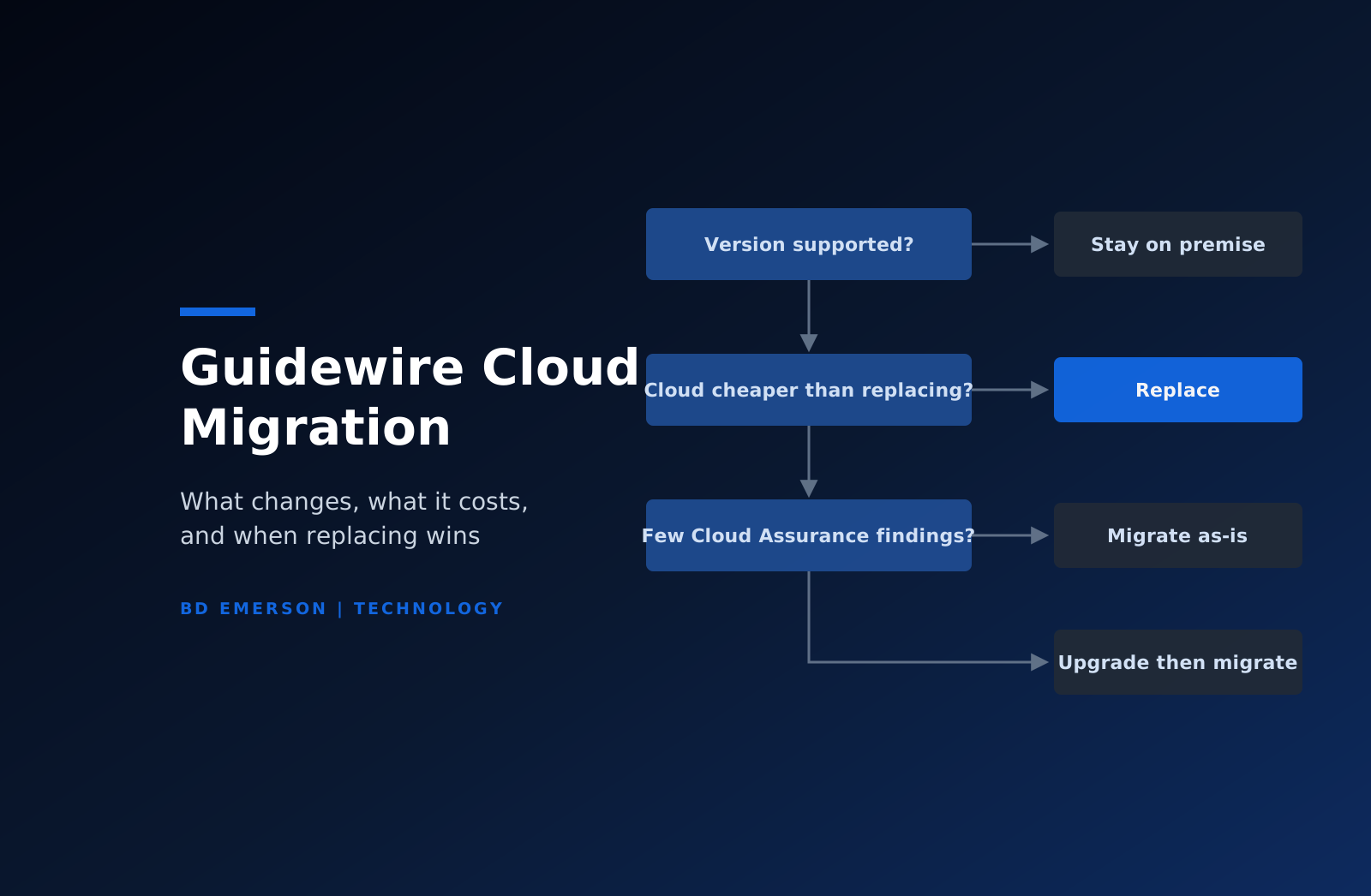
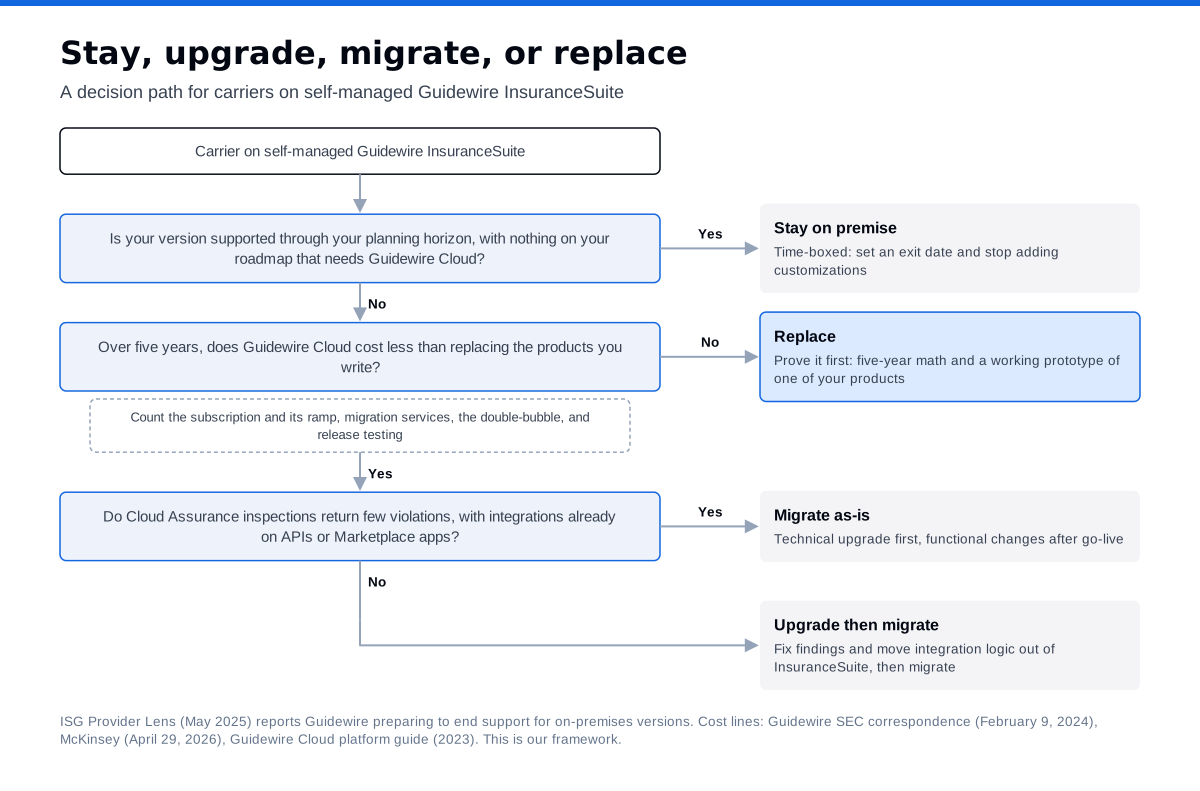
Four paths cover the choices a self-managed carrier faces. The decision tree routes a carrier to one of them, and the table lists the signals for each.
| Path | Signals that favor it | What to watch |
|---|---|---|
| Stay on premise | Your version is supported through your planning horizon, your term license has years to run, and nothing on your roadmap needs a capability Guidewire delivers on GWCP. | ISG reports that Guidewire is preparing to end on-premises support, so set an exit date and stop adding customizations. |
| Upgrade then migrate | Your codebase is several releases behind, Cloud Assurance inspections return many violations, or integration logic lives in Gosu inside InsuranceSuite. | Cleanup on premise delays any cloud benefit. |
| Migrate as-is | Your code is recent, inspections return few violations, integrations already use APIs or Marketplace apps, and the business wants Guidewire Cloud capabilities soon. | Functional changes added to the migration turn a technical move into a reimplementation. |
| Replace | The five-year cost of subscription, migration, double-bubble, and release testing exceeds the cost of rebuilding the products you write, or Cloud Standards would force you to rebuild your customizations anyway. | A replacement needs its own proof: a working product on the new core before the decision. |
Two definitions matter. Migrate as-is is a technical migration: the configuration moves through Guidewire's technical upgrade with only the changes Cloud Standards require, and functional changes wait until after go-live. Upgrade then migrate cleans up the self-managed codebase first, fixing Cloud Assurance findings, retiring customizations the business no longer uses, and moving integration logic out of InsuranceSuite. In our view, the inspection results and the technical debt they expose are the best early signal of which path fits.
The replace path is the one we work on. When the five-year numbers favor replacement, we replace Guidewire with a custom, agentic core built around the carrier's products, and the first deliverable is the five-year comparison plus a working prototype of one of the carrier's own products on the new core. When the numbers favor Guidewire Cloud, we say so. Our Guidewire alternatives guide covers the packaged options as well.
Guidewire cloud migration checklist
These steps belong in the plan, most of them before the migration agreement is signed:
- Request Guidewire's Cloud Upgrade Estimate and build an independent estimate from the same inventory.
- Run the Cloud Assurance inspections in the SurePath plugin against the current codebase and count the violations by type.
- Inventory every integration and map each one to Integration Gateway, Cloud API, App Events, or a Marketplace app.
- List every report, extract, and batch job that reads the database or writes to SFTP, and plan its move to Cloud Data Access or S3.
- Get the full five-year invoice schedule, including the ramp, renewal terms, and the DWP basis, and tie the ramp to go-live.
- Budget the double-bubble month by month until the self-managed estate is switched off.
- Budget regression testing for three releases a year, with automation in place before the first update arrives.
- Rehearse cutover on production-size data until the window fits what the business can tolerate.
- Merge each on-premise production release into the cloud codebase until cutover, as TCS recommends.
- Staff post-go-live support for at least the 4 to 6 weeks in Guidewire's method.
Frequently asked questions
Is Guidewire built on AWS? Yes. Guidewire's 10-K describes Guidewire Cloud Platform as a Guidewire-developed infrastructure layer hosted on Amazon Web Services, and each insurer's InsuranceSuite core runs in its own single-tenant instance on that platform.
What are the different versions of Guidewire Cloud? Guidewire delivers two core products on Guidewire Cloud Platform: InsuranceSuite, and InsuranceNow for regional and super-regional U.S. insurers and MGAs. Guidewire versions the platform itself through named releases, three a year since 2023, from Aspen in June 2020 to Qusar in August 2026.
How long does a Guidewire cloud migration take? Guidewire does not publish a standard duration. ValueMomentum, a Guidewire consulting partner, publishes phase ranges that add up to roughly 5 to 11 months for a technical migration, and integration rework, data volume, and added functional scope extend that.
How do upgrades work on Guidewire Cloud? Guidewire states that Guidewire Cloud delivers automatic updates three times a year to customers in cloud compliance. Guidewire delivers each update and runs the customer's server tests, and the carrier validates the update against its own configuration. Guidewire recommends planning several weeks for each update, most of it for that validation.
Does moving to Guidewire Cloud change what a carrier pays? Yes. The carrier moves from a term license to a subscription priced on direct written premium, and a migration agreement can ramp, as Guidewire's SEC correspondence illustrates with fees rising from $1.0 million in year one to $3.0 million in years three through five. A fair comparison also counts the on-premise hosting, operations, and upgrade costs the carrier stops paying.
If the five-year numbers on a Guidewire cloud migration are on your desk, our Guidewire replacement practice will run the same math against a replacement core, build a working prototype of one of your products, and tell you which path the numbers favor.

About the author