Intangible Assets on the Balance Sheet: Why IAS 38 and ASC 350 Hide Most of What a Company Owns
Most of a company's intangible assets never reach its balance sheet, and the ones that do are recorded at what someone once paid for them rather than what they are worth. Under IAS 38 and US GAAP, an intangible asset a company buys is recognized at fair value on the day of purchase. An identical asset the company builds itself is, with narrow exceptions, expensed as it is created and never recognized at all. That single rule explains why two companies with the same products, the same customers, and the same market position can show balance sheets that differ by hundreds of millions of dollars, and why the accounts are the wrong place to look for what a business owns. This article explains what gets recognized, what does not, and what a management team should keep alongside the statutory accounts so it can see the whole picture.
What gets recognized and what does not
Both major accounting frameworks recognize an intangible asset only when it is identifiable, the company controls it, and future economic benefits are probable and measurable. Those tests are easy to pass for a purchased asset, because the purchase price is the measurement and the contract is the control. They are hard to pass for a self-built asset, and the standards go further and prohibit recognition of several categories outright regardless of how valuable they become.
The practical outcome is a three-way sort. Acquired intangible assets are recognized at fair value, whether bought individually or as part of a business combination. Some internally developed assets can be capitalized under specific conditions, mainly software and, under IFRS, late-stage development work. Everything else a company creates for itself is expensed, and the categories that hold the most value, brand, customer relationships, proprietary data, and know-how, are almost always in the third group.
IAS 38 against US GAAP
IAS 38 is the IFRS standard for intangible assets. Its research phase rule is absolute: research expenditure is expensed. Its development phase rule allows capitalization only when six criteria are all met, including technical feasibility, the intention and ability to complete and use or sell the asset, probable future benefits, adequate resources, and reliable measurement of the costs. Paragraph 63 then prohibits recognizing internally generated brands, mastheads, publishing titles, customer lists, and items similar in substance, on the grounds that the cost of developing them cannot be distinguished from the cost of developing the business as a whole.
US GAAP reaches a similar destination by a different road. ASC 730 requires research and development costs to be expensed as incurred, with no development-phase exception. The main carve-outs are for software. ASC 350-40 allows capitalization of internal-use software costs incurred during the application development stage, and ASC 985-20 allows capitalization of software to be sold once technological feasibility is established. ASC 350 as a whole governs goodwill and other intangibles after acquisition: finite-lived intangibles are amortized over their useful lives, indefinite-lived intangibles and goodwill are tested for impairment rather than amortized, and private companies may elect to amortize goodwill over ten years.
The two frameworks disagree at the margins. A pharmaceutical company under IFRS may capitalize late-stage development spend that its US competitor must expense. A US software company may capitalize internal-use development that an IFRS reporter would treat differently. But on the assets that matter most, they agree: if you built the brand, the customer base, the dataset, or the process yourself, it does not appear.
Goodwill against identifiable intangibles
When one company buys another, ASC 805 and IFRS 3 require the buyer to allocate the purchase price across the identifiable assets acquired and liabilities assumed at fair value. An intangible asset is identifiable if it is separable, meaning it could be sold or licensed on its own, or if it arises from contractual or legal rights. Customer contracts, technology, trade names, licenses, and non-compete agreements are typically identified and valued. Whatever purchase price remains after all of that is goodwill.
The distinction is more than bookkeeping. Identified intangibles carry useful lives, amortization schedules, and a documented basis that management can track and defend. Goodwill is a residual. It carries no useful life, cannot be sold or licensed, and is tested annually for impairment as a lump. Assets that a buyer failed to identify during diligence, most often data, know-how, and undocumented processes, are absorbed into goodwill and disappear from view. In many acquisitions goodwill ends up as the largest single line in the allocation, which usually means the buyer paid for a great deal it never named.
What happens after recognition
An intangible asset that does make it onto the balance sheet is then either amortized or tested for impairment, and the choice depends on whether its useful life is finite. Under ASC 350-30 and IAS 38, a finite-lived asset such as a customer relationship, a patent, or acquired software is amortized over its useful life, so its carrying value falls on a schedule regardless of what happens to its economic value. An indefinite-lived asset such as a trade name with no foreseeable end, and goodwill under ASC 350-20 and IAS 36, is not amortized. It is tested for impairment at least annually and whenever a triggering event suggests the carrying value may not be recoverable, and any shortfall is written down through the income statement.
The result is that recorded values move in one direction only. Amortization and impairment can reduce a carrying value; nothing in either framework can increase it when the asset becomes more valuable, apart from an IFRS revaluation option that is almost never available because it requires an active market for the asset. A brand that has doubled in strength since acquisition sits at its acquisition-date value less amortization. That asymmetry is another reason the accounts understate what a company owns.
The bought-versus-built distortion
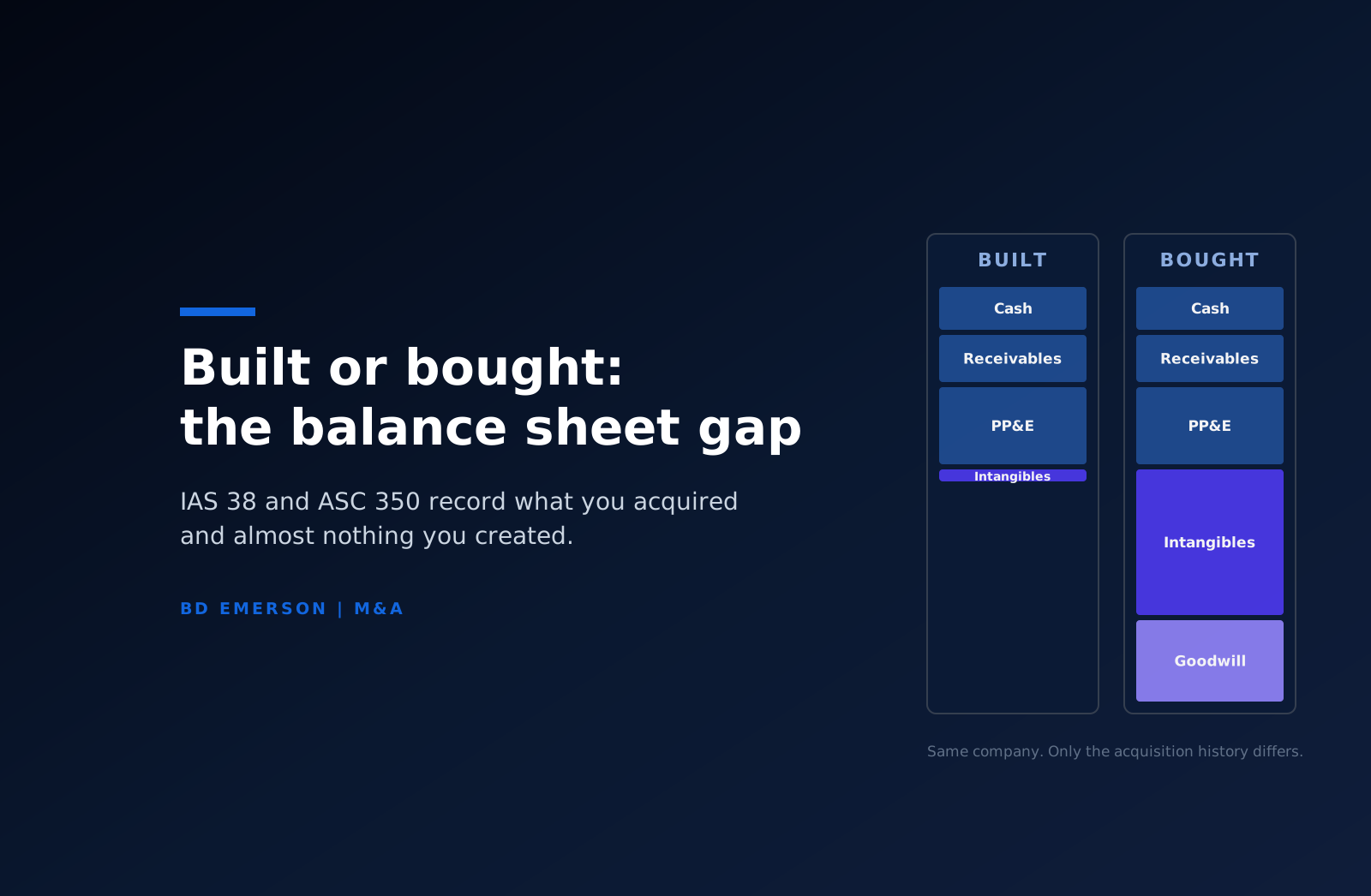
Put the rules together and a distortion appears that most readers of financial statements never correct for. Consider two companies in the same market with the same revenue, margins, and customer base. The first built its brand, its platform, and its customer relationships over fifteen years. The second was assembled two years ago by acquiring a competitor with the same assets. The first company's balance sheet shows almost no intangible assets, because everything was expensed as it was created. The second company's balance sheet shows brand, technology, and customer relationships at the fair values assigned at acquisition, plus goodwill.
Neither balance sheet is wrong under the standards, and neither tells you what the assets are worth today. The first understates the company's asset base by the full value of everything it built. The second states the asset base as of the acquisition date, less amortization, which by year three may bear little relationship to current value in either direction. A lender comparing the two on book equity, a board comparing return on assets, or an acquirer comparing the two as targets is looking at accounting history, not economic reality.
What the blind spot costs
The gap between recorded and actual intangible value has consequences that reach well beyond the finance function. In capital allocation, projects that create durable assets compete for budget against projects that generate near-term earnings, and because the assets created never appear, the asset-building projects lose more often than they should. In lending, banks that secure against tangible collateral will lend less to a company whose value is 90 percent intangible than its cash flows justify, and the company pays more for capital than it needs to. In transactions, a seller that cannot show a buyer what it owns beyond the IP schedule will be priced on an earnings multiple that ignores much of what is changing hands.
The twelve categories of intangible assets I described in an earlier article are the map of what the accounts are missing. The list of what a company has built and cannot show is usually longer than the list of what it has bought and can.
A management-basis register
The statutory accounts are not going to change. IAS 38 has held its position on internally generated intangibles since 1998, and the FASB has studied the question more than once without changing the rule. The answer for management is to keep a second document alongside the accounts: an intangible asset register maintained on a management basis, updated annually, and reported to the board.
The register lists every material intangible asset by category, records who owns it and how it is protected, notes which revenue depends on it, and carries a current value with the method and key assumptions stated. It does not replace the balance sheet and is not audited as part of it. It gives the board and management a view of what the company owns that the accounts cannot, and it becomes the starting point when the assets need to be defended in a negotiation, pledged to a lender, or tested against an impairment charge. When an acquisition does require a formal purchase price allocation, the register is also the fastest route to identifying what should be separated from goodwill.
The register is the first deliverable in most of the engagements I run, because nothing else can be valued, protected, or grown until it exists. If your company's balance sheet shows a fraction of what you know the business owns, BD Emerson's intangible asset valuation service builds the register and puts a defensible number on what it contains.

About the author