Guidewire Pricing: How InsuranceSuite Is Priced and What It Costs to Run
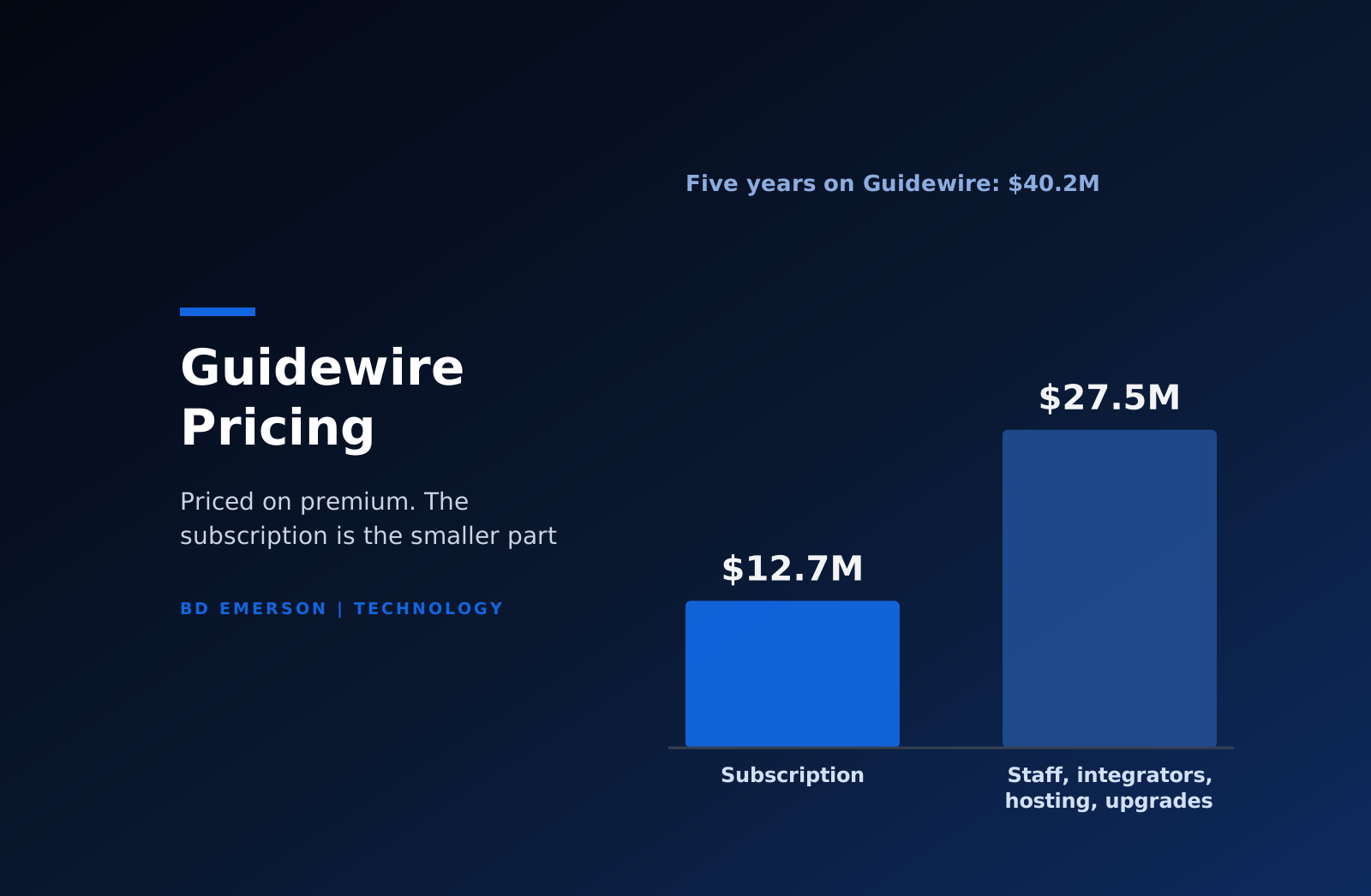
Guidewire does not publish a price list. It prices subscriptions for its core InsuranceSuite products on the amount of direct written premium (DWP) a carrier manages on the platform, and initial contracts generally run five years with annual renewals after that. Across its customer base, Guidewire's fiscal 2026 annual recurring revenue (ARR) averaged about $2.3 million per customer per year. The subscription is usually the smaller part of the bill. Systems integrator fees, the internal team that runs the platform, hosting, and upgrades cost more over five years. In our planning model for a mid-size carrier already on Guidewire, the subscription is $12.7 million of a $40.2 million five-year total.
This guide covers how Guidewire prices its products, what the average customer pays and why your number will differ, what implementation and operation add, how Guidewire Cloud changes the math, and what to settle before your next renewal. If you searched for Guidewire PricingCenter, the rating product, skip to the last section before the FAQ.
How Guidewire prices InsuranceSuite
Guidewire's fiscal 2026 annual report states that it generally prices subscription services for core products on DWP managed on its platform, with certain cloud-delivered products priced on usage or other metrics. That makes Guidewire a premium-indexed cost. If your book grows 5 percent a year, your subscription base grows with it, even when your claims volume, users, and transaction counts stay flat. Pricing is not per user, which surprises carriers comparing Guidewire with horizontal software such as CRM or ERP.
The same filing says initial subscription agreements are generally five years, with annual renewals thereafter, and that some customers sign initial terms of seven years or longer. Guidewire also still sells term licenses, primarily to existing customers who run InsuranceSuite on their own infrastructure, along with support and professional services.
Many contracts step up over their term. Guidewire reports two recurring revenue measures in its fiscal 2026 earnings release. ARR, the annualized recurring value in active contracts, was $1,242 million at July 31, 2026. Fully ramped ARR, which adds the non-variable price increases already written into executed contracts within their first five years, was $1,578 million. The difference, about 27 percent, is scheduled price increases on contracts customers have already signed. Ask for your own ramp schedule before you build a budget, because year one of a Guidewire contract is rarely the year you pay the most.
What the average Guidewire customer pays
Guidewire reported about 550 customers in 44 countries at the end of fiscal 2026, and ARR of $1,242 million. Dividing one by the other gives an average of roughly $2.3 million per customer per year in recurring fees. The average hides a wide spread. A tier-one carrier with billions in premium across many lines pays many times that figure, and a regional mutual on InsuranceNow, Guidewire's all-in-one product for smaller insurers, pays far less. ARR also blends cloud subscriptions, term licenses, and support, so the average is a reference point for a planning model, not a quote.
Guidewire's revenue mix shows where its money comes from. In fiscal 2026 it recognized $970.9 million in subscription and support revenue, $234.6 million in license revenue, and $269.9 million in services revenue, for total revenue of $1,475.4 million. The services line is Guidewire's own professional services. Most implementation work at carriers is done by systems integrators, and their fees never appear in Guidewire's revenue.
Implementation is the largest one-time cost
Guidewire's annual report says the implementation and testing of its products "typically lasts six to 24 months or longer," and that unexpected delays and difficulties can occur. Systems integrators staff most of that work. ISG's 2025 Provider Lens for Guidewire services named nine leaders, among them Accenture, Capgemini, Cognizant, Deloitte, PwC, and TCS, according to ISG's announcement.
No reliable public benchmark exists for what a Guidewire implementation costs, because carriers rarely disclose it and integrators price each program to its scope. Five drivers set where a program lands: the number of lines of business and states, because each adds product configuration and testing; the depth of customization in Gosu, Guidewire's programming language, because custom code has to be carried through every upgrade; the number of integrations to rating bureaus, payment processors, document systems, agency portals, and data warehouses; the volume and condition of legacy data to convert; and the size of the carrier's own team, because integrators bill for the knowledge a thin internal team cannot supply. McKinsey's April 2026 analysis of core modernization notes that configuring the target platform "is only a small portion of the work," with most of the time spent on rules, data conversion, quality control, reconciliation, and operational readiness.
The cost of running Guidewire after go-live
After go-live, a Guidewire carrier pays for five things every year: the subscription or license and support; hosting and infrastructure if it runs InsuranceSuite itself; integrator managed services for release work, defect fixes, and application support; the internal staff who develop, test, and operate the platform; and periodic upgrade or cloud migration programs. Guidewire designs InsuranceSuite to support multiple releases each year for cloud customers, per its annual report, and every release needs regression testing against the carrier's own configuration and integrations.
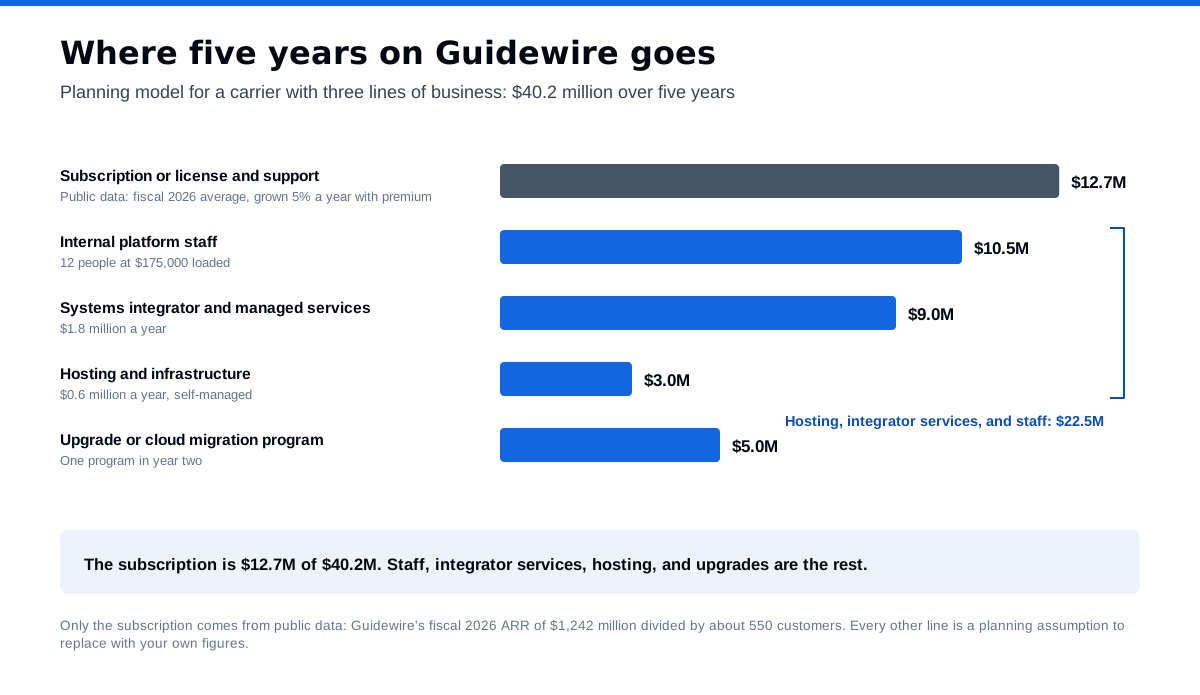
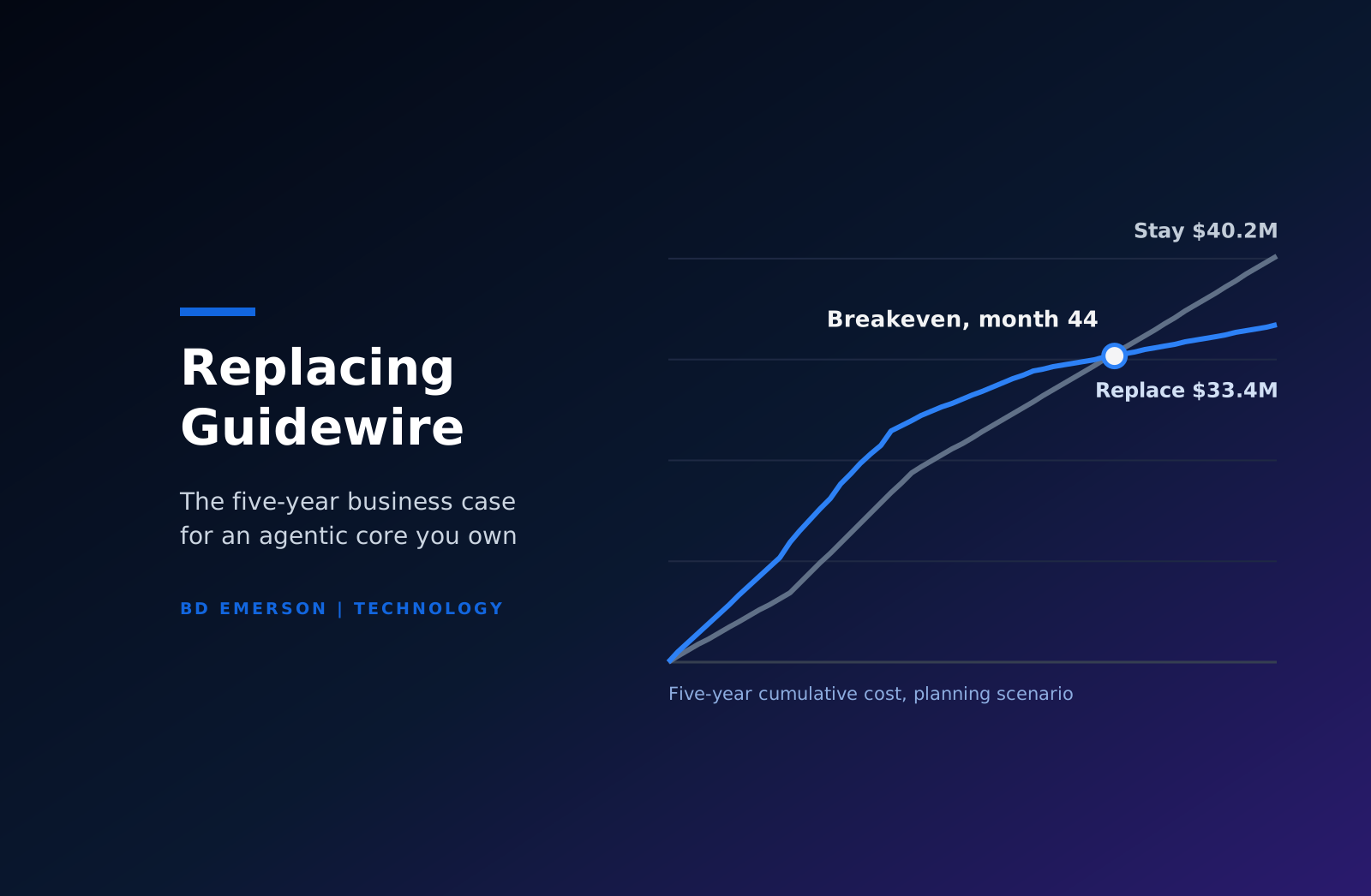
In our planning model for a carrier with three lines of business, those five costs add up to $40.2 million over five years: $12.7 million in subscription growing with premium at 5 percent a year, $3.0 million in hosting, $9.0 million in integrator services, $10.5 million for twelve internal platform staff at $175,000 loaded, and $5.0 million for one upgrade program. Only the subscription comes from public data, the fiscal 2026 average. The rest are planning assumptions, and you can replace each one with your own figures in our five-year Guidewire cost model. In the model, the people and services around the platform cost more than the platform itself, and those are the costs a replacement removes.
How Guidewire Cloud changes the math
A Guidewire Cloud subscription includes hosting and operations that a self-managed carrier pays for separately, so comparing the cloud subscription with an on-premise license line on its own gives the wrong answer. Compare total cost instead: subscription, hosting, operations staff, and the upgrade programs a cloud customer no longer runs on its own schedule. Guidewire Cloud runs a single-tenant InsuranceSuite core for each customer on AWS, with shared multi-tenant services, according to Guidewire's description of its hybrid tenancy model.
The contract mechanics matter as much as the price. In a February 2024 letter to the SEC, Guidewire explained that for migrations from on-premise term licenses to cloud subscriptions, ARR reflects the annualized invoicing in the cloud migration agreement, and gave the example of a customer paying $1.0 million a year on premise who signs a cloud agreement with the same first-year fee and shows no ARR change in year one, per the correspondence on file. A flat first year does not mean a flat contract. Read the ramp schedule for years two through five, because that is where migration agreements carry their increases.
What to settle before your next renewal
A renewal or a cloud migration is the moment a carrier has the most negotiating power, and most carriers spend it on the discount in year one. Settle these points instead, because they decide what you pay over the full term:
- The ramp schedule for every year of the term, in dollars, tied to go-live milestones rather than signature dates.
- How DWP is measured, which lines count, and what happens to the fee if you sell, exit, or move a line to another system.
- The term end date relative to your product roadmap, so you are not locked in past the point where you want options.
- Renewal terms after the initial period, including notice windows and any uplift caps.
- Data access and export rights, in a format you can load elsewhere, at no extra charge at exit.
- Which modules you pay for and which ones you use.
The term end date deserves the most attention. If a carrier ever wants to replace part of its Guidewire estate, a contract that ends inside the window it needs saves a full year of fees. Our build vs buy advisory covers the same question for other systems, and our analysis of custom software vs off-the-shelf explains why vertical systems priced on revenue are where building most often wins.
Guidewire PricingCenter, the rating product
Some searches for Guidewire pricing are looking for PricingCenter, Guidewire's rating and pricing application. Guidewire announced it on October 28, 2025 as a unified pricing and rating application that connects to PolicyCenter, Advanced Product Designer, Data Studio, and HazardHub, and supports lookups, rating tables, formulas, GLM and GAM models, machine learning, and proprietary price optimization algorithms, according to the announcement. Guidewire has not published PricingCenter's price. For background on the full product family, see our guide to what Guidewire is and how its products fit together.
Frequently asked questions
How much does Guidewire cost? Guidewire does not publish prices. Its fiscal 2026 ARR of $1,242 million across about 550 customers averages roughly $2.3 million per customer per year in recurring fees, and large carriers pay many times that. Implementation, integrator services, internal staff, and upgrades usually cost more than the subscription over five years.
Is Guidewire priced per user? No. Guidewire generally prices subscriptions for its core products on the direct written premium managed on the platform, with some cloud products priced on usage or other metrics. Your fee grows with your premium, not with your headcount.
How long is a Guidewire contract? Initial subscription agreements generally run five years, with annual renewals after that, and some customers sign initial terms of seven years or longer, according to Guidewire's fiscal 2026 annual report.
Does Guidewire Cloud cost more than running InsuranceSuite yourself? It depends on what you count. The cloud subscription includes hosting and operations that a self-managed carrier pays for separately, so compare total cost over the term, including the ramp schedule in years two through five, rather than the subscription against the license line.
What is Guidewire PricingCenter? PricingCenter is Guidewire's unified pricing and rating application, announced October 28, 2025. It lets actuaries, pricing teams, and developers build, test, and deploy pricing models that connect to PolicyCenter and other Guidewire products.
How can a carrier lower its Guidewire costs? Most of the savings sit outside the subscription: fewer customizations to carry through upgrades, a stronger internal team that needs less integrator time, and contract terms that tie ramps to go-live and keep exit options open. Some carriers also replace one line of business at a time on a core they own.
If your renewal is inside the next three years, model the full five-year cost now, while the contract date still gives you room. Our Guidewire replacement team builds that model from your invoices and staffing and compares staying, migrating, and replacing.

About the author