AI ROI: Why the Return on AI Shows Up on the Balance Sheet Before It Shows Up in Earnings
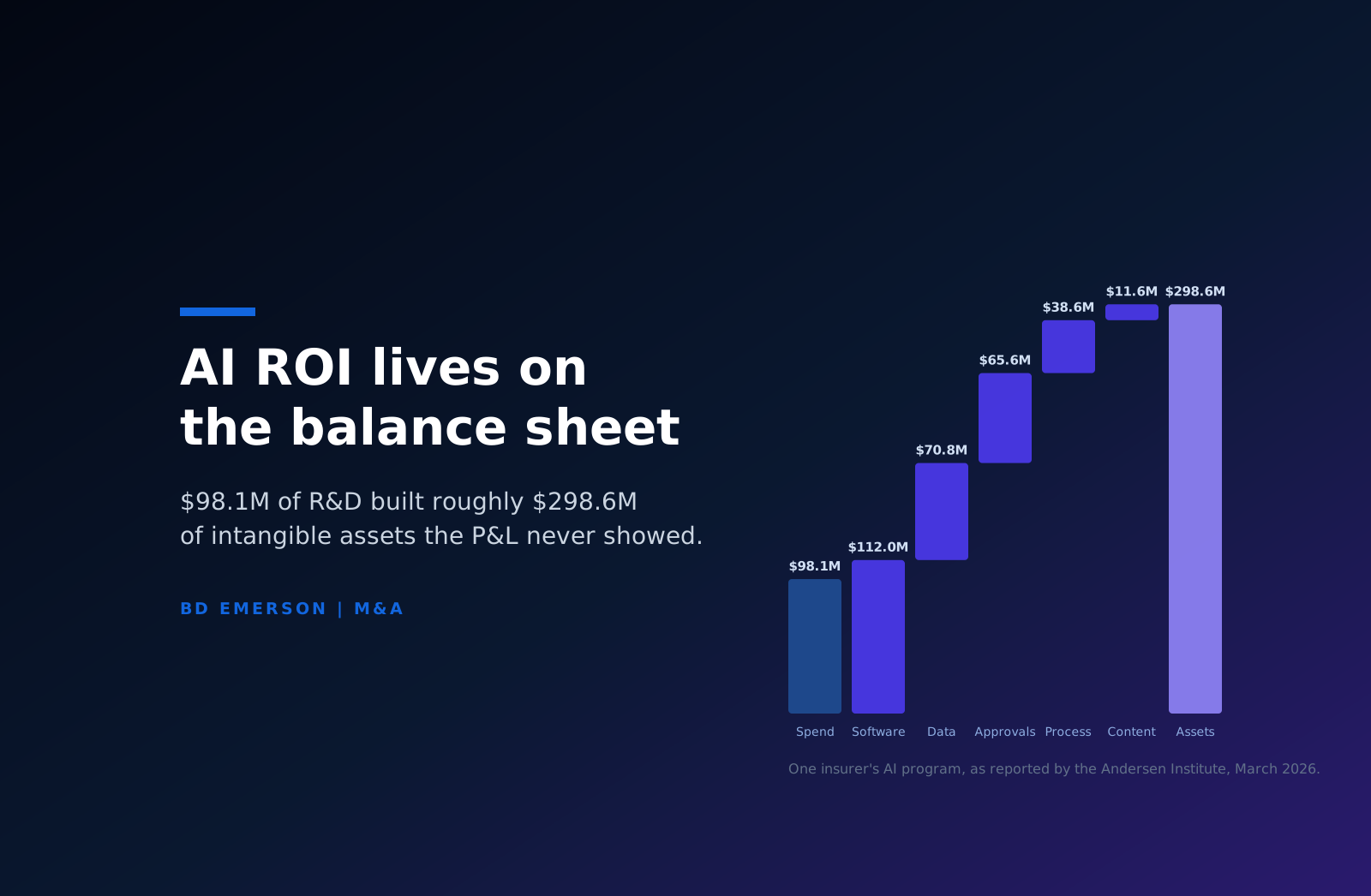
Most companies measure the return on AI the way they measure the return on a new sales office: spend on one side, incremental profit on the other, payback in months. That method undercounts AI, and often by a wide margin, because it counts only what reaches the income statement. An AI program consumes intangible assets, above all the proprietary data and know-how a company has built up over years, and it produces new ones: software, enriched data, redesigned processes, approvals, and content. Those outputs are assets with measurable value, and under current accounting rules almost none of that value appears anywhere. In one case my colleague Jason Strimpel and I analyzed this year, an insurer's $98.1 million of research and development produced roughly $298.6 million of intangible asset value, most of it invisible in the P&L. AI ROI measured on cash flows alone would have called that program a cost. Measured properly, it was capital formation.
The P&L view undercounts AI
Global spending on AI has passed half a trillion dollars over the last three years, and boards are right to ask what it has bought. The trouble is the instrument. A standard business case forecasts the operating savings or revenue lift an AI initiative will produce, sets it against the cost, and computes a return. Jason and I met a CFO planning to invest $100 million with an expected return of $250 million over 36 months, all of it expressed as P&L impact. That is a reasonable case and an incomplete one.
It is incomplete because AI initiatives produce two kinds of value. The first is direct: the cost taken out, the revenue added, the decisions improved. The second is indirect and shows up on the balance sheet, or would if the accounting allowed it: the software built, the data enriched and structured, the processes redesigned and codified, the regulatory approvals obtained for AI-enabled products, and the content generated. Each of those is an asset a buyer would pay for, a lender could secure against, and a competitor would have to replicate. A business case that counts only the first kind of value will reject good programs and misjudge the ones it approves.
Input and output: the flywheel
AI's relationship to intangible assets runs in both directions, and understanding that is the key to measuring it. On the input side, an AI system is only as good as the data it learns from. Public data, what Jason and I call macro-data, is available to everyone and confers no advantage. Proprietary micro-data, the records a company has accumulated about its own customers, operations, and market, is what lets an AI system produce outputs a competitor cannot. A company's existing intangible assets, its data, its know-how, its approvals and relationships, are the raw material.
On the output side, the AI system produces more intangible assets. It generates software. It enriches the data it was trained on by structuring it, labeling it, and adding derived fields. It codifies know-how that previously lived in people. Those outputs then become richer inputs for the next iteration. We call this the flywheel: existing intangibles generate proprietary data, AI consumes that data, AI outputs enhance the intangible base, and the enhanced base generates better data. A company that understands the loop invests in the assets that feed it. A company that does not will find its AI initiatives stall on thin data and wonder why the model that worked in a pilot fails in production.
The flywheel also explains why identical AI business cases carry different risk. Two companies can present the same forecast for the same initiative. If one has strong, well-owned intangible assets underneath it, clean proprietary data, clear data rights, relevant approvals, and durable relationships, the initiative is what we describe as unencumbered. If the other is building on data it may not have the right to use, patents it may not hold, and relationships that depend on one person, the same forecast is encumbered, and no amount of modeling precision changes that.
What one AI program created
The insurer case makes the argument concrete. The company had spent $98.1 million on research and development, most of it on AI and the data infrastructure beneath it. A conventional review would have asked what operating benefit that spend produced. We asked a different question: what assets did it create, and what are they worth?
The answer, as we reported it in the Andersen Institute analysis, was roughly $298.6 million of intangible asset value across five categories. The software stack the program built was worth about $112.0 million. The customer data it structured and enriched was worth about $70.8 million. Regulatory approvals obtained for the AI-enabled products were worth about $65.6 million. The processes and systems redesigned around the models were worth about $38.6 million. Content generated by the program was worth about $11.6 million. None of these figures came from the operating savings the program had been justified on. All of them came from valuing what it had built.
The ratio of asset value to spend, roughly three to one, is specific to that case and should not be read as a rule. The pattern is general: the assets an AI program creates typically exceed the near-term operating benefits that justified it, and a company that measures only the benefits systematically undervalues its own work.
Measuring it in six steps
The method Jason and I use is the Strategic Intangible Asset Value Accretion Model, which reduces to six steps. First, identify the intangible assets the initiative will draw on and could affect, using the twelve-category framework I have described elsewhere on this site. Second, estimate the value of those assets before the initiative begins, so there is a baseline. Third, identify the new assets the initiative will create: the software, the data products, the processes, the approvals, the content. Fourth, measure the value of those new assets, using the standard valuation methods and accounting for their long-term contribution rather than only their first-year effect. Fifth, assess how the initiative changes the value of the existing assets, since an AI program that enriches a dataset or codifies know-how has increased the worth of assets the company already held. Sixth, calculate the overall change in intangible asset value and set it alongside the P&L case.
The output is a business case with two columns instead of one. The first column is the conventional return: cost, savings, revenue, payback. The second is the change in the company's intangible asset base. A program that looks marginal on the first column and strong on the second is building capital. A program that looks strong on the first and weak on the second may be extracting value from assets it is not renewing. Boards need both columns to make the call.
Five reasons to do the measurement
The first reason is capital allocation. Programs that build durable assets compete for budget against programs that produce near-term earnings, and without the second column the asset builders lose more often than they should. The second is competitive position. Quantifying the assets an initiative creates shows whether it strengthens the company's position or merely keeps pace, which a savings number cannot. The third is governance. What gets measured gets managed, and a valued register of AI-created assets brings the same rigor and accountability to AI programs that the fixed asset register brings to capital projects. The fourth is transaction value. A company that can show a buyer the assets its AI investment created, with values and methods attached, avoids being priced on a conventional earnings multiple that ignores much of what is being exchanged. The fifth is communication. Presenting AI spend as capital formation rather than expense changes the conversation with investors from speculative to evidence-based, because the evidence is the valuation.
Preconditions
The flywheel only turns if certain conditions hold, and a company should check them before it commits capital. The data has to be of adequate quality. It has to be proprietary and specific to the firm, because generic AI trained on public data provides commodity capabilities that competitors can buy too. It has to have historical depth, since a model trained on eighteen months of records learns less than one trained on ten years. The insights the system produces have to be integrated into decisions, or the outputs are reports nobody acts on. And the organization has to keep investing in the data infrastructure, because data degrades and models trained on degrading data degrade with it. A company that fails these tests is not ready to build the flywheel, and its AI business case should say so.
What changes in the boardroom
When AI spend is presented as capital formation with a valued asset register behind it, three things change. Budget decisions get made on total value rather than payback alone. Previously rejected initiatives that build assets without near-term savings get reconsidered. And the company arrives at its next transaction or capital raise with a documented, valued account of what its technology investment has built, which is worth more in a negotiation than any number produced for the occasion. The intangible asset strategy I have written about on this site starts from the same register; the AI measurement is the part of it that changes fastest.
Two notes on where this work sits. BD Emerson announced on August 10 that it is joining Andersen Consulting, and the intangible asset valuation practice Tyler Capson and I lead is now available through this site alongside BD Emerson's AI strategy work, which is where the flywheel preconditions get tested before a program is approved. The full two-part analysis this article draws on, including the insurer case in detail, is on the Andersen Institute.
If your board is asking what the AI budget has bought and the answer so far is a savings number, BD Emerson's intangible asset valuation service builds the second column: the assets the program created, what they are worth, and how the value of what you already owned has changed.

About the author