Agentic AI in Insurance: Use Cases That Work Now, and Where the Core System Fits
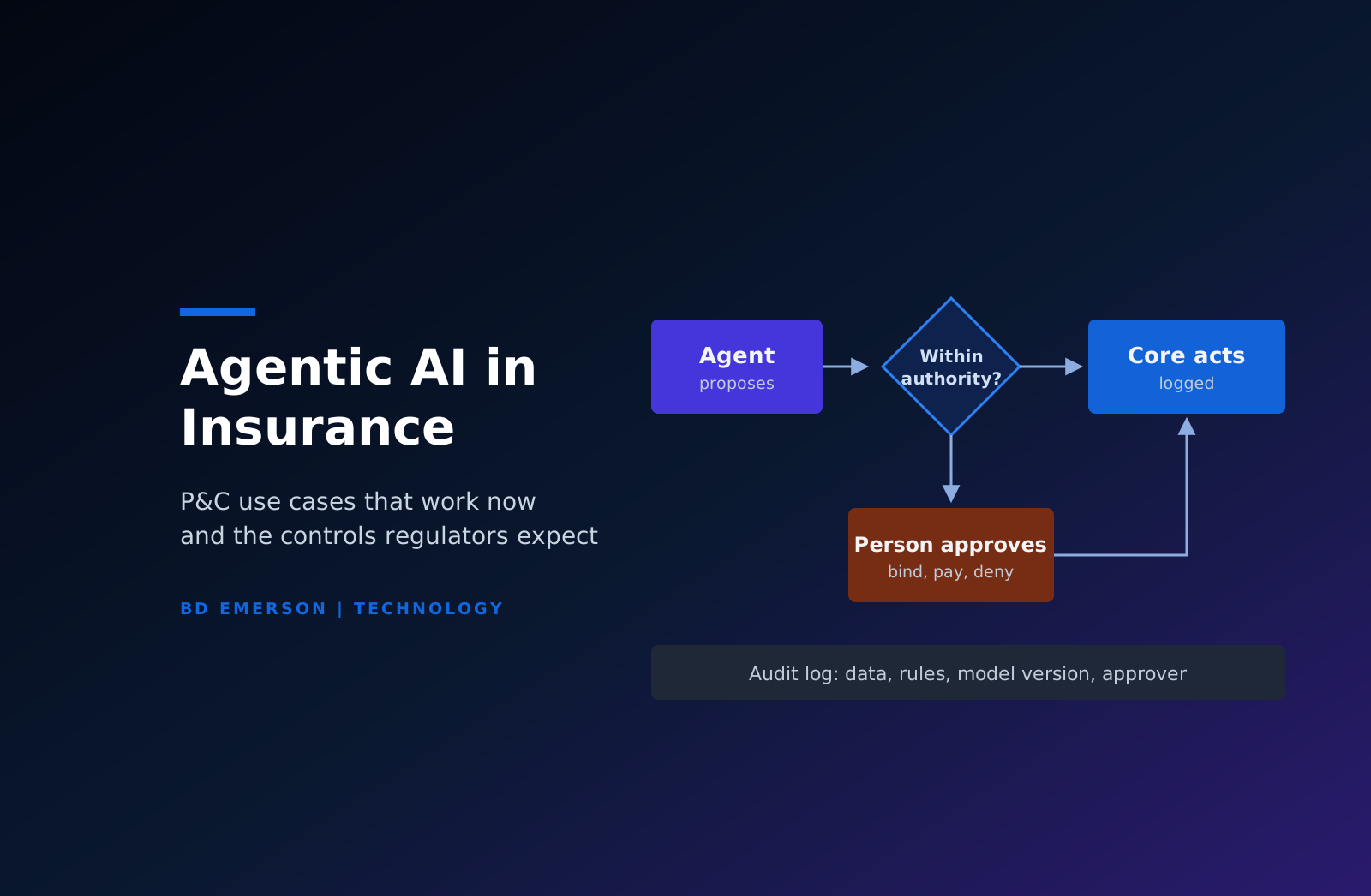
Agentic AI in insurance is software that uses a language model to complete multi-step work inside policy, billing, and claims systems. An agent reads the file, calls the core system, takes an action such as opening a claim, and routes anything above its authority to a person. Generative AI stops at a draft, such as a claim summary, and a person decides what to do with it. In property and casualty (P&C) insurance, documented results sit in submission intake, first notice of loss (FNOL), and small claims: Lemonade's AI Jim takes FNOL 96 percent of the time without human intervention, and Allianz cut processing and settlement time 80 percent on small food spoilage claims.
How agentic AI differs from generative AI in insurance
A generative model produces content, such as a summary of adjuster notes, and a person acts on it. An agentic system pursues a goal over several steps: it plans the work, calls tools and application programming interfaces (APIs), checks the results, and acts within the permissions the carrier gives it.
| System | A model that drafts | An agent that acts |
|---|---|---|
| Policy administration | Drafts a reply to a broker's request to add a vehicle | Adds the vehicle, rates the change, and issues the endorsement or sends it to an underwriter |
| Billing | Drafts a letter that explains a past-due balance | Moves the account to a new installment plan and schedules the payment |
| Claims | Summarizes adjuster notes | Opens the claim, checks coverage, and assigns an adjuster |
The right-hand column writes to the system of record, the database that defines what the carrier has insured, billed, and paid. A wrong endorsement or payment changes the policy and the books, so an agent needs authority limits, logs, and testing that a drafting tool does not.
Use cases for AI agents in P&C insurance that work now
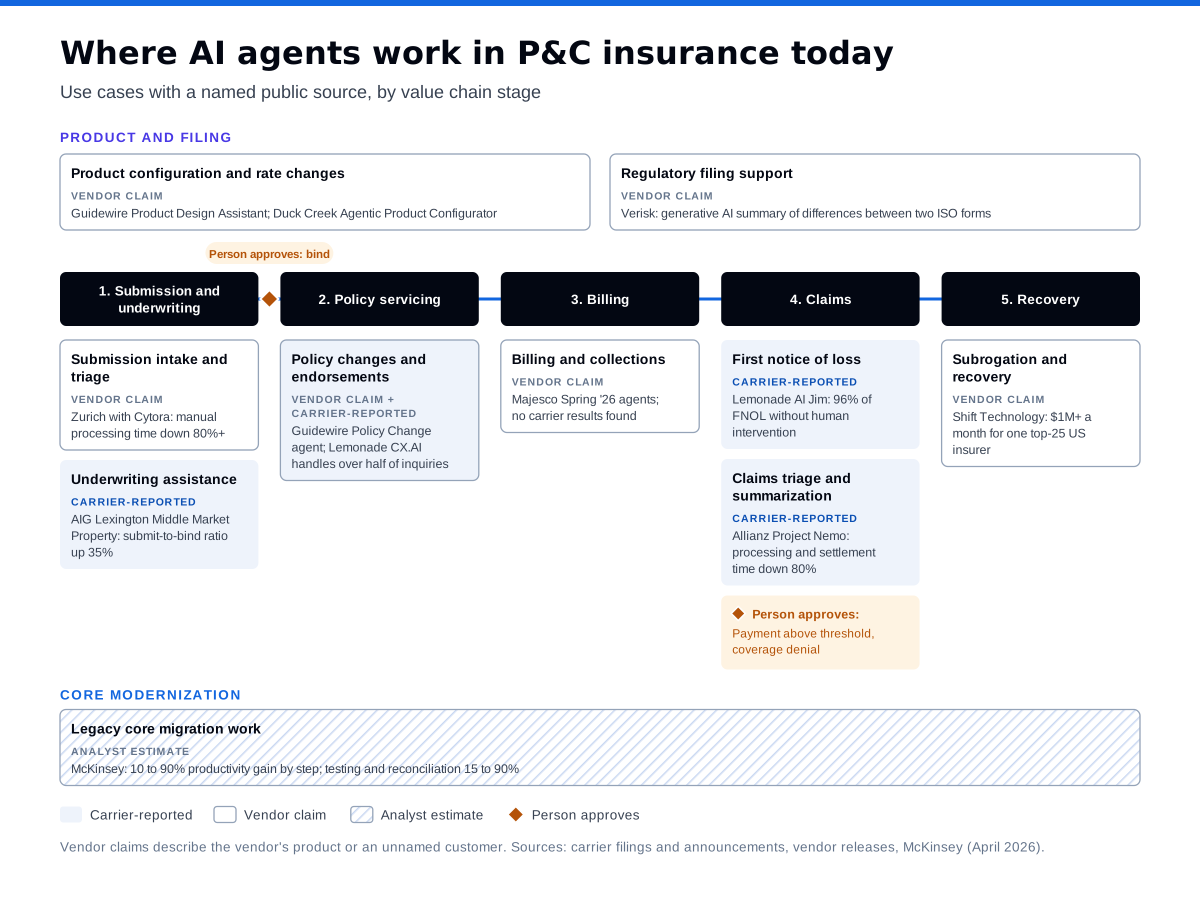
Vendors sell AI agents for insurance at every stage of the value chain, so the map below includes only use cases with a named public source and labels each one by source type.
| Stage | What the agent does | Public evidence | Source type |
|---|---|---|---|
| Submission intake and triage | Extracts exposures from broker emails and ranks the queue | Zurich's commercial mid-market business cut manual processing time more than 80 percent with Cytora, and underwriters still quote and bind (Cytora, May 2026) | Vendor claim |
| Underwriting assistance | Assembles the risk file and prioritizes accounts | AIG's Lexington passed 370,000 submissions in 2025, up 26 percent, and Lexington Middle Market Property improved its submit-to-bind ratio 35 percent since the AIG Assist rollout (AIG 2025 annual report) | Carrier-reported |
| Policy changes and endorsements | Applies and rates a requested change and routes exceptions | Guidewire's Policy Change agent assists underwriters and service staff (Qusar release, August 2026), and Lemonade's CX.AI handles over half of customer inquiries, a category that includes policy changes | Vendor claim; carrier-reported |
| Billing and collections | Answers billing questions and changes payment methods | Majesco's Spring '26 release describes P&C agents for quoting, servicing, billing, and claims (April 2026), and we found no carrier-reported results | Vendor claim |
| First notice of loss | Takes the loss report and opens the claim | Lemonade's AI Jim takes FNOL 96 percent of the time without human intervention, AIG reports FNOL cut from days to hours, and Guidewire and Duck Creek have announced agentic FNOL products | Carrier-reported; vendor claims |
| Claims triage and summarization | Checks coverage, weather, and fraud signals, then summarizes and routes | Allianz Project Nemo runs seven agents on food spoilage claims under 500 Australian dollars, AIG cut some coverage and endorsement reviews from hours to minutes, and Guidewire's agent writes claim summaries for adjusters | Carrier-reported; vendor claim |
| Subrogation and recovery | Reads claim notes and scores recovery potential under state negligence rules | Shift Technology reports more than $1 million a month in recoveries for a top-25 US auto and property insurer (Shift case study) | Vendor claim |
| Product configuration and rate changes | Turns product specifications and approved rate changes into configuration | Guidewire's Product Design Assistant and Duck Creek's Agentic Product Configurator cover product configuration, and we found no carrier-reported results | Vendor claims |
| Regulatory filing support | Drafts form comparisons for compliance review | Verisk added a generative AI summary of the differences between two ISO forms to Mozart Forms Composer (Verisk 2025 year in review) | Vendor claim |
| Core modernization | Reverse engineers rules, maps data, and runs tests | McKinsey estimates gains of 10 to 90 percent depending on the step (April 2026) | Analyst estimate |
Documented results cluster where volume is high and rules are clear. Carriers also set the authority line on purpose: Zurich's underwriters still bind, Allianz never automates a Project Nemo payout, and Lemonade automates roughly 55 percent of its claims from start to finish while AI Jim routes claims beyond its authority to people.
McKinsey's April 2026 analysis treats core modernization itself as an agent use case and puts the gains at 20 to 50 percent for discovery and reverse engineering, 15 to 40 percent for target configuration, 20 to 60 percent for data mapping and quality, 15 to 90 percent for testing and reconciliation, 10 to 40 percent for cutover and operations readiness, and 25 to 50 percent for program management. The same analysis notes that rewriting code or configuring the target platform "is only a small portion of the work." We point agents first at testing and data mapping, where the ranges run widest.
Where agents sit relative to the core system
Agents reach a core system's data, actions, and rules through one of two designs.
Agents added to a vendor suite
Guidewire's Qusar release on August 3, 2026, added an Agentic Framework for building and managing agents on Guidewire Cloud Platform, with "secure, real-time access to policy, claims, and billing data and workflows." Guidewire marks some Qusar features Early Access or Restricted Availability. On Guidewire Cloud, each carrier's InsuranceSuite core runs single-tenant on AWS alongside multi-tenant shared services. Duck Creek's platform, launched April 28, 2026, adds orchestration, an assurance layer for audit, support for the Model Context Protocol (MCP) and Agent2Agent (A2A) standards, and integration with Duck Creek's systems of record.
The suite design lets the agent inherit the suite's data model, security, and product definitions while the vendor maintains the framework and the carrier keeps its book in place. Guidewire is the market leader, with more than 570 insurers in 44 countries, a large partner ecosystem, and a mature product. In our experience, the constraint is reach, because an agent can act only through the interfaces the vendor exposes, on the vendor's release schedule, and carrier logic in custom code can sit outside its view.
A core built for agents
The alternative is a core designed so agents operate on its domain model, events, and rules directly. The core exposes policies, claims, and billing accounts as typed services, publishes each state change, such as a missed payment, as an event an agent can subscribe to, and stores rules as versioned definitions that the agent and the examiner read the same way. It enforces authority limits for every actor, person or agent. Lemonade's FY2025 10-K describes Blender, the platform it built from scratch for underwriting, claims, and other teams. The trade-off is ownership: the carrier funds the engineering and pays for two systems during migration, the "double-bubble" period McKinsey describes.
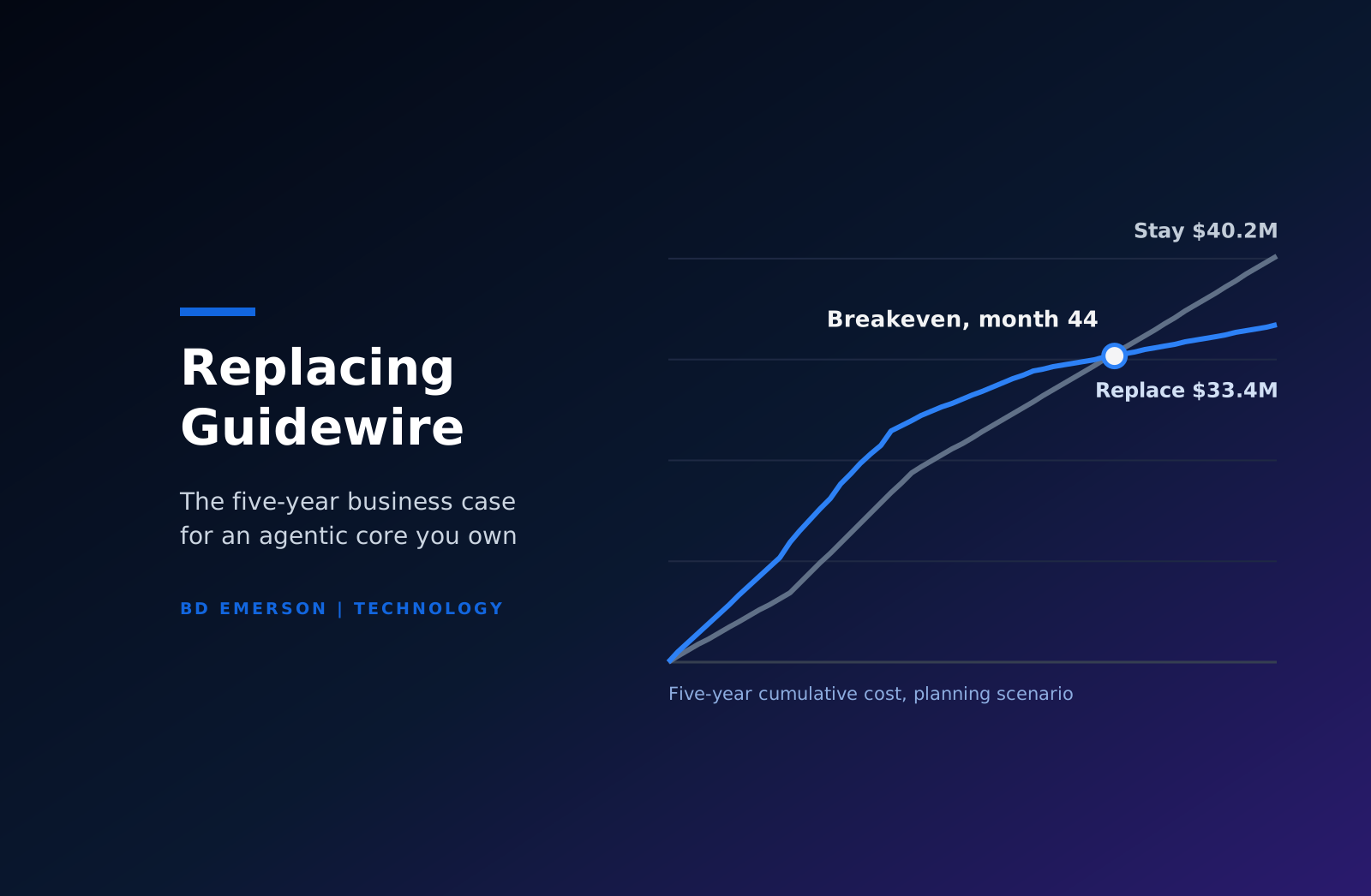
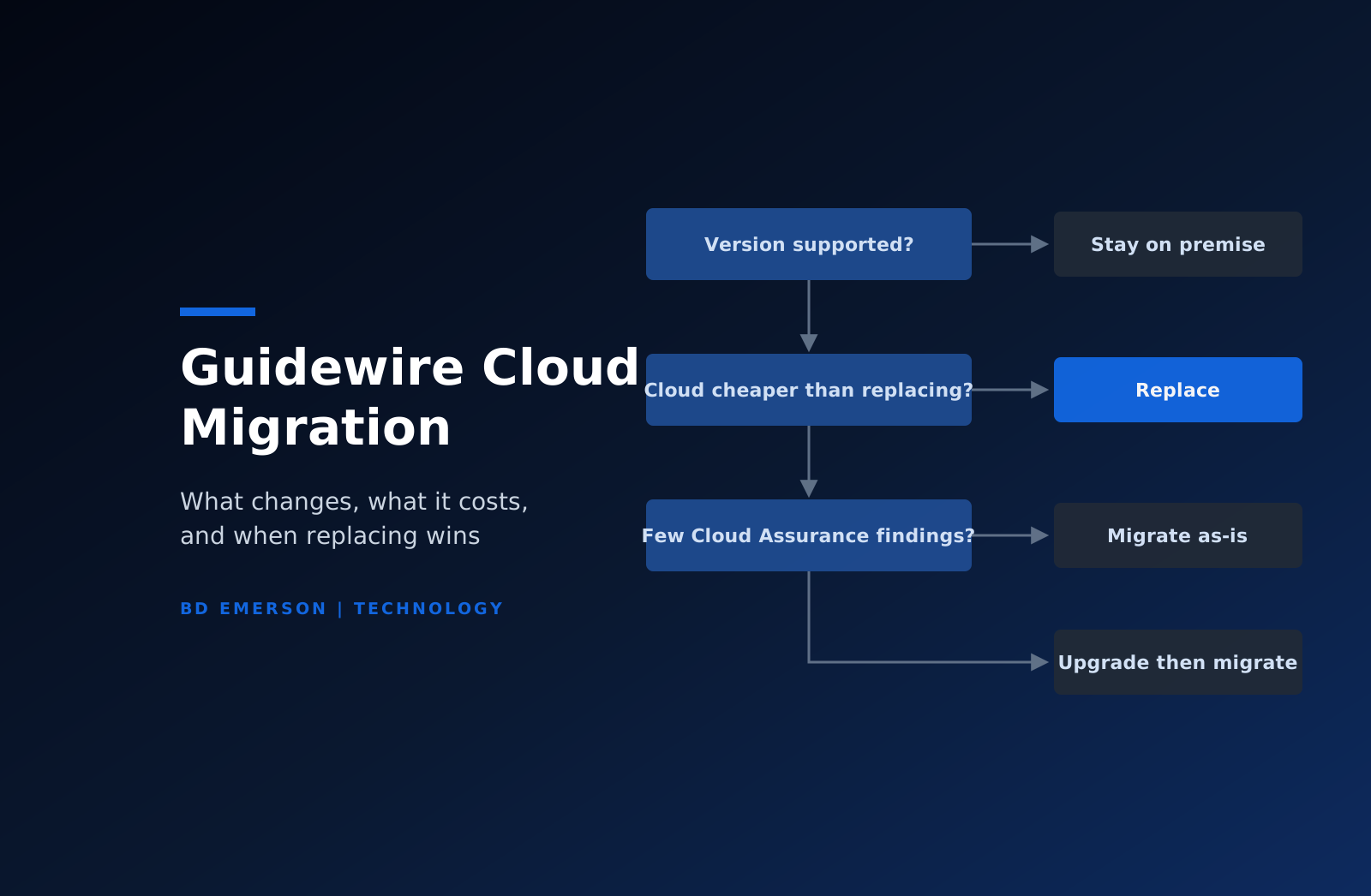
Our insurance team includes people who helped lead a Guidewire implementation practice of thousands of professionals at a Big Four firm, and our advice on this choice starts from that experience. If you run InsuranceSuite on Guidewire Cloud and your first targets are claim summaries, policy changes, and FNOL, we recommend Qusar as the shorter path. If you run it on premise, the agent decision follows the cloud decision, because Qusar's framework runs on Guidewire Cloud Platform, and our Guidewire Cloud migration guide covers that choice. We recommend a core built for agents only when the five-year numbers favor replacement.
Governance regulators already expect
Agents fall inside rules that already exist. The National Association of Insurance Commissioners (NAIC) adopted its Model Bulletin on the Use of Artificial Intelligence Systems by Insurers on December 4, 2023, and its adoption map shows about half the states and the District of Columbia had adopted it as of August 31, 2026, while California, Colorado, New York, and Texas follow their own rules or guidance. The bulletin expects a written AI program covering governance, risk management, internal controls, and third-party systems from product development through claims and fraud detection, with controls scaled to "the extent to which humans are involved in the final decision-making process." Examiners can request inventories and testing records.
New York's Insurance Circular Letter No. 7, issued July 11, 2024, covers AI systems and external consumer data in underwriting and pricing. It expects testing for unfair or unlawful discrimination before production and on a regular cadence after, using measures such as the adverse impact ratio, and it calls for an inventory of AI systems in use, in development, or recently retired.
Colorado's SB21-169, signed July 6, 2021, bars unfair discrimination based on race, religion, sex, disability, and other protected characteristics in any insurance practice, and insurers that use external consumer data, algorithms, or predictive models must keep a risk management framework attested by the chief risk officer. The Division of Insurance's governance regulation has covered life insurers since November 2023, and an amendment effective October 15, 2025, added private passenger auto and health benefit plan insurers.
The EU AI Act treats AI used for "risk assessment and pricing in relation to natural persons in the case of life and health insurance" as high-risk under Annex III, point 5(c), and Article 27 requires deployers of those systems to complete a fundamental rights impact assessment, including human oversight measures, before deployment. Regulation (EU) 2026/1744 set December 2, 2027, as the application date for those obligations, and P&C pricing does not appear in point 5(c). Our guide to building an AI governance framework covers how to fold agents into one program.
The controls an agent needs before it touches production
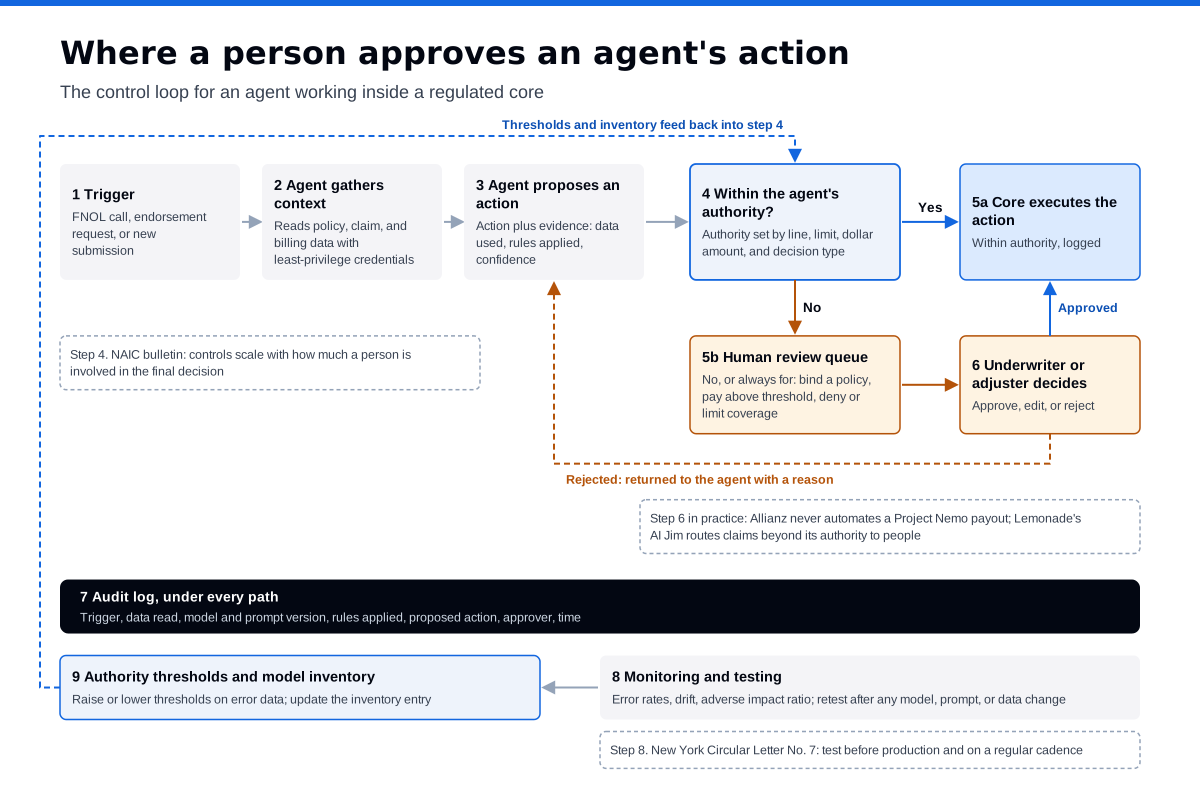
These rules ask for overlapping evidence: who decided, on what data, under what authority, and with what effect on protected classes. Four controls produce that evidence for an agent.
- Set human approval thresholds for binding, payment, and coverage decisions, written like a new underwriter's or adjuster's authority by line, limit, and dollar amount, and route everything above them to a person.
- Keep an audit trail that records the trigger, the data the agent read, the model and prompt version, the rules applied, the proposed action, the approver, and the time.
- Register every agent in the model inventory with its owner, purpose, data, authority, and last test date, including agents in development and recently retired ones, as New York requires.
- Test for unfair discrimination with measures such as the adverse impact ratio before launch, after any change to the model, prompt, or data, and on a fixed schedule.
Give each agent its own identity and least-privilege credentials, and test any agent that reads broker emails for indirect prompt injection before it can write to the policy system. Our agentic AI security work scopes those permissions and runs those tests.
How to start
Start with one bounded workflow that has steady volume, clear rules, and one accountable owner, such as personal auto endorsements, FNOL for one line in one state, or submission intake for one commercial program.
Measure the baseline before the agent runs, including cycle time, touch time per transaction, error and rework rates, leakage, and complaints. We recommend four to eight weeks of data, with low-volume lines at the longer end.
Design the controls before you scale: write the thresholds, add the agent to the inventory, and set the test and rollback plans. Then run the agent in shadow mode, require human approval on every action, and raise thresholds only when the error data supports it. A missing baseline and an unnamed risk owner are two failure points we cover in why AI pilots stall.
Frequently asked questions
What is agentic AI in simple terms? Agentic AI is software that pursues a goal over several steps. It plans the work, uses tools and system connections, checks its results, and acts within its permissions. In insurance, an agent can open a claim or rate an endorsement, while a generative model drafts the summary or letter for a person.
How is AI being used in the insurance industry? Insurers use AI in submission intake, underwriting, policy servicing, FNOL, claims triage, fraud detection, subrogation, and pricing. The best documented P&C results come from AIG's underwriting tools, a Cytora case study at Zurich, FNOL at Lemonade and AIG, and small claims at Allianz. Generative AI drafts summaries and letters, and agentic AI completes steps inside core systems.
Which AI tool is best for insurance? No single tool is best, because the choice depends on the workflow and on where your data and rules live. Guidewire Cloud carriers can start with Qusar, Duck Creek carriers with Duck Creek's platform, and specialists such as Cytora or Shift Technology cover single stages. We recommend choosing the workflow first and then a tool that can act in your system of record.
Can an AI agent bind a policy or pay a claim on its own? An agent can when the carrier's controls allow it. Lemonade says it automated roughly 55 percent of its claims from start to finish as of December 31, 2025, while Allianz keeps every Project Nemo payout with a person and Zurich's underwriters still bind. The NAIC bulletin expects controls that match how involved a person is in the final decision.
Do we need to replace our core system to use AI agents? A carrier on Guidewire or Duck Creek can run agents on its current core through Qusar or Duck Creek's platform, and for many carriers that is the right start. Replacement makes sense when the five-year numbers favor a core built for agents, and we test that case before anyone commits.
We do not implement Guidewire. We replace it when the five-year numbers favor replacement, and our Guidewire replacement practice starts with that math and a working prototype of one of your own products on a core built for agents.

About the author