Digital Product Passports for Textiles, Apparel, and Footwear
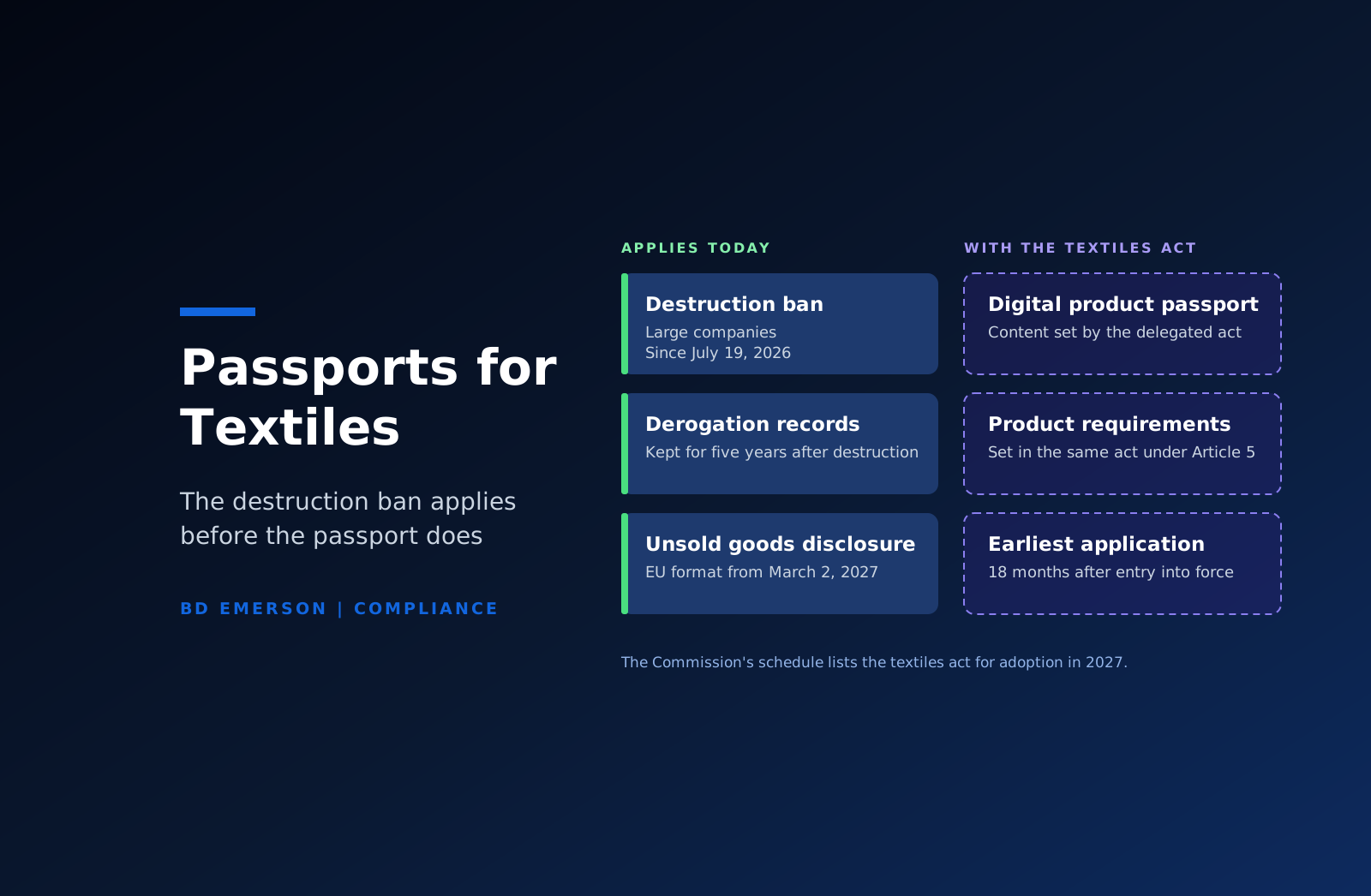
Since July 19, 2026, large companies may not destroy unsold apparel, clothing accessories, or footwear except under one of the ten derogations in Commission Delegated Regulation (EU) 2026/296. Large companies that discard any unsold consumer products must also disclose every year what they discarded and why, and the standard format in Implementing Regulation (EU) 2026/2 becomes mandatory on March 2, 2027. No digital product passport is required for textiles yet. The Commission's 2025 to 2030 working plan lists textiles (apparel) for adoption in 2027, its digital product passport page lists textiles for Q3 to Q4 2027, and any delegated act applies at least 18 months after it enters into force. The destruction ban covers footwear today, while the working plan gives footwear a study due by the end of 2027.
Our guide to the EU digital product passport covers the regulation across every product group.
Key dates for textile, apparel, and footwear companies
Most rows come from adopted EU acts. The two 2027 rows come from Commission planning documents, and the working plan calls its adoption dates indicative.
| Date | What applies or is scheduled |
|---|---|
| July 18, 2024 | ESPR in force: duty to prevent destruction; annual disclosure for large companies |
| July 19, 2026 | Ban on destroying unsold apparel, clothing accessories, and footwear for large companies, with ten derogations |
| October 10, 2026 | REACH restriction on PFHxA applies to consumer clothing and footwear |
| March 2, 2027 | Standard disclosure format becomes mandatory |
| 2027 | Textiles (apparel) delegated act, indicative adoption; the DPP page lists Q3 to Q4 2027 |
| End of 2027 | Commission footwear study due |
| April 17, 2028 | Member State EPR schemes for textiles and footwear due |
| July 19, 2030 | Ban and disclosure extend to medium-sized companies |
The ban on destroying unsold apparel and footwear
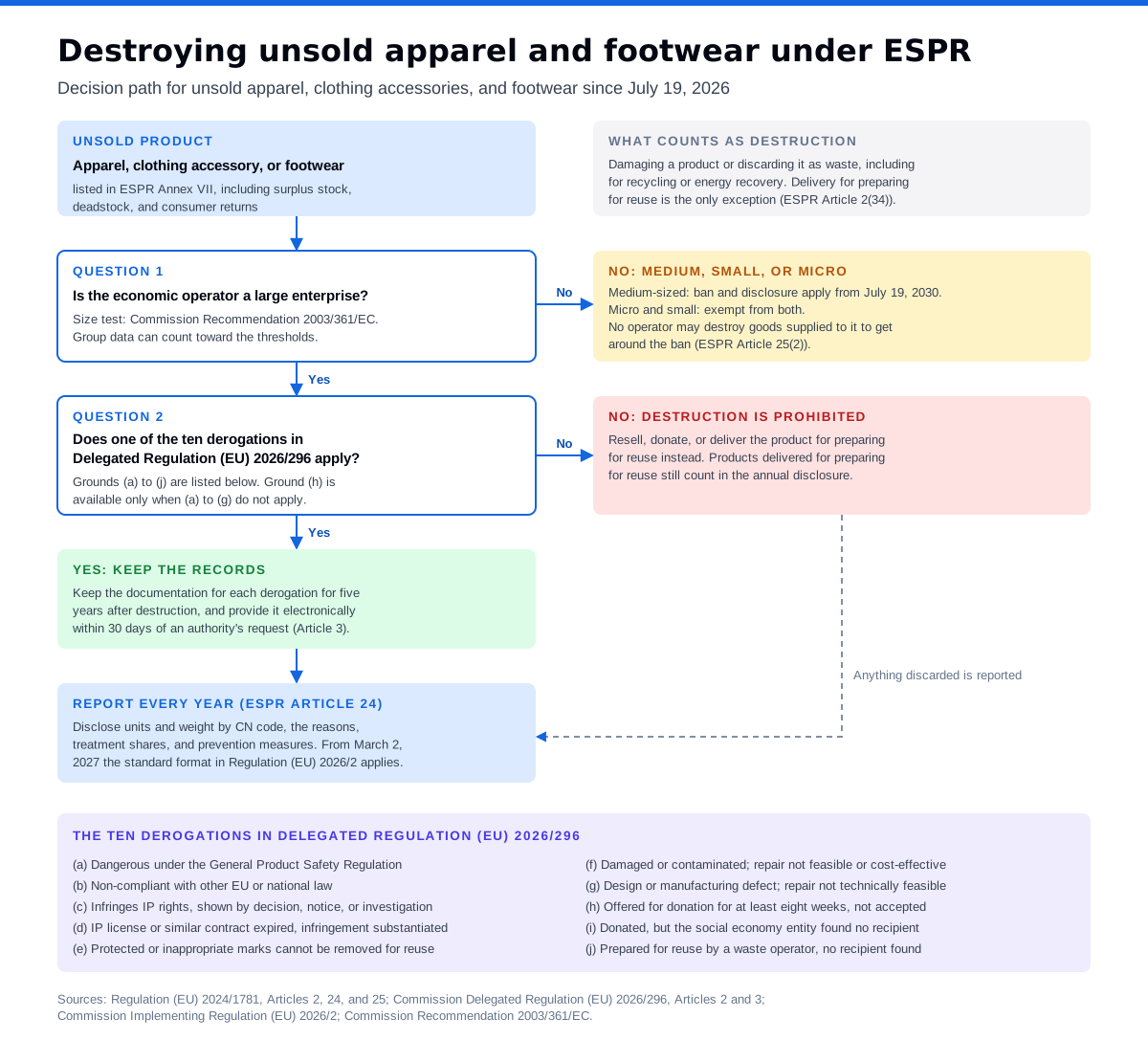
Article 25 of the Ecodesign for Sustainable Products Regulation (EU) 2024/1781 (ESPR) prohibits destroying the unsold consumer products listed in Annex VII: apparel, clothing accessories, and footwear. The ban has applied to large enterprises since July 19, 2026 and reaches medium-sized enterprises on July 19, 2030. Micro and small enterprises are exempt, but Article 25(2) bars any operator outside the ban from destroying unsold goods supplied to it in order to circumvent it, so a smaller liquidator may not destroy stock that a large brand passes on for that purpose.
Size follows Commission Recommendation 2003/361/EC: a company is large when it has 250 or more staff, or when its turnover exceeds EUR 50 million and its balance sheet total exceeds EUR 43 million. The Commission's SME definition page notes that a firm in a larger group may need to include the group's data, so an EU subsidiary of a large US group cannot assume it is small.
The duties fall on economic operators: the manufacturer, authorized representative, importer, distributor, dealer, and fulfillment service provider (Article 2(46)). A brand that has products made and markets them under its own name or trademark is a manufacturer (Article 2(42)), even if it owns no factories. Every operator, whatever its size, must also take measures that can reasonably be expected to prevent the need to destroy unsold consumer products (Article 23).
Destruction means the intentional damaging or discarding of a product as waste, except discarding for the sole purpose of delivering it for preparing for reuse, including refurbishment or remanufacturing (Article 2(34)). Sending unsold garments to a recycler or an incinerator therefore counts as destruction, a reading Cooley's May 2026 analysis shares. Unsold consumer products include surplus stock, deadstock, and items customers return under their right of withdrawal (Article 2(37)), which brings e-commerce returns into scope.
The ten derogations and their records
Delegated Regulation (EU) 2026/296, adopted February 9, 2026 and published April 22, 2026, lists ten situations in which destruction stays lawful (Article 2) and the evidence for each (Article 3). Point (h), the donation route, applies only when none of points (a) to (g) fits.
| Point | Destruction is allowed when | Records to keep |
|---|---|---|
| (a) | Dangerous under the General Product Safety Regulation (EU) 2023/988 | A safety concern description or a chemical test report |
| (b) | Breaks other EU or national law, and destruction is required or is the proportionate corrective action | A self-assessment naming the breach and the law |
| (c) | Infringes IP rights, shown by a court or ADR decision, a right holder or authority notice, or an internal investigation | The decision, notice, or investigation record |
| (d) | An IP license or similar contract expired, the infringement is substantiated, and destruction is proportionate | The license or contract and proportionality reasoning |
| (e) | Protected or inappropriate labels, logos, or design cannot be removed or made permanently inaccessible for reuse | An inspection report showing options were unfeasible |
| (f) | Damaged, deteriorated, or contaminated, and repair is not technically feasible or cost-effective | Quality procedures favoring restocking and repair, or a damage inspection record |
| (g) | A design or manufacturing defect that repair cannot technically fix | Inspection records of the defect |
| (h) | Offered for donation, directly to at least three suitable social economy entities in the EU or on the operator's website, for at least eight weeks, and not accepted | Evidence of the donation offer |
| (i) | Donated to a social economy entity that found no recipient | A declaration that no recipient was found |
| (j) | Prepared for reuse by a waste treatment operator that found no recipient | Proof of receipt and that no recipient was found |
Cost-effective has a defined meaning: repair must cost no more than destroying the product plus the full cost of replacing it, from materials and manufacturing to packaging, transport, and storage. Operators keep the documentation for five years after destruction and provide it electronically within 30 days of an authority's request.
The annual disclosure of discarded products
Article 24 requires large economic operators that discard unsold consumer products, directly or through others, to disclose every year the number and weight discarded by product type, the reasons and any derogation used, the share sent to preparing for reuse, recycling, other recovery, and disposal, and their prevention measures. It covers all unsold consumer products, including bags and home textiles outside Annex VII. The information goes on an easily accessible page of the company's website, and companies that publish sustainability reporting may also include it there.
The first disclosure covers the first full financial year in which ESPR was in force, which is 2025 for a calendar-year company. On February 9, 2026, the Commission stated that the disclosure rules "already apply to large companies."
Implementing Regulation (EU) 2026/2 standardizes the disclosure from March 2, 2027. Its template asks for the entity and financial year, each product category with its Combined Nomenclature (CN) code, units and weight in kilograms, whether packaging is included, the reason, the shares by treatment route, and measures taken and planned. Apparel reports under two-digit CN chapters 61 and 62 and footwear under chapter 64, while Annex II requires four-digit headings for categories such as bags (4202), leather apparel (4203), and bed linen (6302). Companies publish within 12 months after the financial year ends, on their website or by linking to the relevant section of their sustainability report.
When it adopted the rules, the Commission estimated that 4 to 9 percent of unsold textiles in Europe are destroyed each year before they are worn, generating around 5.6 million tons of CO2 emissions. It also cited about EUR 630 million of unsold products destroyed each year in France and nearly 20 million returned items discarded annually in Germany.
The published schedule for a textile passport
ESPR requirements, including passports, reach a product group only through a Commission delegated act, and by September 14, 2026 the Commission had adopted no such act for any product group. The working plan, adopted April 16, 2025 as COM(2025) 187, lists textiles (apparel) as a priority product group with indicative adoption in 2027, citing "high potential to improve product lifetime extension, material efficiency and to reduce impacts on water, waste generation, climate change and energy consumption." It links ESPR information requirements for textiles to the Textile Labelling Regulation, which it describes as "currently under review."
The Commission's DPP page lists textiles, aluminum, and tires for Q3 to Q4 2027, and ESPR Article 4(4) bars a delegated act from applying earlier than 18 months after its entry into force, except in duly justified cases. The EU passport registry, live since July 20, 2026, already lists textiles among the ESPR products it supports.
The Commission's Joint Research Centre runs a preparatory study on textile products that aims to give the Commission a basis to consider ecodesign requirements, green public procurement criteria, and revised EU Ecolabel criteria. Its project plan covers seven tasks, from scope and markets to design options and policy scenarios. The slides for the third stakeholder workshop, held online on January 14 and 15, 2026, describe the delegated act's focus as apparel, including clothing accessories, and list footwear and home textiles as not prioritized. They analyze design options for physical durability, recyclability, recycled content, and lower environmental and carbon footprints, and they name textile-specific passport elements as a later milestone topic. None of these options is a requirement until a delegated act adopts it.
Footwear follows a separate track. The working plan treats it as a distinct category "due to the distinct use of materials, product functionality and supply chains" and commits only to a study due by the end of 2027. No published ESPR schedule names a footwear passport.
Rules that already shape textile product data
Several EU rules in force already require apparel and footwear companies to hold the data a passport draws on.
The Textile Labelling Regulation (EU) No 1007/2011, applicable since May 8, 2012, admits textile products to the EU market only if they are labeled, marked, or documented with their fiber composition in the regulation's harmonized fiber names, visible to the consumer before purchase. Directive 94/11/EC requires footwear labels naming the material of the upper, the lining and sock, and the outer sole, based on the material that makes up at least 80 percent of each part.
Under REACH, Annex XVII entry 72 has restricted listed carcinogenic, mutagenic, and reprotoxic substances in consumer clothing, accessories, skin-contact textiles, and footwear since November 1, 2020 (Regulation (EU) 2018/1513). Entry 79 restricts PFHxA in consumer clothing, accessories, and footwear from October 10, 2026, at 25 ppb for PFHxA and its salts and 1,000 ppb for related substances (Regulation (EU) 2024/2462).
An EU supplier of an article containing a Candidate List substance above 0.1 percent by weight must give customers enough information for safe use and answer consumer requests within 45 days under REACH Article 33, and since January 5, 2021 it must notify the article to ECHA's SCIP database, as ECHA's summary of Candidate List obligations sets out.
Directive (EU) 2025/1892, the revision of the Waste Framework Directive adopted September 10, 2025, gives Member States 30 months from its October 16, 2025 entry into force to set up extended producer responsibility (EPR) schemes for textile, textile-related, and footwear products, a deadline Linklaters' summary dates to April 17, 2028. The Commission's entry-into-force notice says the schemes adjust producer fees for factors such as durability and recyclability, an approach it calls eco-modulation.
Where textile passport data comes from
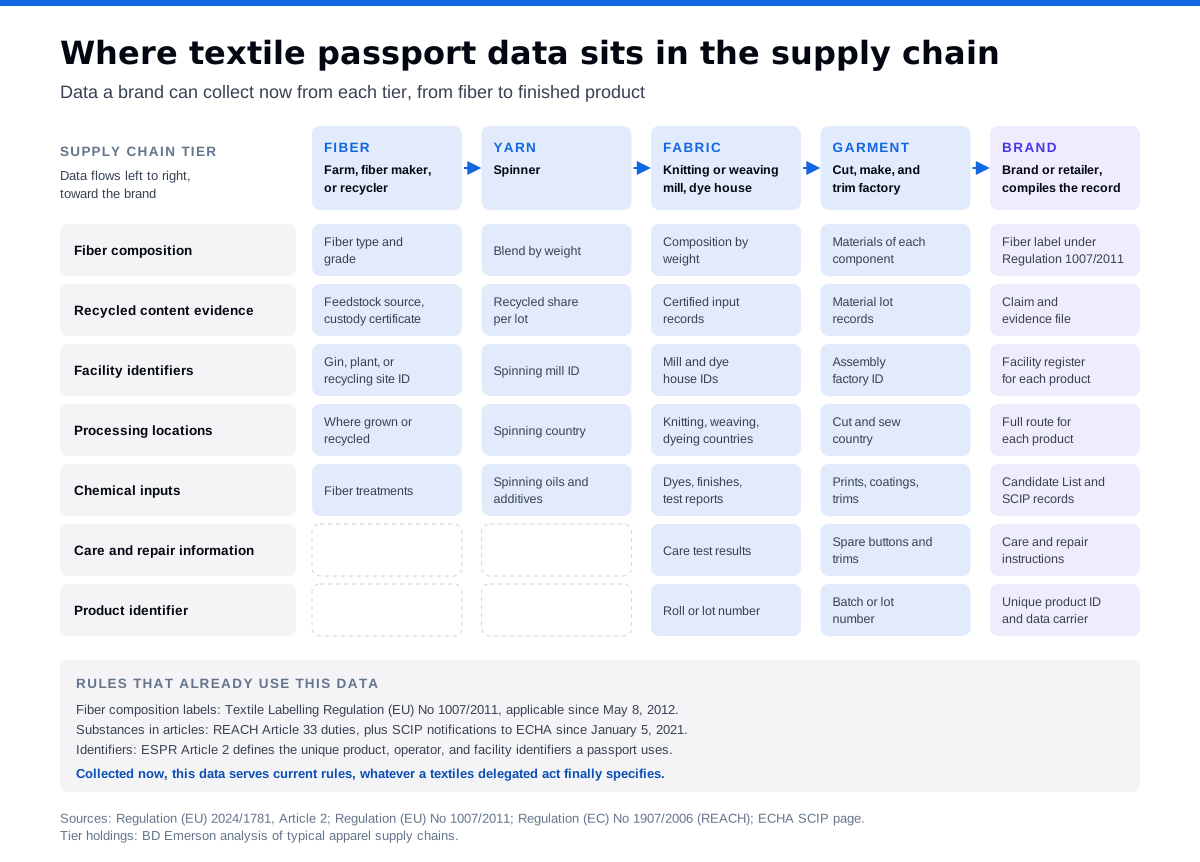
A brand holds only part of the data a textile passport draws on, and the rest sits with suppliers several tiers back. Mapping who holds what is preparation that stays valid under any final delegated act, because a garment's fibers, facilities, and chemistry do not change with the act's wording.
Fiber producers and recyclers hold fiber type, origin, and recycled content evidence, such as chain-of-custody certification under Textile Exchange's Global Recycled Standard. Spinners hold the blend and the recycled share of each lot. Mills, dye houses, and finishers hold fabric composition and the record of dyes, finishes, and chemical tests. The garment factory holds the bill of materials for trims and prints and the batch or lot numbers. The brand holds the fiber label, care and repair instructions, Candidate List and SCIP records, and the product identifier. Every tier also runs facilities, and ESPR already defines a unique facility identifier for locations or buildings in a product's value chain (Article 2(33)).
How fashion brands can prepare now
Start with stock flows. Map every route unsold stock can take, from returns processing and outlets to liquidators, donation partners, recyclers, and waste contractors, including routes that fulfillment providers and distributors run for the company. Each route that ends in destruction, which includes recycling and incineration, needs a derogation basis and a record, and contracts with downstream partners should bar destruction meant to get around the ban.
Set up donation offers before stock needs to go. Standing agreements with social economy entities in each market where stock sits make the point (h) offer routine and its evidence easy to keep.
Build the disclosure dataset from existing systems. Warehouse and returns systems count units, the template adds weight in kilograms and CN codes, and reasons should map to derogation letters so the website disclosure and the derogation file agree.
Collect supplier data through the supplier program. Fiber, recycled content, facility, location, and chemical data often come from tiers the brand does not contract with directly, so requests flow through garment factories and mills with set formats, deadlines, and evidence rules. Teams that already run third-party risk management can extend supplier questionnaires and evidence reviews to product data.
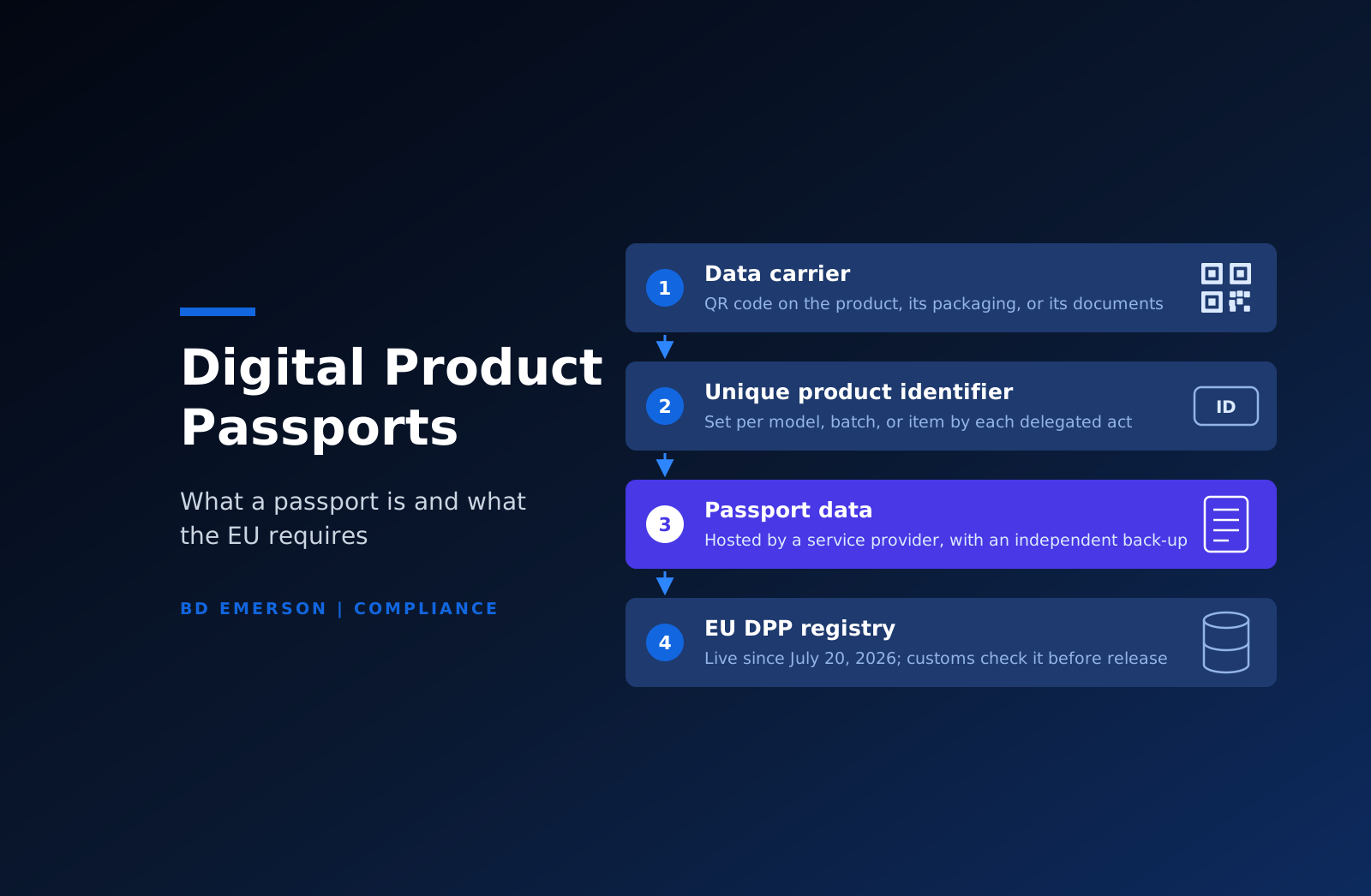
Plan identifiers and the platform once the data model is settled. An ESPR passport connects through a data carrier to a persistent unique product identifier, and Implementing Decision (EU) 2026/1736 cites harmonized standards EN 18219 on unique identifiers and EN 18220 on data carriers. Brands that already use GS1 barcodes can assess GS1 Digital Link as a carrier, and our guide to choosing a DPP platform covers vendor selection.
BD Emerson's ESPR compliance practice maps products and roles to these obligations, sets up derogation records and the disclosure, runs supplier data collection, and selects and integrates the passport platform, which a platform vendor hosts.
Frequently asked questions
Is a digital product passport required for textiles yet? No textile passport is required yet, because ESPR passports become mandatory only through a delegated act and the Commission had adopted none by September 14, 2026. The working plan lists textiles (apparel) for 2027, and the Commission's DPP page lists Q3 to Q4 2027. ESPR Article 4(4) then requires at least 18 months between an act's entry into force and its application, except in duly justified cases.
Does the EU ban on destroying unsold clothing apply to US companies? A US brand that markets apparel or footwear in the EU under its own name or trademark is a manufacturer under ESPR, so the ban applies to it if it is a large enterprise. Its EU importers, distributors, and fulfillment providers are economic operators too. A company that belongs to a larger group may need to count the group's staff and financial data when it tests its size.
Does sending unsold clothes to a recycler count as destruction? Sending unsold clothes to a recycler counts as destruction under ESPR Article 2(34), which excludes only delivery for preparing for reuse. Recycling, energy recovery, or disposal of unsold apparel or footwear by a large company therefore needs a derogation under Delegated Regulation (EU) 2026/296.
What records does a company need when it destroys unsold goods under a derogation? Article 3 of Delegated Regulation (EU) 2026/296 sets the evidence for each derogation, such as a test report for dangerous products, an inspection record for damaged goods, or evidence of the donation offer. The company keeps it for five years after destruction and provides it electronically within 30 days of an authority's request.
Is a digital product passport planned for footwear? No published ESPR schedule includes a footwear passport. The working plan treats footwear as a separate category and commits to a study that "will be completed by the end of 2027." Footwear already falls under the destruction ban, the Article 24 disclosure, Directive 94/11/EC on footwear labeling, and the PFHxA restriction from October 10, 2026.
Apparel and footwear companies selling in the EU can set up the derogation file, the disclosure dataset, and the supplier data program now, and all three serve rules already in force. Our ESPR compliance practice builds them with your product, sourcing, and compliance teams.

About the author