IP Valuation: How Patents, Trademarks, Trade Secrets, and Brands Get Priced
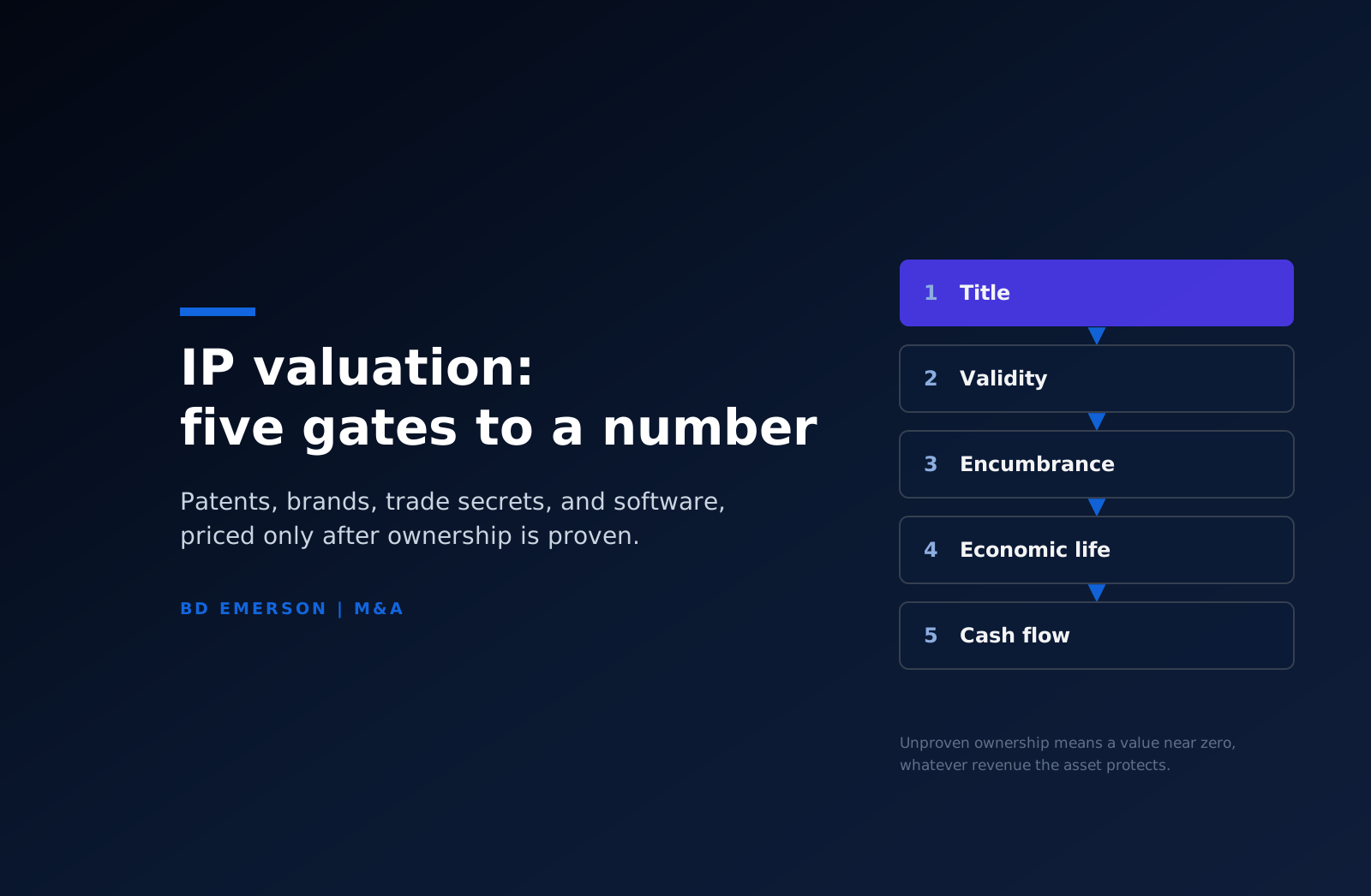
Intellectual property is valued by the cash flow it protects or produces, not by the certificate that registers it. A patent is worth the margin it defends on a product that sells, discounted for the years it has left and the chance it does not hold up. A trademark is worth the premium and the loyalty attached to the brand it protects. A trade secret is worth exactly what its secrecy preserves, which means the controls around it are part of the valuation. Copyright, content, and software are worth what they earn or what it would cost to rebuild them, whichever question the purpose requires. Before any of that can be measured, the company has to prove it owns the asset, and chain of title is where more IP valuations fail than anywhere else. This article takes the main IP asset classes one at a time and ends with the five errors that inflate or sink an IP valuation.
Why IP is valued differently from other intangibles
Intellectual property is the subset of intangible assets that the law protects through registration or statute: patents, trademarks, copyrights, registered designs, and trade secrets. The legal protection is what sets IP apart from the rest of the twelve categories of intangible assets. A customer relationship or a dataset is valuable because of what it does. A patent is valuable because of what it does and because the law stops anyone else from doing the same thing for a defined period. That second property makes IP easier to identify and transfer, and it also introduces questions the other categories do not raise: is the right valid, is it enforceable, has it been encumbered by a license, and who holds it.
The valuation methods are the same ones used across all intangibles, relief from royalty, excess earnings, with-and-without, cost, and market. What changes by asset class is which method fits, what evidence supports the inputs, and which legal facts have to be established before the economics mean anything.
Patents
A patent grants the right to exclude others from making, using, or selling the claimed invention for a term that runs, in the United States, twenty years from the filing date. Its value comes from the products and margins the exclusion protects. Five factors do most of the work in a patent valuation. Claim scope determines how much of the market the patent covers; a narrow claim that competitors can design around protects little. Remaining life sets the horizon, and economic life is often shorter than legal life when the technology is moving fast. Freedom to operate determines whether the patent holder can itself sell the product without infringing someone else's rights. Royalty comparables from the same technology field anchor the relief from royalty rate. And litigation exposure, both the risk the patent is invalidated and the cost of enforcing it, discounts everything.
The relief from royalty method is the default for patents that protect a product with revenue. For patents that block a competitor rather than protect a product, the with-and-without method asks what the company's cash flow would look like if the competitor were free to enter. A pending application is valued with a probability of grant applied. A portfolio is valued as a whole when the patents protect the same product, because valuing each one separately and adding them up double counts the revenue.
Trademarks and brands
A trademark is a registered right in a name, logo, or other sign. A brand is the commercial asset the trademark protects: the recognition, trust, and preference that let a company charge more, convert faster, or retain longer than an unbranded competitor. The distinction matters because a trademark registration with no brand behind it is worth the filing fee, while a strong brand with weak registration is a valuable asset with an ownership problem.
Brands are valued by relief from royalty in most cases, with the royalty rate drawn from comparable brand licensing agreements in the same sector and adjusted for brand strength. The alternative is a price premium analysis, which measures the margin the branded product earns over an equivalent unbranded one and capitalizes it. Both approaches need the brand's revenue to be isolated from revenue that customers would generate anyway, and both need a useful life judgment. Trademarks can be renewed indefinitely, so the legal life is unlimited, but the economic life of a brand depends on the market and on how well the company maintains it.
The registration question comes first. A brand used for years without a registration, or registered in one country and used in twelve, or registered to a founder rather than the company, carries a discount that no royalty rate can offset until it is fixed.
Trade secrets and know-how
A trade secret is information that has commercial value because it is not generally known and that the owner takes reasonable measures to keep secret. Formulas, manufacturing processes, algorithms, customer pricing data, and supplier terms all qualify. Unlike a patent, a trade secret has no fixed term; it lasts as long as the secrecy does. Unlike a trademark, it has no registration; the evidence of ownership is the documentation of what the secret is, when it was created, who created it, and how it has been protected.
The valuation follows from that premise. A trade secret is worth what its secrecy preserves, so the first question is what the company would lose if the secret were disclosed: margin, market share, or the head start it holds over competitors. The with-and-without method captures that directly. The cost approach captures what it would take a competitor to develop the same knowledge independently, which sets a floor. In both cases, the security controls around the secret, access restrictions, confidentiality agreements, and monitoring, are not a separate compliance matter. They are the thing that makes the asset an asset, and a valuer who finds them weak will discount the value accordingly.
Know-how sits next to trade secrets and is often harder to value because it lives in people. A manufacturing team that has learned over ten years how to run a line at yields a competitor cannot match holds an asset, but the asset walks out the door with the team. Valuing it means documenting it first, then valuing the documented version by cost or excess earnings, and treating the retention of the people who hold it as a risk factor.
Copyright, content, and software
Copyright protects original works of authorship from the moment they are fixed, without registration, for the life of the author plus seventy years, or for works made for hire, ninety-five years from publication. That covers software code, written content, images, video, audio, and databases to the extent of their original selection and arrangement. Content that a company licenses to others is valued by the income it produces, usually through relief from royalty or direct capitalization of the license income. Content that supports the business without being sold, such as training material, documentation, or a marketing library, is valued by cost.
Software is the largest asset in this category for most companies and the one with the most valuation approaches available. Software sold as a product is valued by relief from royalty against a technology royalty rate, or by excess earnings when it is the primary asset. Internal-use software is valued by replacement cost, adjusted for functional and technological obsolescence. In both cases the codebase has to be checked for open-source components whose licenses restrict commercial use or require disclosure, because a product built on code the company cannot legally distribute has a value problem that no forecast solves.
Chain of title as a value gate
Every asset class above shares one precondition. Before the economics can be measured, the company has to prove it owns the right. In an interview with MD+DI last year I described the challenge this way: proving ownership of an intangible asset is fundamentally different from proving ownership of a building, because there is no deed and no registry that settles the matter. Ownership has to be documented, and the documentation has to show what was created, when, by whom, and under what agreement.
The gaps that appear most often are predictable. Software written by a contractor without a written assignment of rights belongs, under US copyright law, to the contractor. Inventions made by an employee before an invention assignment agreement was signed may belong to the employee. A brand registered in a founder's name rather than the company's is the founder's. A university collaboration that produced a patent may have left the university with joint ownership. None of these is fatal, and most can be fixed with an assignment, but until they are fixed the asset's value to the company is contingent and a valuer has to say so.
Chain of title is a gate, not a discount. An asset the company cannot show it owns has a value of roughly zero until the ownership is resolved, however much revenue it protects. That is why every IP valuation I run starts with the ownership file and not with the forecast.
Five errors that inflate or sink an IP valuation
The same mistakes recur across sectors and deal sizes. The first is valuing the patent instead of the product: attributing the full margin of a product to a patent that covers one feature of it, when the brand, the distribution, and the unpatented engineering do most of the work. The second is double counting brand and customer relationships by crediting both with the same revenue, which is the most common reason the parts of a valuation add up to more than the whole. The third is ignoring encumbrances: an exclusive license already granted to a third party can remove most of an asset's value to its owner, and a co-ownership interest means the company cannot license without consent. The fourth is using a royalty rate without a comparable, pulled from a database range with no adjustment for the specific asset's strength, exclusivity, or territory. The fifth is assuming legal life equals economic life, which for a patent in a fast-moving field can overstate the horizon by a decade.
Each of these produces a number that looks precise and fails the first serious challenge. The remedy is the same in every case: state the assumption, tie it to evidence, and show the sensitivity. If you need a value for a patent portfolio, a brand, a trade secret, or a codebase that will hold up with a buyer, a lender, or a board, BD Emerson's intangible asset valuation service starts with the ownership file and builds the valuation on it.

About the author