How to Value Intangible Assets: Three Approaches, Five Methods, and What Makes the Number Defensible
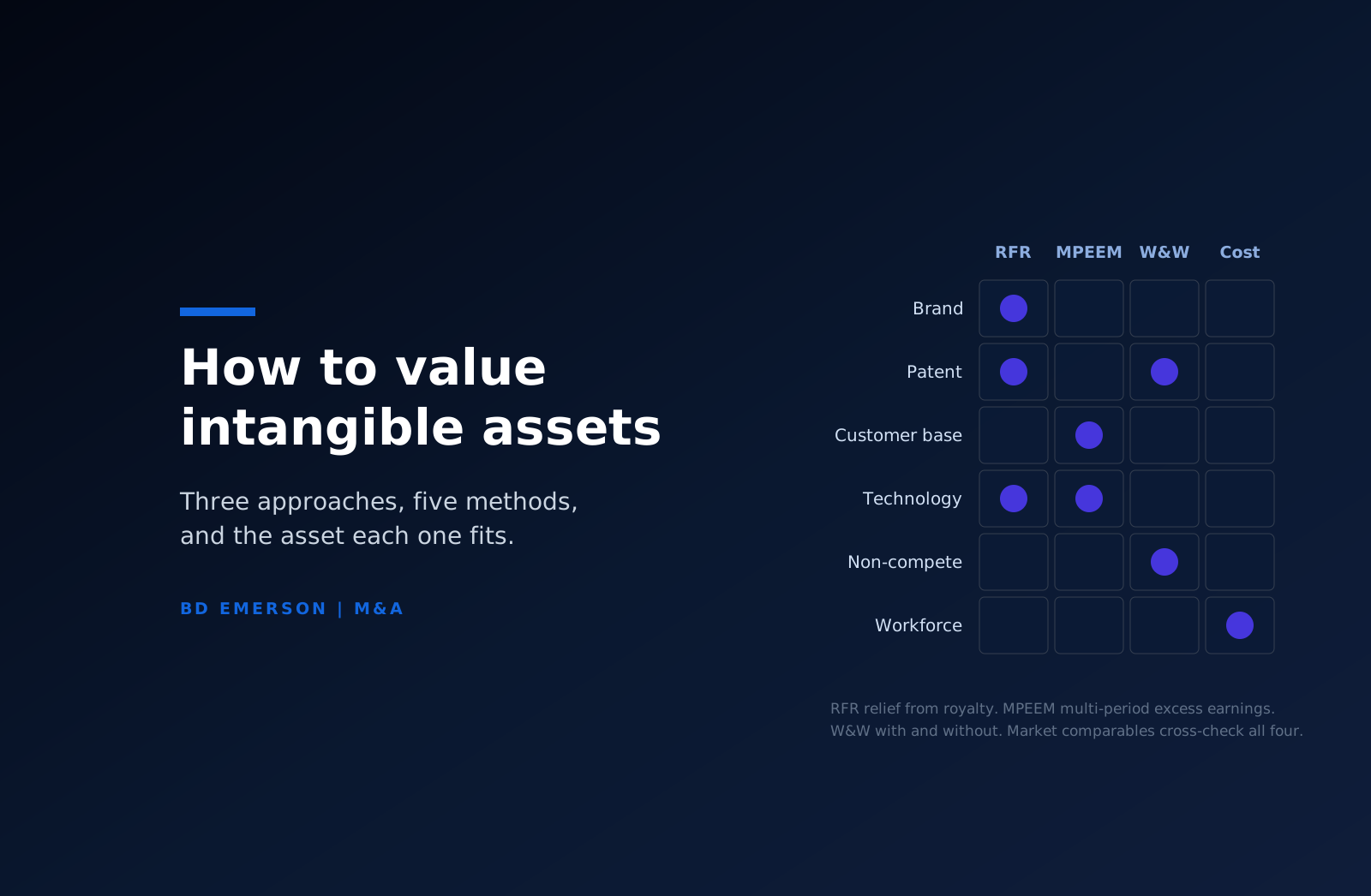
Intangible assets are valued using three approaches: market, income, and cost. In practice, the income approach does most of the work, through three methods that each fit a different kind of asset. Relief from royalty values brands, patents, and technology by asking what the company would pay to license the asset if it did not own it. Multi-period excess earnings values the asset that drives the business, usually customer relationships or core technology, by isolating the cash flow left after every other asset has been paid for its contribution. With-and-without values assets whose absence would change the forecast, such as non-compete agreements. The cost approach covers assets with no direct income stream, like an assembled workforce or internally built software. The market approach applies where comparable transactions exist. A defensible valuation names the method, states the assumptions, and shows how the number moves when they change.
When a valuation is triggered
Companies value intangible assets for one of two reasons: because they have to, or because a decision depends on it. The mandatory triggers are financial reporting after an acquisition, impairment testing, tax structuring, and litigation. The decision triggers are the ones this article is mainly about, and they are more common than most executives realize: pricing a deal on either side, raising capital, setting a licensing or royalty rate, securing debt against the assets, approving an R&D or AI program, and reporting to a board that wants to understand what the company owns.
The purpose shapes the work. A valuation for a purchase price allocation follows fair value standards and will be reviewed by auditors. A valuation to support a sale price or a capital raise needs to be credible to a counterparty and its advisers. A valuation to inform a capital allocation decision needs to be directionally right and fast. The methods are the same across all three. The depth of evidence and documentation is not.
The market approach
The market approach values an asset by reference to prices paid for comparable assets in arm's-length transactions. For intangibles, that evidence is thinner than for businesses or real estate, because intangible assets are rarely sold on their own and the terms are rarely disclosed. Where it exists, it is powerful. Patent portfolio sales, domain name transactions, brand acquisitions, and licensing deals in the same sector all provide reference points, and royalty rate databases compile disclosed license terms by industry and asset type.
The market approach is most often used as a cross-check on an income approach rather than as the primary method. When a relief from royalty calculation produces a value, a handful of comparable transactions that support the royalty rate and the implied multiple make the result far harder to challenge.
Relief from royalty
The relief from royalty method rests on a simple idea. If a company did not own its brand, its patent, or its technology, it would have to license it from someone who did, and it would pay a royalty for the privilege. Owning the asset relieves the company of that payment. The value of the asset is the present value of the royalties avoided over the asset's remaining useful life, after tax.
The calculation runs in four steps. Forecast the revenue the asset supports over its economic life. Select a royalty rate, expressed as a percentage of that revenue, supported by comparable license agreements for similar assets in similar industries. Apply the rate to the revenue forecast to get the pre-tax royalty savings each year, and tax-effect them. Discount the after-tax savings to present value at a rate that reflects the risk of the asset, which is usually higher than the company's overall cost of capital because a single asset is riskier than a diversified business.
The royalty rate is where valuations are won or lost. A rate pulled from a database without regard to the comparability of the licenses behind it is the most common weakness I see in work that comes across my desk for review. The rate should be supported by named comparables, adjusted for differences in exclusivity, territory, and term, and cross-checked against the profit the asset generates, because no licensee pays a royalty that consumes more than a reasonable share of the operating margin.
Multi-period excess earnings
Most businesses have one intangible asset that drives them, and the multi-period excess earnings method exists to value it. The method starts from the cash flow the business generates, then charges that cash flow for the contribution of every other asset the business uses: working capital, fixed assets, the assembled workforce, the brand, the technology, and anything else that is not the asset being valued. Those charges are called contributory asset charges, and they represent a fair return on and, where appropriate, return of each supporting asset. What remains after all of them is the excess earnings attributable to the primary asset, and its present value is the asset's value.
Customer relationships are the classic application. The forecast starts with revenue from the existing customer base, which declines over time as customers leave, so an attrition analysis based on the company's own history sets the decay curve. Margins are applied, contributory asset charges are deducted, the result is tax-effected and discounted, and a tax amortization benefit is added where the buyer would be able to amortize the asset for tax purposes. The output is the value of the relationships as they stand today, excluding customers not yet won.
The method demands discipline, because every input is a judgment. Attrition rates drawn from two years of data behave differently from rates drawn from ten. Contributory asset charges that are too low inflate the primary asset. A forecast that includes growth from new customers has valued something other than the existing relationships. Done properly, the method produces a number that reconciles to the value of the whole business, which is the check that matters most.
With and without
The with-and-without method, sometimes called the differential cash flow method, values an asset by comparing two forecasts: the business with the asset and the business without it. The difference in present value is the asset's value. It fits assets whose contribution is protective rather than productive. A non-compete agreement does not generate revenue, but its absence would cost revenue as the departing founder took customers with them. A regulatory approval does not sell product, but without it the product could not be sold in that market for the years it would take to obtain a new one.
The method makes its assumptions visible in a way the others do not, because the "without" scenario has to be written down and defended. How much revenue would the founder take, how fast, and for how long? How many years would a replacement approval require, and what would be lost in the interval? Those questions are usually answerable with management input and market evidence, and the answers are the valuation.
The cost approach
The cost approach values an asset at what it would cost to recreate it today, adjusted for obsolescence. It applies where an asset supports the business but does not generate a separable income stream. An assembled and trained workforce is the standard example: it has value because a buyer would otherwise have to recruit and train one, and the cost to do so can be estimated from hiring costs, training time, and lost productivity. Internally developed software that runs the business but is not sold is another. So are databases whose value lies in the effort to compile them rather than in a direct revenue line.
The cost approach sets a floor rather than a ceiling. An asset that would cost five million dollars to rebuild may be worth far more if it produces income, and the cost approach will not capture that. It is also the method most likely to be misused, because replacement cost is easy to estimate and easy to mistake for value. An asset that costs a great deal to recreate and generates nothing is not valuable.
What makes the number defensible
A valuation survives scrutiny when a reader who disagrees with the conclusion can see exactly which assumption they disagree with. That means the method is stated and the reason for choosing it is given. Every royalty rate, attrition rate, discount rate, and useful life is tied to evidence: comparable licenses, the company's own customer data, market rates for the asset's risk class, and the legal and economic factors that limit the asset's life. Contributory asset charges are itemized. The tax amortization benefit is shown separately so the reader can see its size. And sensitivities are presented, so the reader knows what the value becomes if the royalty rate moves a point or attrition moves two.
The reconciliation check closes the loop. The sum of the values of all identified intangible assets, plus tangible assets and working capital, should reconcile to the value of the business as a whole, with goodwill as a plausible residual. When the parts add up to more than the whole, one of the methods has double counted, and the most common culprit is a brand and a customer relationship asset that were both credited with the same revenue.
An illustrative example
Take a software company with $40 million of annual revenue, of which $30 million comes from existing customers under recurring contracts. The numbers below are rounded and illustrative. Its brand is valued by relief from royalty: a 2 percent royalty on total revenue, supported by three comparable software licensing agreements, gives $800,000 a year pre-tax, about $600,000 after tax, and at a 14 percent discount rate over a ten-year life the brand is worth roughly $3 million. Its customer relationships are valued by multi-period excess earnings: the $30 million of existing revenue attrits at 12 percent a year, carries a 30 percent margin, is charged for the contribution of working capital, fixed assets, workforce, technology, and the brand just valued, and the excess earnings discounted at 15 percent with a tax amortization benefit come to roughly $18 million. Its platform is valued by relief from royalty at a technology royalty rate, and its assembled workforce by replacement cost. The four values are summed, compared to the enterprise value, and the residual is checked for reasonableness.
Every figure in that example could be challenged, and that is the point. A challenger can name the assumption they dispute, and the valuer can show the evidence behind it. That exchange is what a defensible number looks like. What a company cannot defend is a value with no method behind it, or a balance sheet that shows nothing at all because everything was built rather than bought, which is the situation I described in an earlier article on intangible assets and the balance sheet.
The methods above apply to every one of the twelve categories of intangible asset, with the fit varying by asset. If you need a value that will hold up in a negotiation, a data room, or a board pack, BD Emerson's intangible asset valuation service selects the method by asset and purpose and shows the assumptions and sensitivities that matter to the conclusion.

About the author