Strategic Due Diligence: Testing the Deal Thesis Before You Pay for It
Strategic due diligence tests the acquisition thesis itself: whether the market and the target's position are what the buyer believes, whether the combination creates the value the price assumes, and whether the buyer can actually capture it. Commercial diligence asks whether the target's business is as good as it looks. Strategic diligence asks whether buying it is a good idea for this acquirer, at this price, with this plan. The distinction matters because most failed acquisitions had targets that performed roughly as diligenced; what failed was the thesis, the synergy case, or the integration, none of which a standard workstream tests. Strategic diligence runs early, often before a letter of intent, and its output is a decision: proceed at the modeled price, proceed with the thesis changed, or walk.
Strategic versus commercial diligence
The two overlap on market and competitive analysis and diverge on the question being answered. Commercial diligence is target-centric: market size and growth, customer quality, competitive position, and whether the standalone revenue plan holds, work covered in our commercial due diligence checklist. Strategic diligence is buyer-centric: it starts from the acquirer's strategy and asks how the target advances it, what the combined entity looks like, where the synergies are and who will deliver them, and what the deal forecloses. A target can pass commercial diligence cleanly and fail strategic diligence because the buyer's sales force cannot sell its product, because the cost synergies require a plant closure the buyer will never execute, or because the market position that made the target attractive evaporates when a competitor responds to the combination. Private equity buyers without an operating platform lean on commercial diligence; strategic acquirers and platform companies need both.
What strategic diligence examines
The workstream tests five things. The thesis: written down as a falsifiable statement, the deal creates value because of a specific mechanism, and the evidence that mechanism exists. Market and position: the same market work as commercial diligence, but framed against the buyer's own position, asking whether the combined share and offering change the competitive dynamic or merely add revenue. Fit: whether the target's customers, channels, product, and operating model can actually be combined with the buyer's, tested against the concrete integration decisions rather than the deck's adjacency map. Synergies: each revenue and cost synergy quantified, assigned to an owner, timed, and net of the cost to achieve it, with the ones that depend on customer behavior tested in customer interviews rather than assumed. And downside: what the buyer loses if the thesis fails, including the distraction cost to the core business, the capital tied up, and the strategic options the deal closes off. The last one is the least performed and the most valuable, because an acquirer that has priced its own downside negotiates differently.
How the work runs
Strategic diligence is a hypothesis-driven engagement measured in weeks. It starts by making the thesis explicit and breaking it into the claims that have to be true: the market is growing at the assumed rate, customers want the combined offering, the cost base can be integrated, the target's key people will stay. Each claim gets an evidence plan. Market claims are tested with data and expert interviews. Customer claims are tested with interviews of the target's customers and, distinctively, of the buyer's own customers, who are the ones expected to buy the cross-sell. Integration claims are tested by walking the combination with the functional leaders who will own it, which is where the plant that cannot close and the systems that cannot merge get found. Synergy claims are rebuilt bottom-up from the evidence and compared to the number in the model, and the gap is usually large. The output is a thesis scorecard, a synergy case the buyer's own operators have signed, and a set of conditions that belong in the price, the structure, or the integration plan.
Synergies: the number that decides the deal
Acquirers overpay because they capitalize synergies they will not capture, and strategic diligence exists in large part to discipline that number. Cost synergies are the more reliable kind and still routinely arrive late and smaller than modeled, because procurement savings require contracts to expire, headcount savings require decisions leaders defer, and system consolidations run years. Revenue synergies are the less reliable kind, because they depend on customers behaving as the model hopes, and the empirical record is that a large share never materialize. The discipline is mechanical: no synergy enters the price without an owner who will carry it as a target, a timeline, a cost to achieve, and evidence beyond the assertion. Deals that clear the return hurdle only with revenue synergies included are deals where the thesis has not been proven, and the honest response is either a lower price or a structure, such as an earnout, that pays for the synergy when it appears.
Where strategic diligence changes the deal
The findings map to specific deal mechanics. A thesis that survives with a smaller synergy case lowers the walk-away price. A fit problem, such as a channel conflict or a product overlap that cannibalizes the buyer's own line, changes the integration plan and sometimes the perimeter of what is bought. A key-person dependence that the thesis relies on becomes retention and rollover structure. A downside case the buyer cannot absorb becomes a smaller deal, a joint venture, or a pass. And a thesis that fails entirely, which happens more often than boards expect, saves the acquirer the years of value destruction documented in our article on why mergers and acquisitions fail. Because the work runs early and cheap relative to full diligence, it is the highest-return workstream in a deal for the acquirers who actually let it change their minds.
A worked example
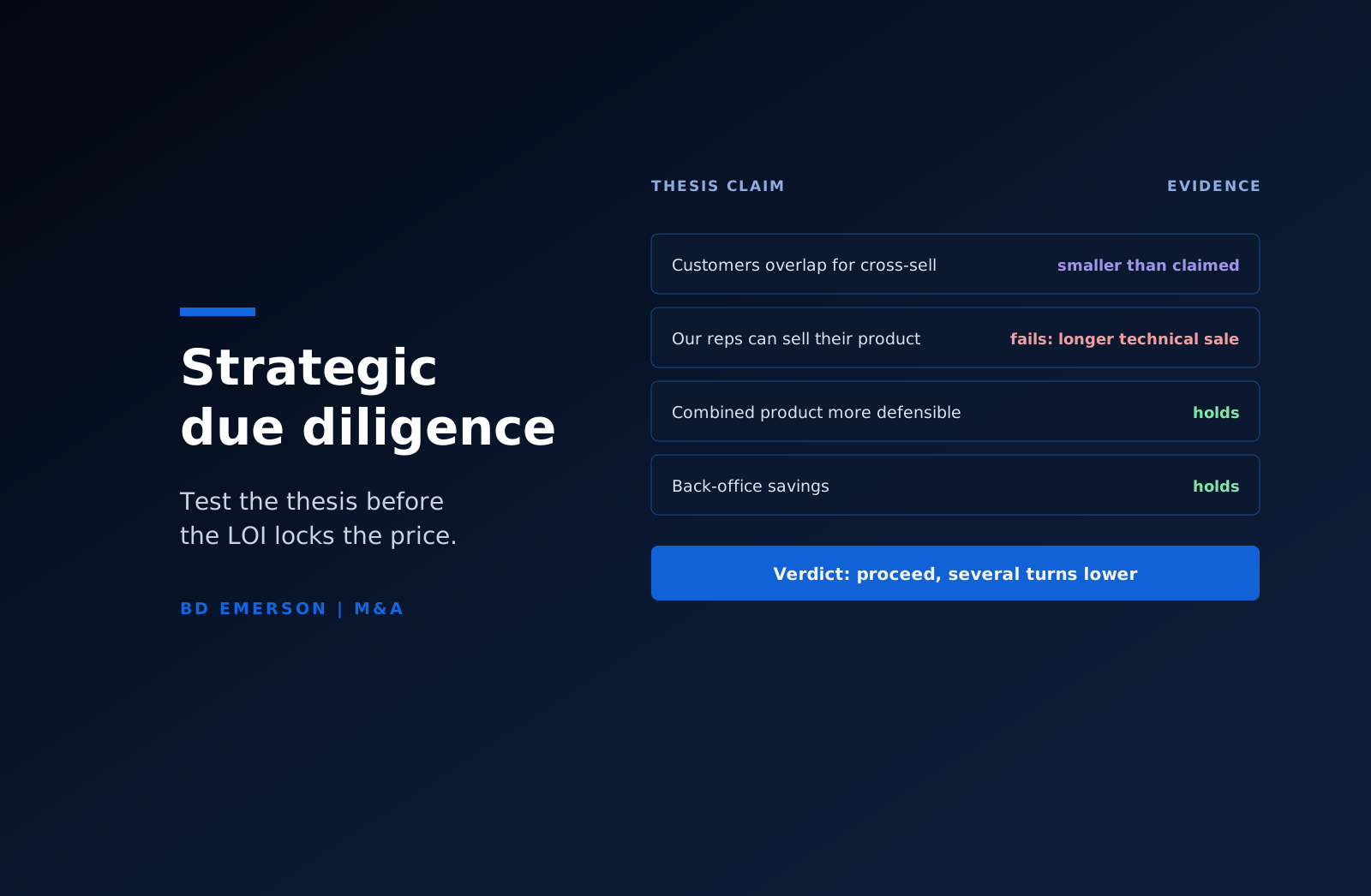
A mid-market software company selling compliance workflow tools to financial institutions considers acquiring a smaller company that sells vendor risk software to the same buyers. The thesis has four claims: the two customer bases overlap enough for cross-sell, the buyer's sales force can sell the target's product, the combined product is more defensible against a large platform competitor, and back-office consolidation saves a stated amount. Strategic diligence tests each. Customer overlap analysis finds the bases overlap by about a quarter rather than the half the deck implied, and interviews with the buyer's own customers find real interest in a combined offering but at a bundled price below the two standalone prices. Sales force review finds the target's product requires a longer, more technical sale than the buyer's reps run, and that the target's three top sellers carry most of its bookings. Competitive analysis supports the defensibility claim. Back-office savings hold at roughly the modeled level. The verdict: the thesis survives at a lower revenue synergy, with a retention structure for the target's sales team and a walk-away price several turns below the initial model. The buyer proceeds, wins at that price because the auction was thin, and enters integration with a plan its own operators wrote. The alternative version, in which the buyer skipped the work, would have paid for a synergy that arrived at half the size two years late.
When to run it
Strategic diligence runs before the letter of intent whenever possible, because the price locks at the LOI and the room to reflect the findings disappears with exclusivity. A two-to-four-week engagement between first management meeting and bid is typical. For programmatic acquirers, the thesis work happens continuously as part of pipeline development, and the deal-specific diligence becomes a confirmation of a case already built.
From diligence to integration
The strategic diligence output is also the integration plan's foundation. The synergy case with owners becomes the first hundred days' targets, the fit analysis becomes the sequence of integration decisions, and the retention findings become the day-one people plan, a continuity covered in our guide to the post-merger integration 100-day plan. Acquirers who keep the diligence team and the integration team separate lose exactly this continuity, and the synergy targets get rebuilt from scratch by people who never saw the evidence.
Running it
BD Emerson performs strategic diligence for acquirers and platform companies inside our M&A due diligence practice, structured around the thesis rather than around a template, with the market and customer work run by our own team and the integration and systems claims tested by practitioners who run those integrations. The deliverable is a thesis verdict and a synergy case the buyer's operators have signed, before the letter of intent locks the price.

About the author