Series A to Series B, and B to C: What Investors Test at Each Stage
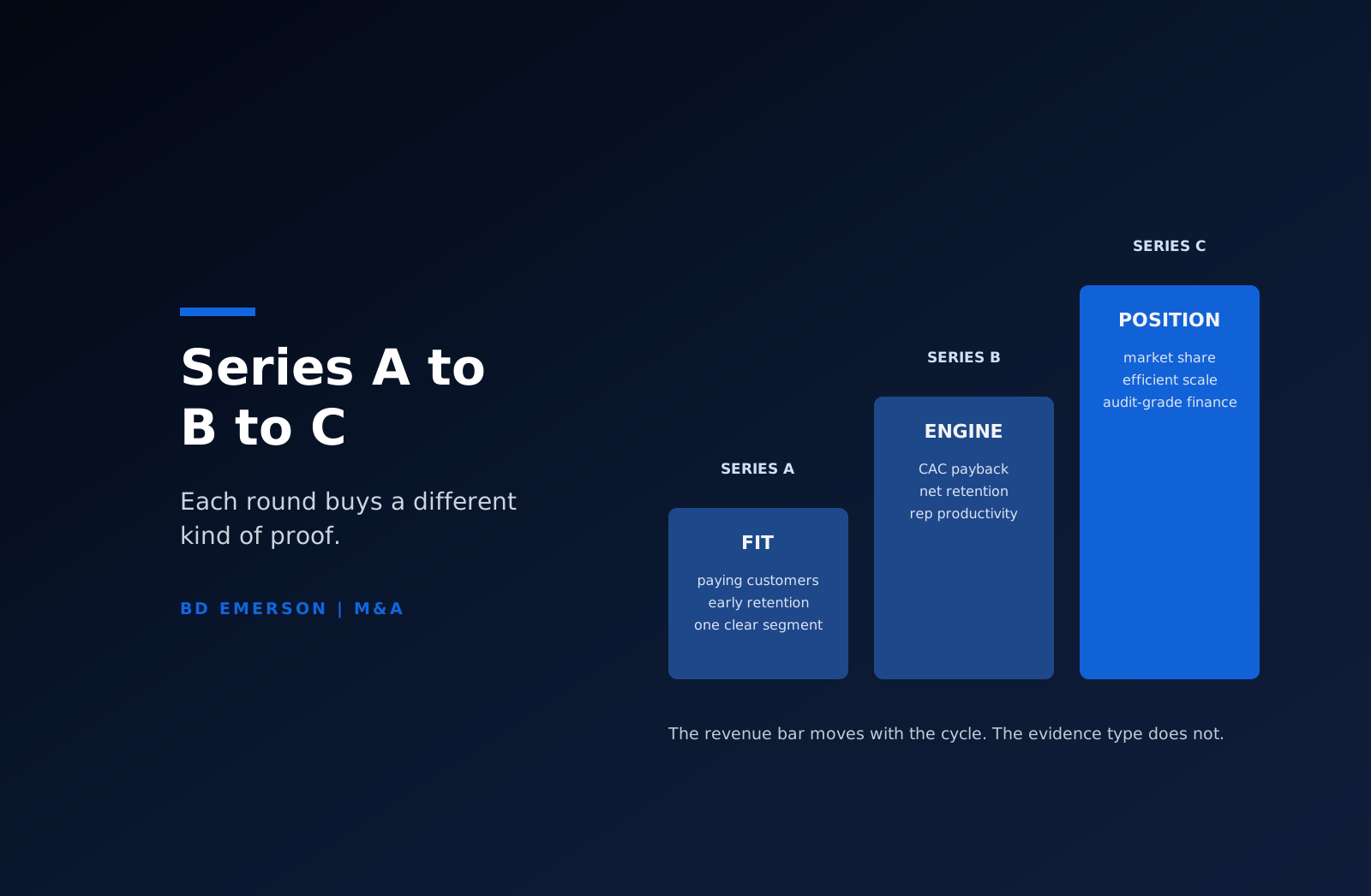
Each funding round buys a different kind of proof. A Series A buys evidence that customers want the product and will pay for it repeatedly. A Series B buys evidence that the company has found a repeatable, efficient way to acquire and keep those customers, and that the market is big enough to keep doing it. A Series C and later rounds buy evidence of a market position: durable share, expanding economics, operational maturity, and a credible path to either an exit or independence from outside capital. The revenue thresholds attached to each stage move with the cycle and the sector, and founders who chase last year's numbers miss the point. The evidence type is what stays constant, and it is what investors actually test. This article walks what changes from A to B to C, the metrics and market proof each stage requires, and how to prepare it before the process starts.
Series A: proof of fit
At the Series A, the question is whether the product solves a problem customers will pay to solve, more than once. Investors look for a coherent initial customer segment, paying customers who renew or expand, early retention data that shows the product is sticky rather than trialed, and a founding team that has learned something specific about why customers buy. The market evidence at this stage is a bottom-up model of the initial segment with real numbers behind it: how many of these customers exist, what they pay, and the early evidence of how many the company can reach. Grand total addressable market figures are read skeptically here, because every deck has one; a precise serviceable market with a plan to win the first slice reads as judgment. The diligence is light on financial history, since there is little, and heavy on the cap table, the IP assignments, the customer references, and the team. The most common failure is a company that has revenue without a pattern: customers from five segments who bought for five different reasons, which is a set of pilots rather than a business.
Series B: proof of a repeatable engine
The Series B question is whether the company has built a machine that turns capital into customers at a predictable cost and keeps them. The evidence shifts to unit economics and efficiency: customer acquisition cost and its payback period, gross margin at scale, net revenue retention showing that existing customers grow, sales productivity per rep and the ramp time for new ones, and pipeline conversion by stage. Investors want to see that the second and third cohorts of customers behaved like the first, that the company can hire salespeople and have them hit quota, and that growth came from the engine rather than from the founders' personal networks. The market proof deepens accordingly: the initial segment's size and penetration, evidence of the adjacent segments the B capital will fund, and win-loss data against named competitors. Diligence gets heavier. Expect a rebuild of retention cohorts from raw billing data, customer calls run by the investor, a review of metric definitions against the ledger, and the first real look at the security and compliance posture, since enterprise customers by now are asking for it. Companies that treated SOC 2 as a later problem find it becomes a Series B problem when the investor's diligence and the sales pipeline both stall on the same questionnaire, a dynamic covered in our guide to SOC 2 for startups.
Series C and beyond: proof of position
By the Series C, investors are underwriting a market position and the operating maturity to hold it. The evidence is scale with efficiency intact: growth that has not required deteriorating unit economics, gross and net retention that hold as the customer base broadens, expansion into the segments the B promised, and a path to profitability that management can describe in operating terms rather than as a slope on a chart. Market proof becomes share: what portion of the serviceable market the company holds, how that compares to competitors, and what the next adjacency or geography is worth. Diligence begins to look like a transaction. Growth-stage and crossover investors commission quality of earnings work, review audited or auditable financials, examine the finance function's ability to close and forecast, and probe governance, board composition, and the compliance program. The company is being evaluated as a future public company or acquisition target, and the gap between how it currently operates and how it would need to operate becomes a diligence finding and sometimes a price adjustment. The mechanics of that later bar are covered in our guide to IPO readiness.
The metrics that move between stages
The same metrics get read differently at each stage. Retention is a signal of fit at the A, a proof of engine quality at the B, and a determinant of terminal value at the C. Customer acquisition cost is nearly irrelevant at the A, decisive at the B, and expected to improve at the C. Gross margin matters at every stage but is forgiven early and not later. Concentration is tolerated at the A, questioned at the B, and priced at the C. The definitional discipline matters more each round: a metric defined loosely at the A becomes a diligence finding at the B when the investor's rebuild disagrees with the deck, and a credibility problem at the C when the company has been reporting it to a board for three years. Writing down metric definitions once, applying them without exception, and footnoting changes is the cheapest preparation a company can do, and the one most often skipped.
What investors are actually testing at each stage
Beneath the metrics, each round tests a judgment. The A tests whether the founders understand their customer better than anyone else. The B tests whether they can build an organization that executes without them in every deal. The C tests whether they can run a company that institutions will trust with large amounts of capital, which means finance, governance, security, and compliance functions that produce evidence rather than assurances. The market research expected at each stage follows the same arc: a precise initial segment at the A, a defensible serviceable market with segment-level evidence at the B, and a share position with quantified adjacencies at the C. Companies that build the market model bottom-up once, with sources, and update it each year arrive at every round with the argument already made.
Preparing before the process
The preparation for each round is the diligence for the next one, started early. Before the A: clean the cap table, paper every IP assignment, define the initial segment, and instrument retention from the first customers. Before the B: close the books monthly on a consistent basis, define metrics and reconcile them to the ledger, build the cohort analysis investors will rebuild anyway, start the security program enterprise customers will require, and document the sales process so productivity claims are evidence rather than anecdote. Before the C: consider a sell-side quality of earnings review to find the revenue recognition and adjustment questions first, described in our guide to quality of earnings reports, strengthen the finance function to forecast accuracy institutional investors expect, put governance and compliance in a form that survives a data room, and rebuild the market model with share data. In each case the work is cheaper before the process than during it, and the company that arrives with the evidence organized negotiates from a stronger position than the one that assembles it under a term sheet clock.
Where BD Emerson fits
BD Emerson prepares growth-stage companies for institutional diligence through our investor relations consulting practice: the market model with sources, metric definitions reconciled to the ledger, the security and compliance evidence enterprise customers and investors both ask for, and the data room assembled before outreach. The preparation is the same discipline we apply in M&A, where the party with organized evidence keeps more of the terms it negotiated.

About the author