IPO Readiness: The Assessment and the Checklist
IPO readiness is the work that turns a private company into one that can operate as a public company on the day it lists: close its books and report on the SEC's calendar, certify its controls, govern itself through an independent board, disclose material events within days, and answer to investors every quarter. The work takes 12 to 24 months when done deliberately, and the companies that compress it into the six months before filing pay for it in restatements, material weaknesses, and a first year of public life spent remediating. An IPO readiness assessment is the diagnostic at the start: a gap analysis across financial reporting, internal control, governance, technology and security, and organizational capacity, against the standard the company will be held to. This article covers what the assessment tests, the workstreams it produces, the timeline, and the checklist.
What the readiness assessment tests
The assessment asks one question across five areas: could this company meet public company requirements today, and if not, what is the gap and how long does it take to close? Financial reporting: are there two or three years of audited financials from a PCAOB-registered firm, can the company close quarterly within the 10-Q deadline, and are complex areas such as revenue recognition, equity compensation, and segment reporting resolved? Internal control: does a documented control environment exist that could support Section 302 certifications at listing and a Section 404 assessment a year later? Governance: is there a board with the independence, committees, and charters the exchanges require, and the policies a public company needs? Technology and security: are the systems that produce financial data controlled, and does the security program meet the disclosure and governance expectations that now attach to public companies? Organization: does the finance, legal, and investor relations team have the capacity and public company experience to run the cadence, or is the CFO about to become the bottleneck for everything? The output is a gap register with owners, timelines, and costs, sequenced against the target filing date.
Financial reporting: the longest pole
Audited financials are the gating item, and their lead time is the reason readiness starts two years out. A first-time PCAOB audit of prior periods routinely surfaces accounting conclusions that have to be revisited, most often revenue recognition under ASC 606, equity instruments and the valuation of common stock granted before the IPO, capitalized software, and lease accounting. Each revisit can move historical results and each takes time. Beyond the audit, the company has to build a close process that produces reviewed quarterly financials inside 40 to 45 days, with the disclosure controls to support them, and it has to prepare the S-1 disclosures: management's discussion and analysis, risk factors, executive compensation, and segment and key metric reporting that it will then have to reproduce every quarter. Companies discover here that metrics they have reported to investors privately do not have definitions they can defend publicly, and that the finance team that ran a monthly close for a board cannot yet run a quarterly close for the SEC.
Internal control and SOX
At listing, the CEO and CFO begin certifying each periodic report under Section 302, which requires disclosure controls and procedures and an evaluated control environment from day one. The Section 404(a) management assessment of internal control over financial reporting arrives with the second annual report, and the 404(b) auditor attestation applies once the company is an accelerated filer and no longer an emerging growth company. The readiness implication is that control documentation, key control identification, and IT general controls should be designed and operating before the IPO, so that the first assessment year is spent testing rather than building. The program structure is covered in our guides to SOX compliance and SOX 404, and the IT layer, which is where pre-IPO companies most often carry material weaknesses in user access and change management, is covered in our guide to IT general controls. Companies with a current SOC 2 report hold much of the ITGC evidence already and mainly need to scope it to financial systems.
Governance: board, committees, and policies
Exchange listing standards require a board with a majority of independent directors and independent audit, compensation, and nominating committees, with phase-in periods after listing but with the audit committee required to have at least one independent member at listing and full independence within a year. The audit committee needs a financial expert and a charter, a whistleblower channel, and oversight of the auditor relationship. The company needs a code of ethics, insider trading and Regulation FD policies with a trading window and pre-clearance process, related party transaction procedures, and a disclosure committee that decides what is material and when. Cybersecurity has joined this list: public companies must disclose material cybersecurity incidents on Form 8-K within four business days of determining materiality, and describe their cybersecurity risk management, strategy, and governance annually, which requires a materiality determination process, board-level oversight, and an incident response capability that produces the information the disclosure needs on a four-day clock. Boards that have never had to decide materiality of a breach in real time need to rehearse it before they are public.
Technology, security, and the systems behind the numbers
Readiness assessments consistently find that the systems producing financial data were built for a private company's tolerance for manual work. The general ledger runs on a mid-market platform stretched past its limits, revenue is calculated in spreadsheets, equity is tracked in a tool no one reconciles, and access to all of it is broad because the company grew faster than its controls. The readiness workstream decides which systems to replace before the IPO, which to control tightly and replace later, and how to close the ITGC gaps in either case, because an ERP implementation in the year of the first 404 assessment is the classic way to manufacture a material weakness. On the security side, the program has to be able to support the disclosure regime: asset inventory, logging, incident detection and classification, and a documented governance structure that a risk factor and an annual disclosure can describe truthfully.
The timeline
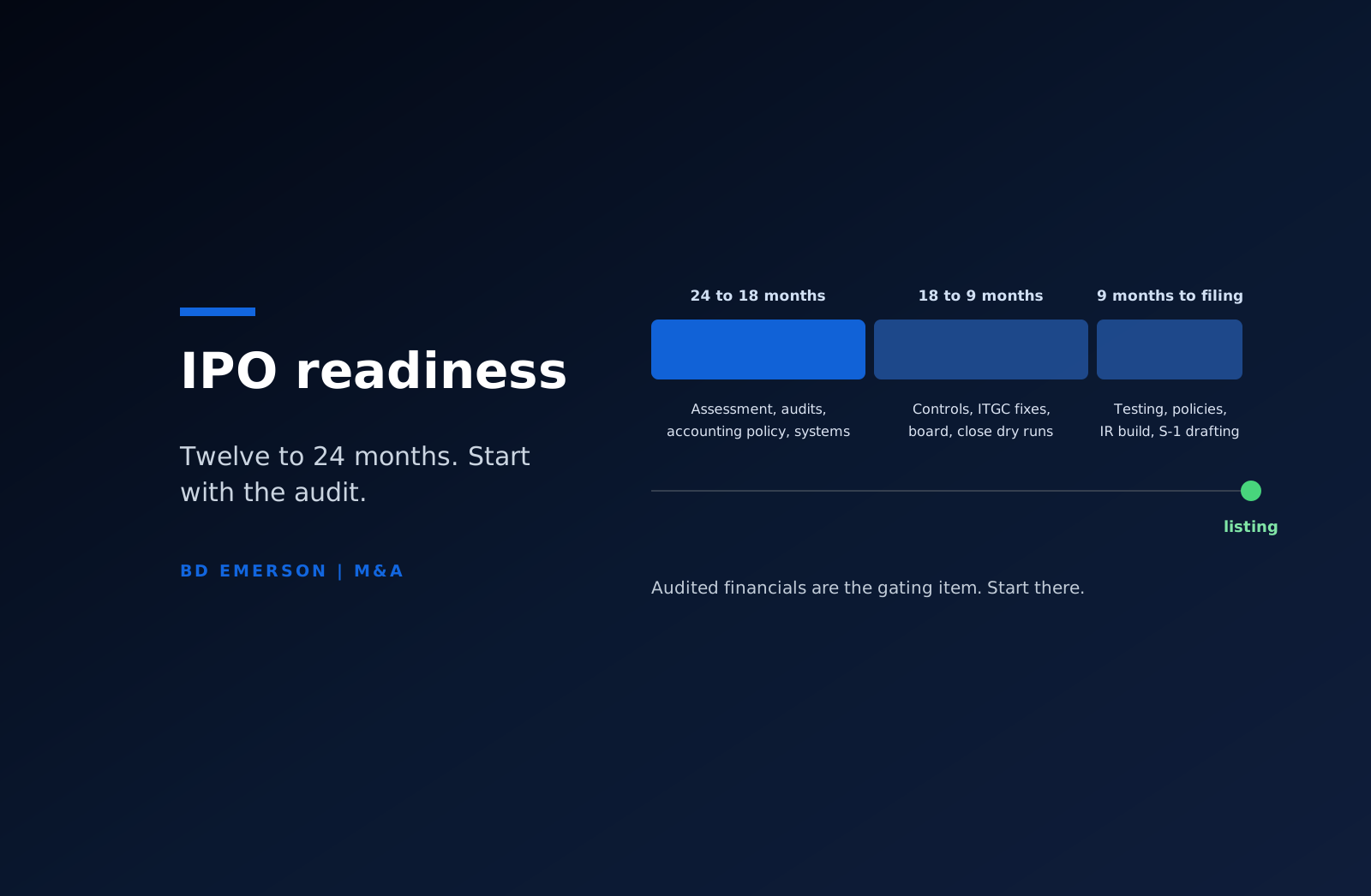
A deliberate readiness program runs in three phases. Twenty-four to eighteen months before filing: the assessment, audit firm selection and the historical audits, accounting policy decisions, and the decision on systems. Eighteen to nine months: control design and documentation, ITGC remediation, quarterly close practice runs against the public deadlines, board composition and committee formation, and drafting of the disclosure framework and key metric definitions. Nine months to filing: dry-run quarters with full disclosure controls, testing of key controls, policy adoption, investor relations build-out, and S-1 drafting with counsel and bankers. Companies that start in the last phase can still list, and they arrive public with a control environment that has never been tested and a finance team that has never closed on the clock.
The IPO readiness checklist
The checklist a readiness program works against covers: audited financial statements for the required periods from a PCAOB-registered auditor, with complex accounting areas concluded; a quarterly close that meets the 10-Q deadline with reviewed financials and disclosure controls, demonstrated in at least two dry runs; documented key controls over financial reporting with owners, and ITGCs designed and operating for in-scope systems; defined and defensible key business metrics with a reporting process; a board meeting independence and committee requirements on the exchange's phase-in schedule, with charters, a financial expert, and a whistleblower channel; adopted public company policies, including insider trading, Regulation FD, code of ethics, related party transactions, and clawback; a cybersecurity governance and incident disclosure process that can meet the four-business-day determination clock; an equity compensation plan and administration ready for public company accounting and reporting; a finance, legal, and investor relations organization staffed for the cadence; and an S-1 disclosure framework, including risk factors and MD&A, that the company can maintain quarter after quarter.
Where BD Emerson fits
BD Emerson runs the internal control, ITGC, and security readiness workstreams of IPO preparation through our SOX compliance consulting practice: the readiness assessment, control design and documentation, ITGC remediation and testing, and the cybersecurity governance and disclosure process, coordinated with the company's auditors and counsel. We build the control environment and its evidence; the independent audit opinions come from the company's PCAOB-registered auditor. The companies that do this work early list with controls that already operate and spend their first public year growing rather than remediating.

About the author