Market Opportunity Analysis: Researching the Total Opportunity Before Each Raise
A market opportunity analysis answers whether a market is worth entering or expanding in, and on what terms: how large it is, how fast and why it is growing, who competes for it and how, what it costs to win a customer there, and what has to be true for a specific company to take a meaningful share. Market sizing is one input. The analysis adds growth dynamics, competitive structure, customer economics, timing, and the entry or expansion path, and it ends in a recommendation with a number attached. Companies produce one at every point where capital is committed against a market: a product launch, a geographic expansion, a funding round, an acquisition, and eventually a public offering, where the market opportunity section of the prospectus is the same analysis written for a regulator. This article covers the components, how to research each one, and how the deliverable changes as a company moves from its first raise toward the public markets.
The components of a market opportunity analysis
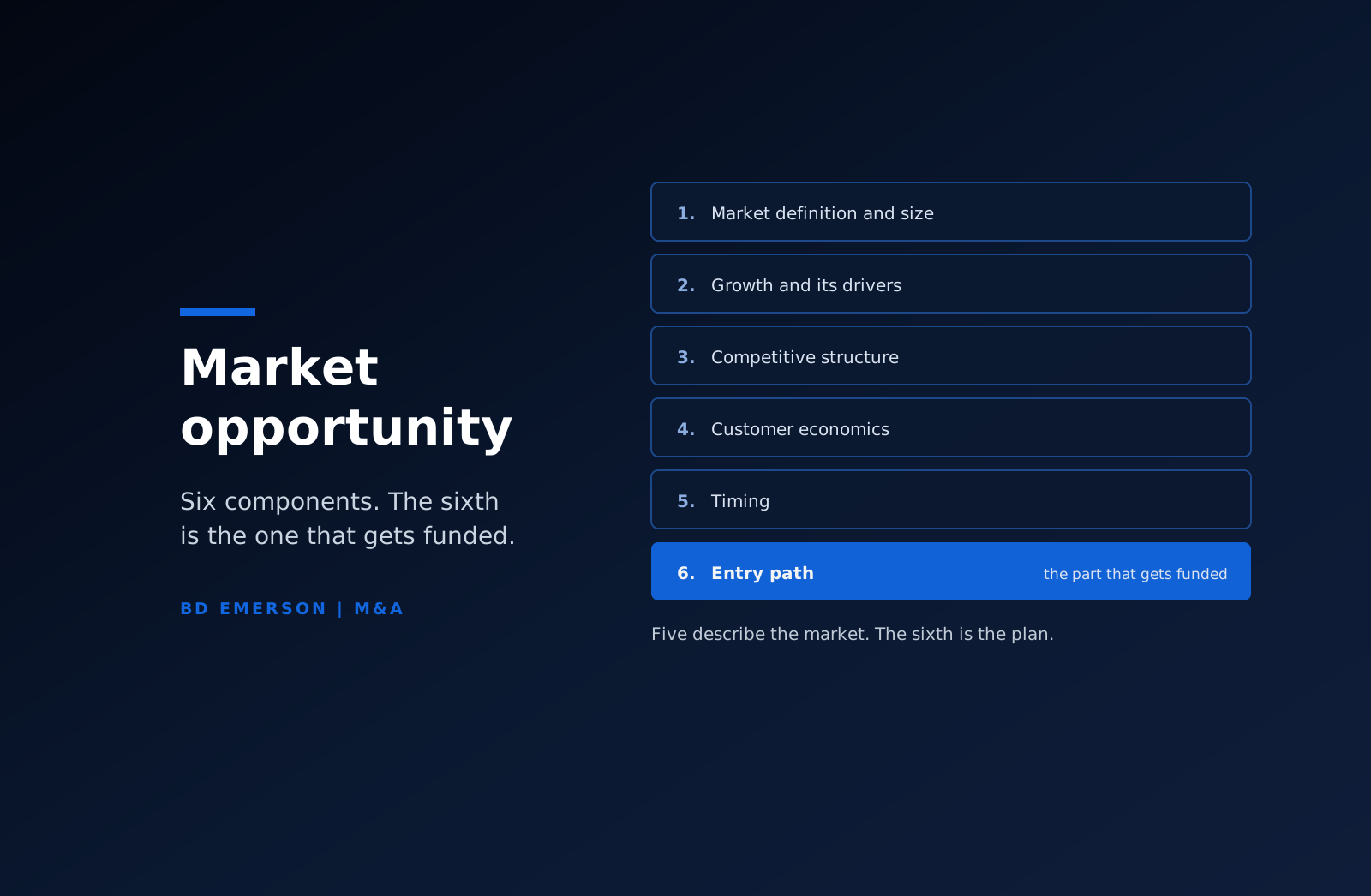
A complete analysis has six parts. Market definition and size: the boundary of the market in customer, product, geography, and time terms, sized bottom-up from customer counts and spend and cross-checked top-down, presented as a range with drivers, following the method in our guide to market sizing and layered into total, serviceable, and obtainable views as described in our guide to TAM, SAM, and SOM. Growth and its drivers: the historical growth rate from revealed data, the forces behind it, regulation, technology substitution, demographic or budget shifts, and an explicit view on whether those forces strengthen or fade over the planning horizon. Competitive structure: who holds share, how concentrated the market is, how incumbents compete, on price, distribution, product, or relationships, and where the structure leaves openings. Customer economics: what it costs to acquire a customer in this market, what they pay, how long they stay, and therefore whether a share position is worth having at all. Timing: why now, in terms of a change in the market that makes entry feasible or urgent, and what happens to the opportunity if the company waits. And the entry path: the segment to start in, the position to take against the specific alternative customers use today, and the investment and time to reach a defined share. The sixth part is where most analyses stop short, and it is the part investors and boards fund.
Researching each component
The research mixes public data, purchased data, and primary work, and the mix should favor whatever can be verified. Market size and structure come from census and industry counts, public company filings that reveal revenue and customer numbers, and the company's own pricing evidence. Growth drivers come from the same sources over time, plus regulatory calendars and technology adoption data. Competitive structure comes from filings, pricing pages, job postings that reveal where competitors are investing, and win-loss records. Customer economics come from the company's own cohort data where it exists and from interviews where it does not. Timing evidence comes from the drivers and from customers themselves. The primary research, structured interviews with twenty to forty buyers in the target market, including customers of competitors and buyers who chose to do nothing, is where the analysis earns its conclusions, because it tests the behavior the model assumes rather than inferring it. Desk research frames the questions; interviews answer them.
Where analyses go wrong
Four failures recur. Sizing the industry rather than the addressable spend, which produces a large number that no diligence reader believes. Projecting growth from enthusiasm rather than drivers, so the market grows at the plan's required rate rather than at the rate the evidence supports. Treating competitors as a list rather than a structure, missing that the real alternative for most buyers is inertia or an in-house workaround. And stopping at the market without the entry path, delivering a document that says the market is attractive without saying how this company, with its actual assets, wins a specific piece of it in a specific order. The fix for all four is the same: build from the customer up, source every number, and write the entry path as a plan someone will be measured against.
How the deliverable changes by stage
The analysis is the same discipline at every stage, and what changes is precision and audience. At a seed or Series A raise, investors want a tight initial segment, sized bottom-up, with early evidence that the company can win it, and a credible view of the adjacent segments that make the eventual business large. The entry path is the whole story. At a Series B, the analysis has to show the initial segment's penetration and the evidence, win rates and unit economics, that the engine works there, plus a sized and researched view of the next segments the capital will fund. At Series C and growth rounds, share becomes the frame: what the company holds, what the competitors hold, and what the next adjacency or geography is worth against the cost of taking it. For an acquisition, the analysis becomes commercial diligence, rebuilt by the buyer with the incentive to find the market smaller. And for a public offering, the market opportunity section of the registration statement puts the analysis in front of regulators and public investors, with every figure attributable to a source and every claim reviewed by counsel, which is a useful standard to write to from the beginning.
A worked example in brief
A company selling vendor risk management software to mid-size banks is deciding whether to expand into credit unions before a Series B. Market definition and size: roughly 4,500 US credit unions, of which the 1,200 or so above an asset threshold have compliance staff and budget for a dedicated tool, at an average contract value the company's bank pricing suggests, giving a serviceable market in the low tens of millions per year. Growth drivers: examiner scrutiny of third-party risk has been rising and the largest credit unions face the same expectations as banks, supported by regulator guidance rather than opinion. Competitive structure: two incumbents serve the segment through core-processor partnerships, and interviews with twenty credit union compliance officers find dissatisfaction with both on usability and price. Customer economics: the segment buys through associations and conferences the company already attends, so acquisition cost is comparable to banks with smaller contracts. Timing: a wave of examiner findings has created budget this cycle. Entry path: the larger institutions first, positioned against the incumbents' core-processor bundles on usability and total cost, with an association partnership as the channel. The recommendation is to enter, with a stated investment and a share target for the B pitch, and the memo names the assumption that would break it: if the incumbents respond on price, the economics thin quickly, and the company would know within two quarters from win rates.
Positioning and opportunity are one decision
A market opportunity analysis and a positioning decision are two views of the same choice. The analysis identifies the segment where the structure leaves an opening and the economics justify the effort; positioning is the commitment to that segment against a named alternative with a provable difference. Analyses that end without a positioning recommendation leave the hardest decision to the reader, and positioning decisions made without the analysis are guesses about where the money is. The connection is covered in our guide to positioning strategy, and the practical consequence is that the same team should produce both, or at least read each other's work before either is final.
From analysis to a decision
The deliverable is a memo, not a data appendix. It states the recommendation first: enter or expand, in which segment, with what investment, to reach what share by when, or do not, and why. It supports that with the six components, each with sources and a stated confidence, and it names the two or three assumptions that would change the recommendation if they proved wrong, along with how the company would know. Boards and investors read the recommendation and the assumptions; the analysts who rebuild the work read the sources. Writing for both audiences at once is the discipline, and the memo that manages it gets funded, whether the reader is a Series A partner, a corporate development committee, or an underwriter.
Where BD Emerson fits
BD Emerson builds market opportunity analyses for companies preparing to raise, expand, or transact through our transaction advisory practice, with market models built bottom-up and sourced, interview programs run by our own team, and the entry path written as a plan with owners and numbers. The same analysis, rebuilt from the other side of the table, is what we deliver as commercial diligence to buyers, which is why the version we build for a company is the version that survives when a buyer or investor tests it.

About the author