AI in Private Equity: Fund Uses, Portfolio Value Creation, and the Controls That Matter
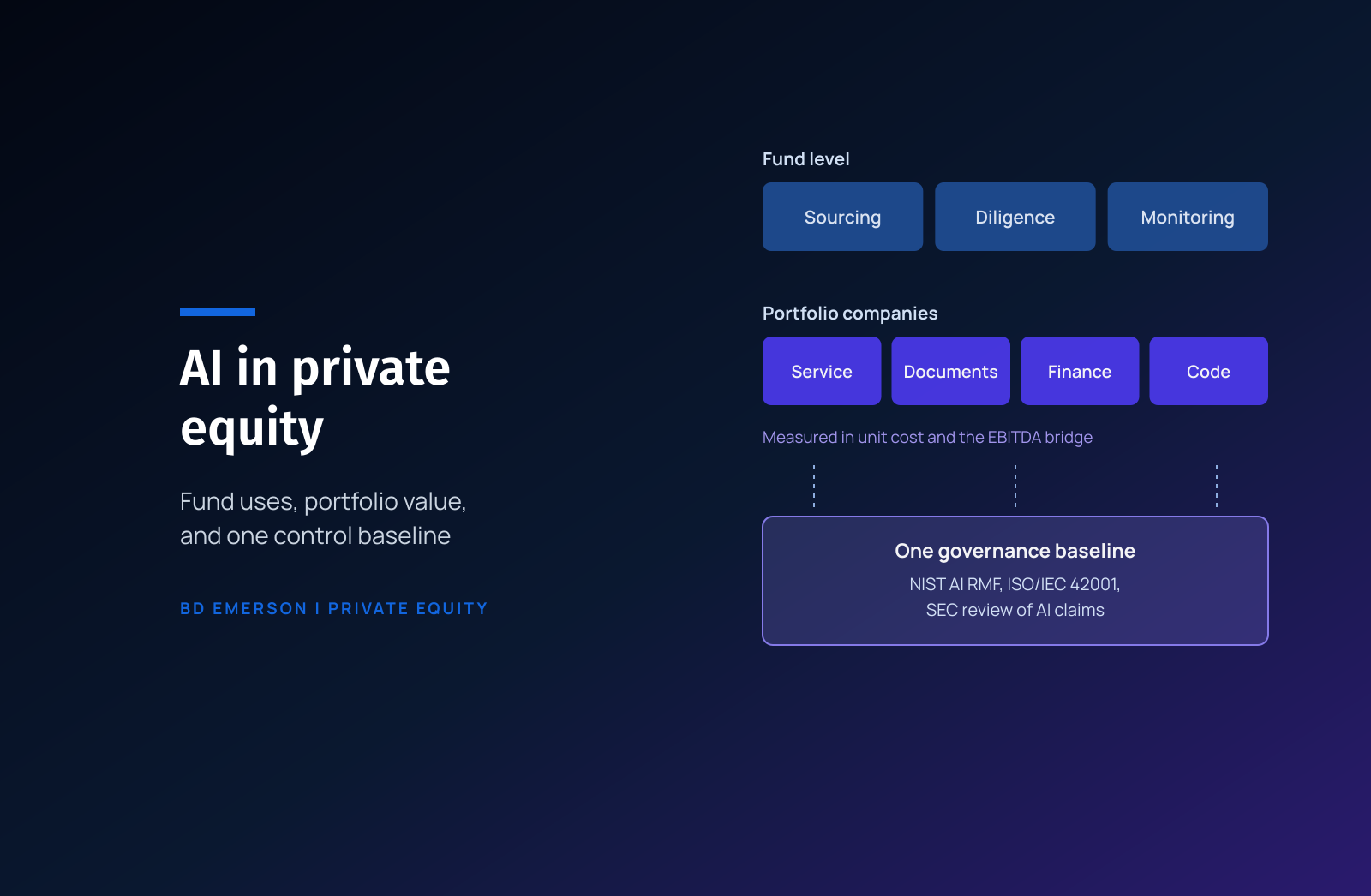
AI in private equity works at two levels. At the fund, sponsors use AI to screen and source targets, read data rooms and contracts faster during diligence, and monitor portfolio company reporting. Inside portfolio companies, AI is a value creation lever applied to high-volume work such as customer service, claims and invoice processing, collections, and software development, measured against unit cost and EBITDA. Both levels need the same governance. The SEC has fined investment advisers for overstating their AI capabilities, its fiscal year 2026 examination priorities include reviewing firms' AI representations and supervision, and frameworks such as the NIST AI Risk Management Framework and ISO/IEC 42001 give sponsors a control baseline they can apply across a portfolio.
How do private equity firms use AI at the fund level?
Fund-level AI changes how a deal team spends its hours. The work it replaces is reading, sorting, and summarizing, which is most of the early work on any deal. The judgment calls remain with the investment committee.
Sourcing and screening
Sponsors run AI models over company databases, websites, job postings, and their own CRM history to build target lists that match an investment thesis. A model can classify thousands of companies by business model, end market, and signs of growth faster than an associate can, and it can draft a first-pass profile of each one. The output is a shortlist for people to work, and its quality depends on the data the model can see. A thesis built on proprietary relationship data in the CRM gives a sponsor an edge that a public dataset does not.
Due diligence
Diligence is the most document-heavy stage of a deal, so it gives AI tools the most to read. Language models can summarize data room documents, extract terms such as change of control, assignment, exclusivity, and termination rights from hundreds of customer contracts, and flag the ones that deviate from the standard form. They can also give the quality of earnings team a first pass at classifying general ledger detail. Every extracted term that affects price or structure still needs a person to confirm it against the source document.
Diligence also now includes testing a target's own AI claims. A target that says its product uses proprietary AI should be able to show the models, the training data rights, the evaluation results, and the cost to serve. The AI due diligence work that tests those claims belongs in technology diligence on any deal where AI drives the valuation.
Confidentiality sets the limits. Data room contents arrive under a nondisclosure agreement, and the sponsor needs to know where any AI tool processes that data, whether the provider can retain or train on it, and who can access the outputs. An enterprise deployment with contractual no-training terms and access controls meets that test, and a consumer chatbot account fails it.
Portfolio monitoring and investor reporting
A sponsor with a dozen portfolio companies receives a dozen differently formatted monthly packs. AI can map them to a common chart of KPIs, flag variances against plan, and draft the first version of the quarterly commentary the deal team edits before it goes to the investment committee or to limited partners. The same tools can draft responses to investor due diligence questionnaires, which is where accuracy rules apply most directly, as covered below.
Where does AI create value inside portfolio companies?
The portfolio company opportunity reaches the income statement directly, through cost and revenue. The pattern that works starts with two or three workflows that drive the most cost per unit, such as cost per claim, per ticket, or per order, measures the baseline, and reports AI results against that baseline in the value creation plan. The portfolio company AI playbook covers that method in more depth, including how to route work between small and frontier models to control cost.
| Use case | Where it shows up | What to measure |
|---|---|---|
| Customer service triage and drafting | Contact center and support | Cost per contact and time to resolution |
| Document intake for claims, invoices, and orders | Operations and finance | Cost per document and error rate |
| Collections and cash application | Finance | Days sales outstanding and cash applied per person |
| Pricing and discount analysis | Sales and commercial | Realized price and discount leakage |
| Software development with coding agents | Product and engineering | Cycle time and defects that reach production |
Two cautions apply across the portfolio. First, a pilot that never reaches the EBITDA bridge has not created value, however impressive the demonstration. Second, AI that touches customers, employees, or money needs human checkpoints and an audit trail, because the next buyer will diligence how it was governed, and regulators in some jurisdictions treat certain uses as high risk.
Which AI rules and frameworks apply to private equity firms?
Private equity firms face AI rules on two fronts: how the adviser itself uses and describes AI, and how portfolio companies use it in regulated decisions.
SEC enforcement and examinations
On March 18, 2024, the SEC settled charges against two investment advisers, Delphia (USA) Inc. and Global Predictions Inc., for making false and misleading statements about their use of AI, with combined civil penalties of $400,000. The agency called the conduct AI washing. The lesson for a sponsor is that any AI claim in a pitch book, a due diligence questionnaire response, or a fundraising deck has to match what the firm has built.
The SEC Division of Examinations' fiscal year 2026 examination priorities say the division will review the accuracy of registrants' representations about their AI capabilities and assess whether firms have adequate policies and procedures to monitor and supervise their use of AI. In the cybersecurity section, the division adds a focus on the training and security controls firms use to identify and mitigate new risks associated with AI.
The EU AI Act
Portfolio companies with operations or customers in the European Union fall under the AI Act. According to the European Commission, the Act entered into force on August 1, 2024, and its prohibited practices and AI literacy obligations applied from February 2, 2025. The high-risk category includes AI tools for employment and worker management, such as CV-sorting software for recruitment, and certain uses that decide access to essential services, such as credit scoring. Under the AI Omnibus amendments, the Commission states that strict obligations for high-risk systems in those sensitive areas start on December 2, 2027. A portfolio company that screens job applicants or makes credit decisions with AI should inventory those systems now.
NIST AI RMF and ISO/IEC 42001
Two frameworks give sponsors a common language for AI controls. NIST released the AI Risk Management Framework on January 26, 2023, as voluntary guidance organized around four functions: Govern, Map, Measure, and Manage. ISO/IEC 42001, published in December 2023, is the international standard for AI management systems, with requirements covering leadership, AI policy and objectives, risk management, data governance and lifecycle controls, transparency, performance monitoring, and continual improvement. Certification is voluntary, independent certification bodies perform it, and ISO does not certify organizations itself. A certificate gives a buyer outside evidence that the controls exist.
What governance and data security controls should sponsors require?
A sponsor can govern AI across the portfolio with one standard, mapped to the NIST functions, that each company implements at a depth matched to its size and risk. The standard should require these controls:
- An AI inventory that lists every model, tool, and agent in use, its business owner, and the data it touches.
- An acceptable use policy that names approved tools and prohibits entering confidential, customer, or deal data into unapproved ones.
- Enterprise agreements with AI providers that bar training on company inputs, state where data is processed, and set retention limits.
- Access controls based on least privilege, so an AI assistant or agent sees only the data and systems its user is allowed to see.
- Human approval for AI actions that affect customers, employees, or payments, with logs that show who approved what.
- Testing before deployment, including evaluation of output quality and prompt injection testing for any agent that can call tools or reach external content.
- Vendor review of AI providers under the existing third-party risk process.
- Compliance review of every external statement about AI capabilities, at the fund and at each portfolio company.
The standard should also produce comparable reporting. When every portfolio company reports its AI inventory, incidents, and results in the same format, the operating team can see which companies are ready to scale AI, and the sponsor has evidence ready for the next buyer's diligence.
Where should a sponsor start?
Start with the governance baseline and one measurable use case at each level. At the fund, diligence document review is the most contained place to begin, because the data is already organized in a data room and the time saved is easy to count. In the portfolio, pick the company whose largest cost line runs through a documented, high-volume workflow, measure the unit cost, and set a target the board will review monthly. Expand only after the first use case shows up in the numbers.
If you are building an AI program across a fund or inside a portfolio company, BD Emerson's private equity technology consulting team sets the governance baseline, selects the first workflows, and builds the reporting that ties AI results to the value creation plan.

About the author