

Private Equity Operating Partner: What the Role Is and How It Works
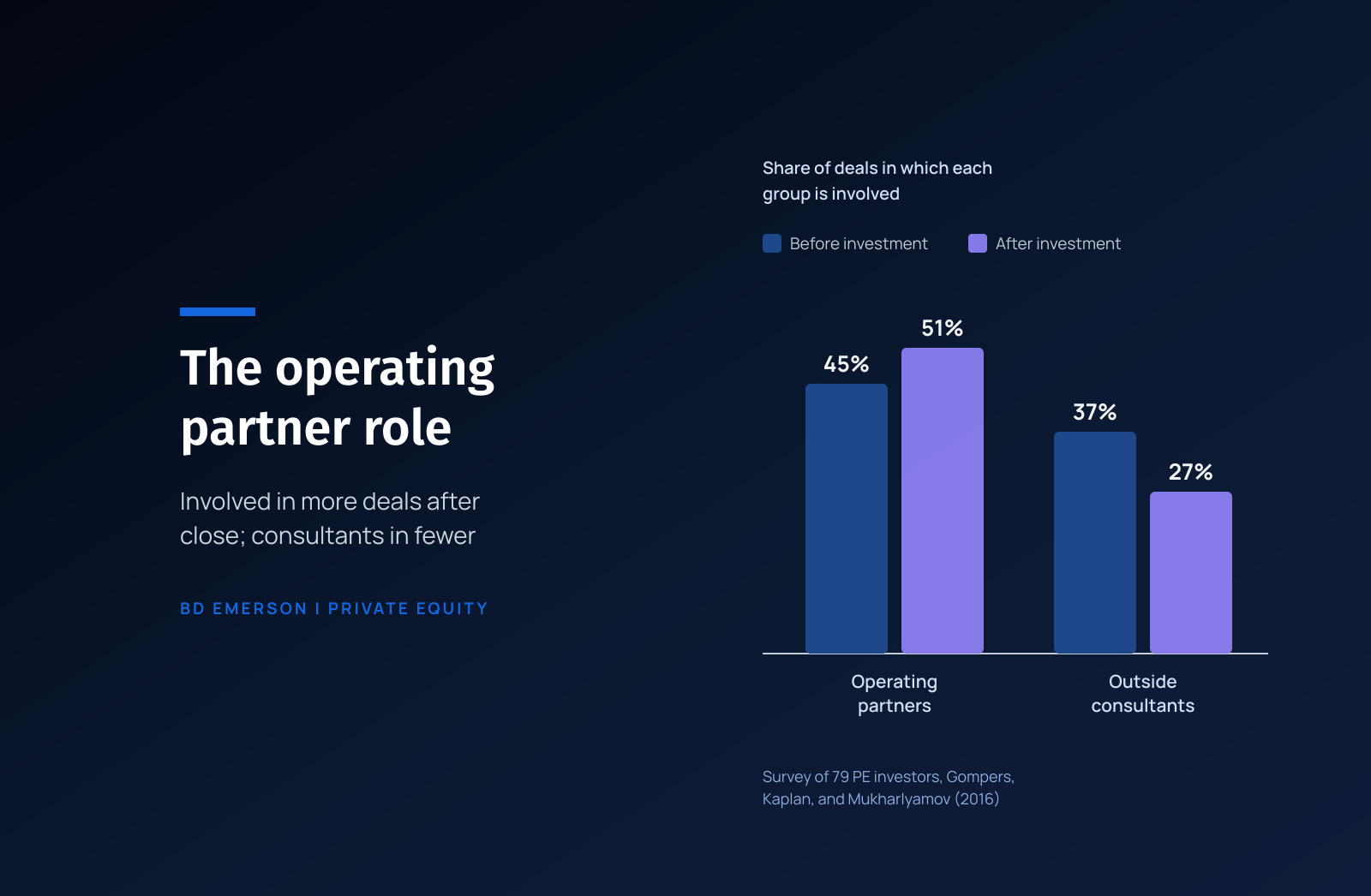
An operating partner is a senior operator whom a private equity firm engages to improve the companies it owns. Deal partners find, price, and close investments; operating partners work with portfolio company management on the plan that produces the return, covering growth, cost, leadership, pricing, technology, and preparation for exit. Some operating partners are full-time members of the firm, some are executives-in-residence or senior advisers engaged part-time, and some are functional specialists in areas such as procurement, talent, or cybersecurity. Who pays them matters to the fund's investors: the SEC's examination staff has cited advisers that did not adequately disclose the role and compensation of operating partners, or who bore their costs.
What does an operating partner do?
The job follows the investment. Before a deal signs, an operating partner tests whether the value creation case is achievable: whether margins can expand, whether the management team can run a larger business, and what the first year of ownership will cost. After close, the same person usually leads or supervises the 100-day plan, sets the operating metrics the board will track, and steps in when a portfolio company misses its plan.
Survey data on this work comes from a study of 79 private equity investors with combined assets under management of more than $750 billion, published by Paul Gompers, Steven Kaplan, and Vladimir Mukharlyamov. The study, most of whose responses were collected in 2012, found that operating partners were involved in identifying sources of value in 45% of deals before investment and 51% after. Outside consultants were involved in almost 37% of deals before investment and 27% after. The survey also reported that 8.7% of employees at the responding firms were operating professionals, and in roughly one-third of investments the investors expected to create value by changing the CEO or CFO.
Those numbers describe a role that grows after closing. Deal teams move to the next transaction; the operating partner stays with the company through the hold. That is why the work so often centers on the value creation plan: the operating partner is the person at the firm accountable for turning that document into results the next buyer will pay for.
What operating partner models do PE firms use?
Firms organize operating talent in three common ways, and many combine them. The model determines how much time the operating partner spends inside each company, who employs them, and who pays for their work.
| Model | Relationship to the firm | Where the work shows up |
|---|---|---|
| Full-time operating partner or portfolio operations team | Employee of the private equity firm, often a former CEO, COO, or CFO | Board seats, 100-day plans, and oversight across several portfolio companies |
| Executive-in-residence or senior adviser | Part-time or between executive roles, engaged by agreement | Diligence on a specific target, then sometimes a chair, board, or interim executive role at that company |
| Functional specialist | Employee or adviser focused on one function, such as procurement, pricing, talent, or technology | Programs run across the portfolio in that function |
The full-time model gives the firm a consistent operating method across companies. The executive-in-residence model gives the firm a candidate leader who has already studied the target during diligence, which shortens the search if the plan calls for new leadership. The functional model reflects a change the Institutional Limited Partners Association (ILPA) described in its Principles 3.0: general partners increasingly engage operating partners with specialized expertise to execute specific strategic growth plans, paid for by the portfolio company.
Research suggests the background of the people doing this work should match the plan. A study published in The Review of Financial Studies, covering 395 Western European buyouts from 1991 to 2007, found that general partners with an operational background, meaning former consultants or former industry managers, generated significantly higher outperformance in organic deals focused on internal value creation. Partners with a finance background generated higher outperformance in deals with significant M&A. A buy-and-build plan and a margin improvement plan call for different operators.
How are operating partners paid, and why do investors care?
Operating partner compensation draws regulatory attention because it can be paid from three places: the private equity firm's own management fee, the fund, or the portfolio companies. Each choice shifts the cost to a different party, and limited partners want to know which one applies.
ILPA's guidance is direct. Where operating partners are presented to limited partners as members of the firm's team, investors should understand how they are compensated. Fees that portfolio companies pay for services from operating partners deemed affiliates of the general partner should be fully offset against the management fee. If an operating partner participates in the general partner's economics, that should also be disclosed.
The SEC has acted on the same issue. In a June 23, 2020 risk alert, the agency's examination staff reported private fund advisers that did not provide adequate disclosure about the role and compensation of individuals known as operating partners, who provide services to the fund or its portfolio companies without being adviser employees. The staff said this could mislead investors about who would bear the costs of those services. Four years earlier, the SEC settled charges with Blackstreet Capital Management after finding that one fund's portfolio companies paid the adviser for operating partner oversight that the fund's limited partnership agreement did not disclose. The total settlement exceeded $3.1 million and also covered other violations.
For a candidate considering an operating partner role, these rules shape the offer. Ask whether the position is employed by the firm or engaged through portfolio company consulting agreements, whether any fees are offset against the management fee, and whether the role carries a share of the firm's economics. For a portfolio company CFO, the practical point is to record operating partner fees separately so they can be reported accurately to the sponsor.
How do operating partners work with portfolio company management?
An operating partner's authority usually comes through the board. In the Gompers, Kaplan, and Mukharlyamov survey, more than 90% of investors preferred boards of five to seven members, with the private equity firm taking roughly three seats, management one or two, and unaffiliated outsiders one or two. An operating partner who holds one of those seats can shape priorities, but the CEO still runs the company.
The relationship works when decision rights are written down early. The clearest arrangements settle four things in the first month: which metrics the operating partner reviews and how often, which decisions require sponsor approval, which outside advisers the company will hire and who manages them, and what the operating partner will do if the plan slips. Without those answers, management treats the operating partner as an auditor, and the operating partner learns about problems late.
Good operating partners also protect management's time. A mid-market portfolio company with a lean finance team cannot absorb a new reporting package, a pricing project, an ERP migration, and a security program in the same quarter. Sequencing that work is part of the job.
How do operating partners work with outside advisers?
Operating partners are frequent buyers of consulting work. The same survey found that almost 32% of investors hired strategy consultants to help with operating plans, and that smaller and younger firms were less likely to engage outside consultants in their transactions. An operating team of three people cannot cover every function across a dozen companies, so the operating partner's role often becomes scoping, buying, and supervising specialist work.
Who pays for that work is also governed by the fund documents. ILPA's position is that due diligence consulting costs should be charged to the portfolio company or covered by the management fee, that only specialized consulting costs should be borne by the fund, and that work performed by consultants affiliated with the general partner should be disclosed to limited partners.
A useful brief to an outside adviser names the decision the work informs, the deadline, the data the adviser can see, and the format the board needs. Advisers who report into the operating partner and management jointly tend to produce work that management will implement, because management helped shape it.
Where do technology and cyber specialists fit?
Technology and cybersecurity often sit outside a generalist operating partner's background, yet the consequences of getting them wrong are financial. A ransomware event can stop revenue for weeks, a weak identity program can surface as a finding in the next buyer's diligence, and an aging platform can cap the growth plan. These issues fit into the operating partner's work at four points.
In diligence, technology and cyber findings belong in the price and the purchase agreement, which means they have to surface before signing. In the first 100 days, the portfolio company needs a security baseline: multifactor authentication, tested backups, endpoint detection, and an incident response plan with a retainer in place. During the hold, a sponsor can put a fractional security leader such as a virtual CISO across several portfolio companies so the operating team gets one consistent report on cyber risk. Before exit, the same evidence that satisfied the board becomes the material that answers the buyer's technology and cyber diligence requests.
A technology or cyber specialist working with the operating partner should translate findings into the terms the board uses: cost, timeline, effect on EBITDA, and effect on exit value. A finding that cannot be expressed that way rarely gets funded.
If you are an operating partner building the plan for a new platform, or a portfolio company leader working with one, BD Emerson's private equity value creation team supports technology, cyber, and AI workstreams from the first 100 days through exit readiness.

About the author
















