What Is a Portfolio Company? Meaning, Ownership, and the Path to Exit

A portfolio company is a business that an investment fund, such as a private equity or venture capital fund, owns a stake in and holds in its portfolio. In private equity, the fund usually buys control, puts its own people on the board, and works with management to raise the company's value over a hold of several years before selling it. A platform company is the first acquisition in a sector that the sponsor builds around; an add-on is a smaller business the platform buys and absorbs. After closing, a portfolio company reports to its sponsor, runs a 100-day plan, and meets higher standards for financial reporting, compliance, and cybersecurity, which a buyer will test at exit.
What does portfolio company mean in private equity?
The term describes who owns a business, whatever the business does. A manufacturer, a software company, and a dental group can all be portfolio companies; what they share is an owner that is an investment fund with a plan to sell. The SEC's investor education site describes the typical private equity strategy as taking a controlling interest in an operating company and engaging actively in its management and direction to increase its value. It also notes that some private equity funds instead make minority investments in fast-growing companies or startups, which is closer to how venture capital funds hold their portfolio companies.
A few terms come with the relationship. The sponsor is the private equity firm that manages the fund and makes the investment decisions. The fund raises money from limited partners, such as pension plans, endowments, and insurers, who commit capital for a long horizon; the SEC's guide puts the typical private equity investment horizon at 10 or more years. The portfolio company, often shortened to portco, is the operating business the fund owns. The same SEC page notes that funds typically pay the private equity firm for advisory services and that portfolio companies may also pay the firm for services, which is one reason fee arrangements between a sponsor and its companies are disclosed to investors.
What is the difference between a platform company and an add-on?
A platform company is the first, usually larger, acquisition a sponsor makes in a sector. It brings the management team, the systems, and the brand that later acquisitions will plug into. An add-on, also called a bolt-on, is a smaller company the platform acquires to add customers, geography, products, or capacity. Growing a platform through a series of add-ons is the buy and build strategy, which sponsors use to build scale in fragmented industries.
The distinction matters operationally. The platform's finance system, identity directory, security tools, and policies become the standard each add-on must adopt, often within months of close. An add-on with weak security controls becomes the platform's problem the day its network connects to the platform's network, which is why integration planning for add-ons should start during diligence.
How do ownership and governance work in a portfolio company?
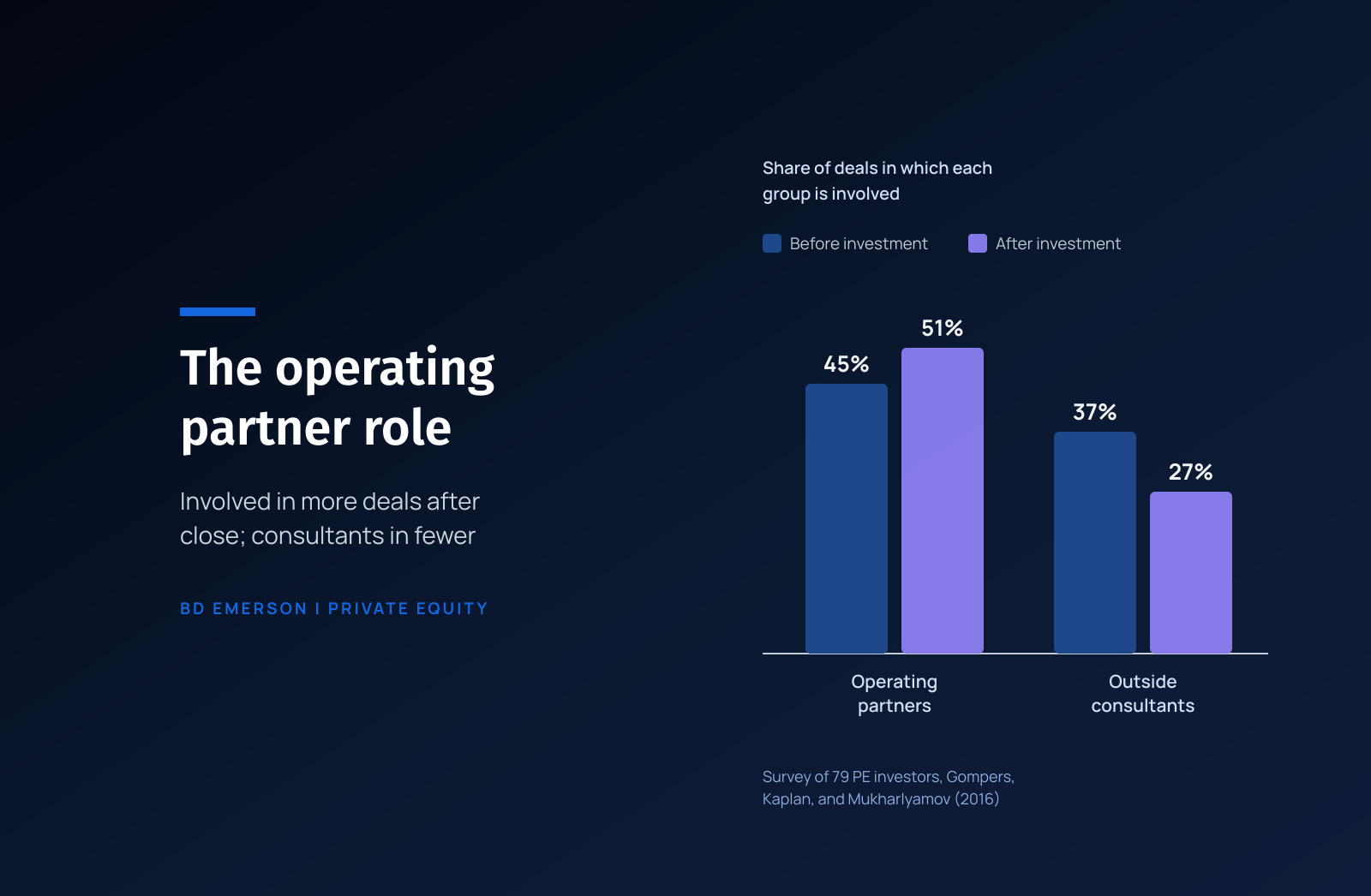
In a buyout, the fund typically owns the company through a holding company it controls, alongside equity held by management. Sellers who stay often take rollover equity, reinvesting part of their proceeds in the new structure, and executives receive incentive equity that pays out at exit. A study of 79 private equity investors by Paul Gompers, Steven Kaplan, and Vladimir Mukharlyamov found that investors expect to provide strong equity incentives to their management teams and consider those incentives very important. A management team that owns part of the upside tends to make decisions the way an owner would.
The board is where the sponsor exercises control. In the same survey, more than 90% of investors preferred boards of five to seven members, with the private equity firm taking roughly three seats, management one or two, and unaffiliated outsiders one or two. The sponsor's representatives, often a deal partner and an operating partner, approve the budget, major capital spending, debt, acquisitions, and senior hires. The CEO runs the company day to day but answers to a board whose members are measured on the fund's return.
How long does a private equity firm hold a portfolio company?
Most sponsors surveyed planned for about five years. The Gompers, Kaplan, and Mukharlyamov survey, whose responses were mostly collected in 2012, found that most private equity firms expected to hold their investments for approximately five years, and almost all of them built their models on a five-year forecast. Actual holds run shorter or longer depending on how the plan performs and on whether buyers are paying the price the sponsor wants.
The same survey asked how sponsors expected to exit. Investors expected roughly half of their deals to end in a sale to a strategic buyer, almost 30% in a sale to a financial buyer such as another private equity firm, and fewer than 20% in an initial public offering. Each route asks for different preparation: a strategic buyer tests integration fit, a financial buyer tests the next value creation plan, and public markets require reporting controls the company may never have needed.
What changes after a company is acquired by private equity?
Three things change quickly: the pace of the plan, the volume of reporting, and the expectations for compliance and cybersecurity.
The first 100 days
The sponsor arrives with a value creation plan built during diligence, and the first 100 days turn it into owners, deadlines, and metrics. Typical early work includes closing out transition items from the seller, setting up banking and insurance under the new ownership, confirming or changing leadership, and starting the projects that drive the investment case, such as pricing, procurement, or an add-on pipeline. The survey found that in roughly one-third of investments, sponsors expected to create value by changing the CEO or CFO.
Reporting to the sponsor
A founder-owned company may close its books once a quarter. A portfolio company usually produces monthly management accounts, a KPI pack, budget-to-actual analysis, a board pack, and compliance certificates for its lenders. That information flows up into the sponsor's own reporting to its limited partners. In January 2025, the Institutional Limited Partners Association released an updated Reporting Template and a new Performance Template, its first update to the Reporting Template since 2016, and said the new templates should be implemented beginning in the first quarter of 2026. A portfolio company CFO who understands what the sponsor must report can design a monthly close that feeds it directly.
Compliance and cyber expectations
Sponsors carry cyber risk across every company in the fund, so they set a minimum standard and ask each company to report against it. A practical reference point is the NIST Cybersecurity Framework 2.0, released on February 26, 2024, which organizes security around six functions: Govern, Identify, Protect, Detect, Respond, and Recover. NIST added the Govern function in version 2.0 and wrote the framework for organizations of any size and sector. In practice, the early asks are multifactor authentication, tested backups, endpoint detection, an incident response plan, and a named person accountable for security, plus the sector rules the company already lives under, such as HIPAA for healthcare data or PCI DSS for card payments.
What is portfolio company management?
Portfolio company management is the work a sponsor does to oversee the companies it owns during the hold. At the fund level, it means a regular cycle of board meetings, monthly KPI reviews against the value creation plan, quarterly valuations that feed investor reports, and intervention when a company falls behind. Operating partners carry much of this work, supported by outside specialists for functions the sponsor does not staff, such as pricing, technology, or cybersecurity.
Inside the company, the same phrase describes how the leadership team runs a business with an institutional owner: fewer informal decisions, documented approvals for spending above agreed limits, and a reporting rhythm that leaves no surprises for the board. Management teams that build this discipline early spend less time answering ad hoc sponsor requests, because the monthly pack already answers them.
How does a portfolio company prepare for exit?
Start exit preparation 12 to 24 months before a sale; that is a BD Emerson planning range, and a company with gaps in its financial or security evidence should start earlier. The goal is to answer the buyer's diligence questions before they are asked, with evidence. The exit readiness work usually covers four areas.
| Area | What buyers ask for | What a ready company has |
|---|---|---|
| Financial | Quality of earnings, working capital, and adjustments to EBITDA | A sell-side quality of earnings report and a clean monthly close |
| Technology | Architecture, technical debt, scalability, and key-person risk | Current system documentation and a costed remediation list |
| Cybersecurity | Controls, incident history, penetration test results, and insurance | Evidence mapped to a framework, recent test results, and a closed findings log |
| Legal and compliance | Contracts, data protection, and regulatory standing | An organized data room with exceptions explained in advance |
An initial public offering raises the bar further. Under rules the SEC adopted on July 26, 2023, public companies must disclose a cybersecurity incident they determine is material on Form 8-K, generally within four business days of that determination, and must describe their cybersecurity risk management, strategy, and governance each year in their Form 10-K. A portfolio company on an IPO track needs those processes running before it files, because the first annual report will ask for them.
Exit evidence costs least when it is a byproduct of running the business throughout the hold. Monthly reporting, a maintained risk register, and tested security controls cost far less to keep current than to reconstruct in the months before a sale.
If your portfolio company needs a security baseline after close or cyber evidence ready for a buyer, BD Emerson's private equity cybersecurity team works with sponsors and portfolio company leaders from the first 100 days through exit.

About the author