RAG vs Fine-Tuning: Which One Solves Your Problem?
The question arrives already framed as a technical choice, usually after someone has been told the company needs its own model. It is worth reframing before spending anything, because retrieval and fine-tuning solve different problems and the most common outcome of choosing wrongly is a six-figure project that produces a system nobody trusts.
The distinction that settles most cases
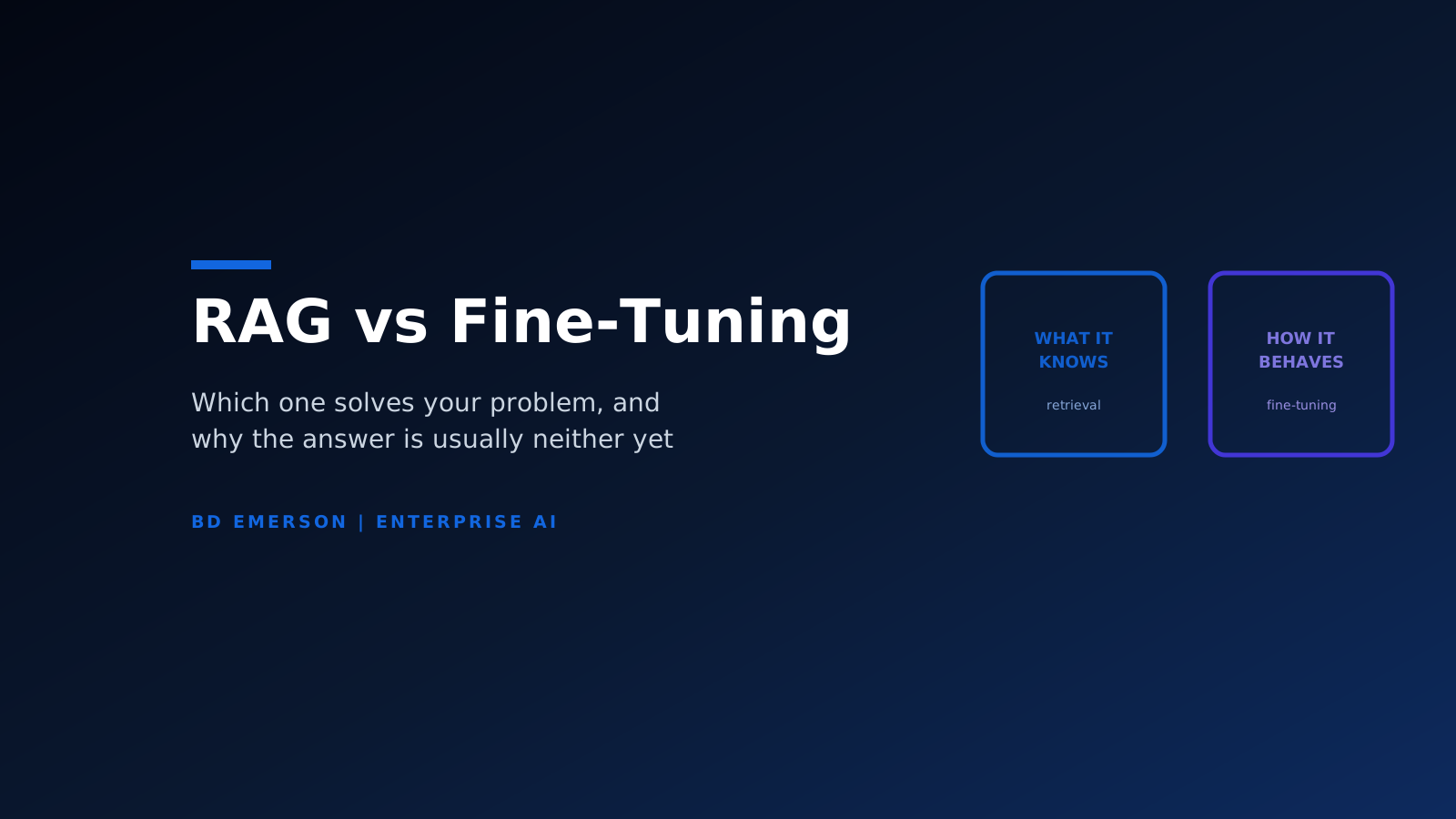
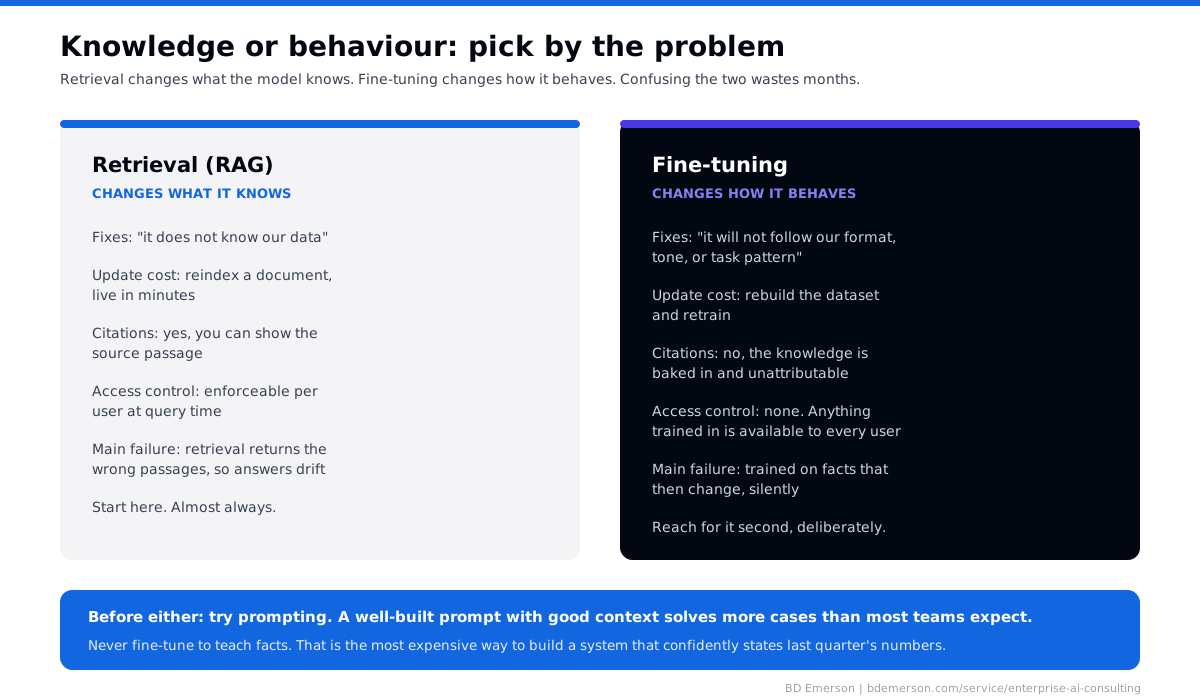
Retrieval-augmented generation changes what the model knows. Fine-tuning changes how the model behaves. If your complaint is that the model does not know your data, that is a retrieval problem. If your complaint is that it will not follow your format, tone, or task pattern reliably, that is a fine-tuning problem.
Try prompting first, seriously
A well-constructed prompt with the right context in it solves more cases than most teams expect, and it is the only option you can iterate on in an afternoon. We have watched organizations approve fine-tuning budgets for problems that a better prompt and a properly scoped context window resolved in a week. Prompting is also the cheapest way to learn what good output actually looks like, which you will need before you can build a fine-tuning dataset anyway.
The honest test: if you cannot get acceptable results with careful prompting on a handful of representative examples, you probably do not yet understand the task well enough to train for it.
Why retrieval is usually the right first build
Three properties matter more than accuracy benchmarks. Updates are cheap: reindex a document and the system knows the new thing in minutes, which matters because your policies, prices, and products change. Citations are possible: you can show the source passage, and in regulated environments an answer without provenance is often unusable regardless of correctness. And access control is enforceable at query time, so the retrieval layer can respect the permissions the underlying documents already have.
That last point deserves emphasis because it is the one that gets discovered late. Retrieval lets you filter what a specific user is allowed to see before the model ever sees it. There is no equivalent control once information is trained into weights.
What fine-tuning is genuinely good at
Consistent output structure, domain tone and vocabulary, and narrow repeated tasks where you have thousands of good examples of the transformation you want. It reduces prompt length and latency, and it can make a smaller model perform a specific task about as well as a larger one, which is a real cost lever at volume. That is the strongest business case: not capability, but capability per dollar on a task you run a million times.
The mistake that keeps recurring
Fine-tuning to teach facts. It is intuitive and it is wrong. Training data becomes frozen knowledge with no citation, no access control, and no cheap update path. You end up with a system that states last quarter's numbers with total confidence and gives you no way to know it is doing so. When the facts change, your only remedy is retraining.
If you want the model to know things, retrieve. If you want the model to act a certain way, train. When someone proposes fine-tuning on a corpus of company documents to make the model an expert, that is the mistake in its most common costume.
When you need both
Mature systems often combine them: fine-tune for reliable structure and domain register, retrieve for current facts. The sequencing matters, though. Build retrieval first, get it working, and measure. Then, if output format or tone is still the bottleneck at production volume, fine-tune on top of a system whose behaviour you already understand. Doing it in the other order means debugging two unfamiliar systems simultaneously.
What actually decides success
Neither technique. Retrieval quality does. Most disappointing RAG deployments fail at retrieval rather than generation: the system returns plausible but wrong passages, and the model faithfully summarizes them. Chunking strategy, embedding choice, hybrid keyword and semantic search, reranking, and above all an evaluation set built from real user questions matter more than which model sits at the end. If you cannot measure retrieval precision on questions your users actually ask, you cannot improve the system, and you will be guessing about whether it works.
Budget for evaluation from the start. It is the least glamorous line item and the one that determines whether anyone trusts the thing in six months.
The security dimension
Both approaches create attack surface. Retrieval introduces sources an attacker may be able to poison, and if your pipeline ingests anything user-submitted or externally sourced, indirect prompt injection becomes a live concern. Fine-tuning creates a permanent disclosure risk, because anything in the training data is potentially retrievable by any user of the model. We cover how these get tested in AI in offensive security, and where they sit in a governance program in how to build an AI governance framework.
Where BD Emerson fits
Our enterprise AI practice scopes this decision against your actual use cases rather than a default architecture, builds the retrieval and evaluation layers, and routes workloads by task as described in smart model routing. Where data sensitivity rules out third-party inference, private model hosting keeps everything inside your boundary, and offensive testing checks whether the result holds up against someone trying to break it.

About the author