The Best M&A Advisory Firms in 2026
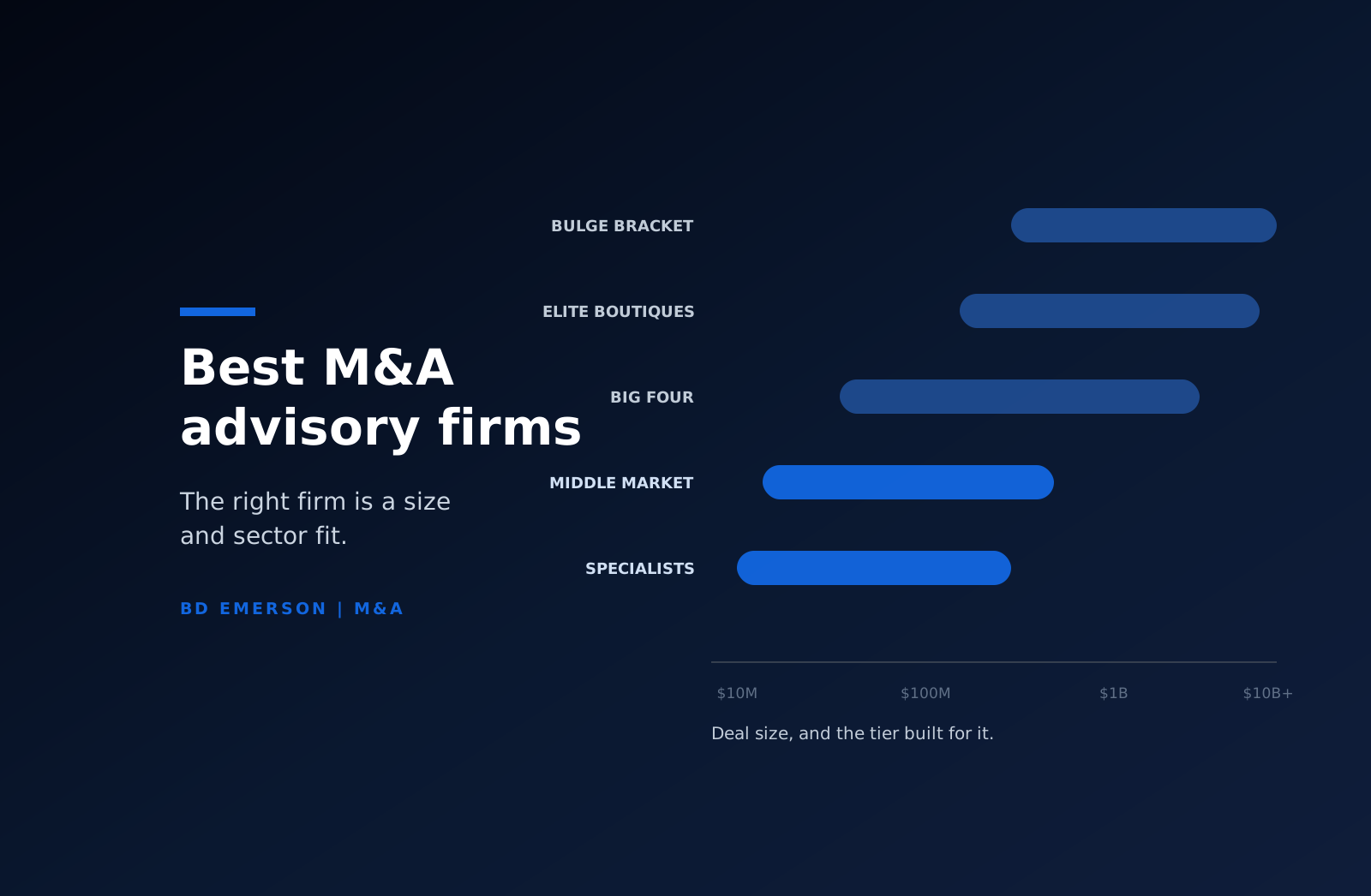
The best M&A advisory firm depends on the deal: its size, its sector, and whether you need a bank to run a process or an advisor to test what you are buying. The market sorts into five tiers. Bulge bracket banks for multibillion-dollar deals with financing attached, elite boutiques for board-level advice on large transactions, the Big Four for deals that lean on accounting and tax complexity, middle market specialists for the $25 million to $1 billion range where most transactions actually happen, and sector and diligence specialists who go deeper on one dimension than a generalist bank can. This guide covers who belongs in each tier and how to choose. One disclosure up front: BD Emerson appears in this list, and this is our site. We have marked where we fit and why, and the rest of the list is the honest map we would give a client who asked.
Bulge bracket: scale and financing
Goldman Sachs, Morgan Stanley, and J.P. Morgan lead the league tables for large-cap M&A year after year, with Bank of America and the other universal banks close behind. They bring the largest deal teams, relationships with every plausible buyer of a large asset, and balance sheets that can finance the transaction they are advising on. The trade-offs are cost, minimum deal sizes that exclude most companies, and the reality that a mid-market deal at a bulge bracket firm gets the bench, not the names on the pitch. Hire this tier when the deal is large enough that the buyer universe is global and the financing is part of the problem.
Elite boutiques: advice without the balance sheet
Evercore, Centerview Partners, Lazard, Moelis, and PJT Partners built their franchises on senior-banker attention and independence: they advise, they do not lend, so their advice is not shaped by financing fees on the other side of the deal. They compete with the bulge bracket on the largest and most sensitive mandates, board defenses, restructurings, and cross-border deals, and their fee expectations match that altitude. For a company whose transaction is complex and board-visible, the elite boutique model buys judgment concentrated at the top of the deal team.
The Big Four: transaction services at scale
Deloitte, PwC, EY, and KPMG run the largest transaction services practices in the world, and their natural ground is where deals lean on accounting, tax, and cross-border structuring. They dominate quality of earnings work, run corporate finance arms in the middle market, and can staff a multi-country carve-out in a way few others can. The considerations are independence rules, which can constrain what a firm can do for its audit clients, and the breadth-over-depth trade in specialized domains like software architecture or security, where the work is often generalist-led.
Middle market leaders: where most deals get done
Houlihan Lokey has ranked as the most active M&A advisor by deal count for years, built on mid-market volume. Alongside it sit William Blair, Baird, Lincoln International, Harris Williams, Raymond James, and Jefferies at the upper end, with strong regional and founder-focused shops below. This tier runs disciplined processes for companies between roughly $25 million and $1 billion of value, knows the private equity buyer universe deeply, and prices success fees the mid-market can carry. For a founder or a fund selling a company in this range, the middle market specialists are usually the right process bank, and the differentiation between them is sector depth: each has industry groups where their buyer relationships are strongest.
Sector and diligence specialists: depth on one dimension
Some mandates are won on specialization. Qatalyst Partners advises large technology sellers. Software and healthcare boutiques carry buyer relationships generalists cannot match. And a separate specialist category runs the diligence rather than the process: firms that test what the deal is actually buying. BD Emerson sits here, and this is the disclosure paragraph: we are a technology, security, and compliance-led M&A advisory practice for mid-market transactions. Our lane is buy-side and sell-side advisory where the asset's value lives in its technology and its risk lives in security and compliance, with technology due diligence, cyber diligence, and quality of earnings run by in-house practitioners who implement these systems outside of deal work. We are the right call when that describes your deal, and one of the firms above is the right call when you need a bulge bracket balance sheet or a thousand-person global process team. Guidance on evaluating this specialist tier is in our review of the best technical due diligence firms.
How to actually choose
Four criteria decide the hire better than league tables. Deal-size fit: you want to be a meaningful client, not the smallest mandate on the desk, so match your transaction to the firm's median deal, not its maximum. Sector evidence: ask for the last ten closed deals in your space and call two of the sellers or buyers. Team specifics: the pitch team and the deal team are often different people, so negotiate who actually works the deal. And conflict posture: ask who else the firm represents in your market, including the buyers likely to bid for you. On fees, expect retainers plus success fees, with percentages that scale down as deal size grows, and read the tail provisions, which govern what you owe if a deal closes after the engagement ends. Whether you are hiring for the sell side or the buy side changes the shape of the engagement, and the differences are covered in our guide to buy-side versus sell-side M&A.
Questions that separate the pitches
Bake-offs reward preparation, and six questions do most of the separating. Who exactly staffs this deal day to day, named, and what else is each of them working on. What were your last ten closed transactions in our sector, and which two references may we call, including one from a process that went badly. Where does our deal sit against your median deal size this year. Which likely buyers of our company do you currently represent, and how will you handle that conflict if they bid. What is your view of our realistic valuation range and, more usefully, what evidence would move it up or down. And what happens to our fee obligation if we pull the process, or if a buyer you introduced closes a deal eight months after we part ways. The answers matter less than their specificity: an advisor who answers with names, numbers, and documents will run your process the same way.
On fees, the standard shape is a monthly retainer, often credited against a success fee of one to two percent on mid-market deals, scaling higher for small transactions and lower for large ones, with minimum fees common. The terms that deserve legal attention are the tail period, the definition of a covered transaction, and expense provisions. None of it is exotic, and all of it is negotiable before signing and none of it after.
Advisor, banker, broker: terms that get conflated
The market uses three labels for the sell-side seat, and they describe different services at different deal sizes. Business brokers serve main-street transactions, typically under $5 million, listing businesses for sale in a manner closer to real estate than to investment banking, with commission structures to match. M&A advisors and investment bankers serve the middle market and above with managed processes: prepared materials, curated buyer lists, structured bidding, and negotiation through to close, and at these sizes the seller's outcome is driven by process quality rather than listing reach. The regulatory line matters too: in the US, intermediaries handling securities transactions generally operate through broker-dealer registration, so asking a prospective advisor how their fees are structured and under what registration they operate is a fair and normal question. Separately from all three, diligence firms serve either side of a deal without running the process, which is the seat specialist firms occupy, and the two engagements are complements rather than substitutes: a process bank and a diligence specialist on the same deal is a common and healthy pairing.
Where to start
If your transaction is mid-market and the value or the risk is concentrated in technology, security, or compliance, that is the deal profile BD Emerson's mergers and acquisitions advisory practice was built for. If it is not, the map above is the one we would use to point you at the right tier, and we are glad to make the introduction.

About the author