M&A Strategy: Growth Through Acquisition
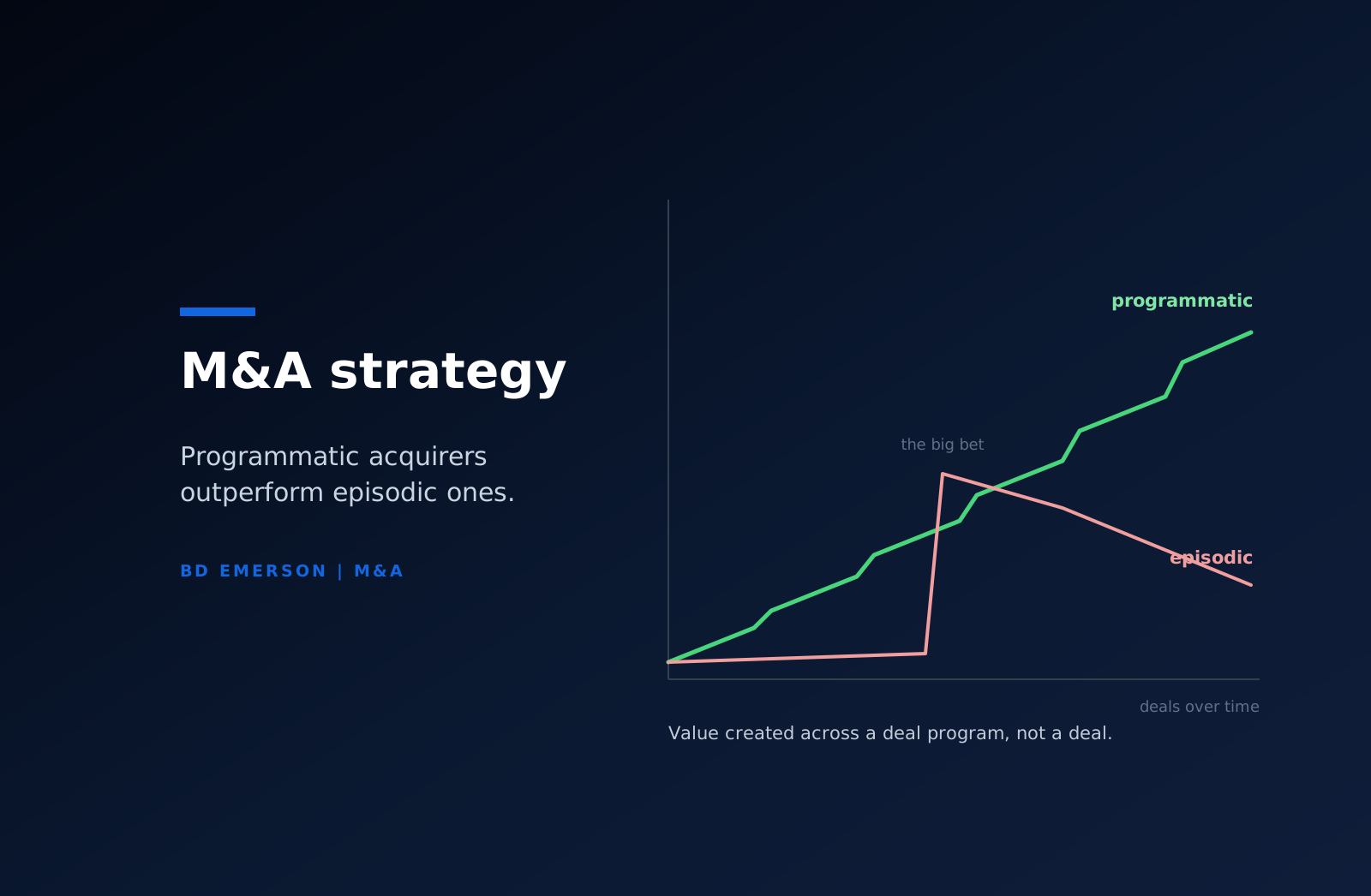
An M&A strategy is a written answer to three questions: what the company will buy, why those deals create value that organic investment cannot, and what each acquisition must return before it is approved. Growth through acquisition works when it is programmatic, a series of deliberate deals executed against a thesis, and it destroys value when it is episodic, a large opportunistic bet justified after someone falls in love with a target. The research on this is consistent across decades: frequent, smaller, thesis-driven acquirers outperform occasional big-deal acquirers by a wide margin. This article covers how to build the thesis, screen targets against it, and design out the failure modes that make acquisitions the most expensive way to learn strategy.
The four theses that justify buying instead of building
Acquisitions earn their premium in four situations. Capability deals buy something slow or impossible to build: a product line, a technology, a regulatory license, a specialized team. The build-versus-buy math has to be honest about time, because the acquirer pays a premium precisely for the years saved. Market access deals buy distribution: customers, geographies, or channel relationships that would take a decade to replicate. Consolidation deals buy economics: combining overlapping businesses to remove duplicate cost and gain pricing or purchasing power, the classic roll-up logic, which works exactly to the extent the integration actually captures the overlap. Talent deals buy teams, and they are the smallest and the most fragile, because the asset can resign. A real strategy names which of these the company is running and why that thesis fits its market, and the market analysis behind that choice runs on the same arithmetic as any other strategic claim, covered in our guide to TAM, SAM, and SOM.
From thesis to screen: criteria with numbers
A thesis becomes operational as a screen: revenue and EBITDA ranges the balance sheet can absorb, growth and margin floors, customer concentration ceilings, technology and security posture minimums, geography, and culture markers that history says matter. The screen's job is to generate fast, cheap kills. Every criterion should be phrased so a target either passes or fails on evidence available early, because the expensive failure mode is a marginal target that survives screening on hope and consumes a quarter of diligence before dying. Write the deal-breakers first. An acquirer that knows what it will never buy moves faster on everything else, and sellers' advisors learn quickly which buyers are serious about their own criteria.
Price discipline: the return math that survives the auction
Every acquisition strategy fails at the same place: the moment competitive pressure meets a target the team wants. The protection is mechanical rather than motivational. Set the walk-away price from the return math before the process starts, underwrite synergies at the value the integration plan can evidence rather than the value the model can print, and require that the deal clears its hurdle on the base case, with synergies as margin of safety rather than justification. The winner's curse in M&A is not bad luck, because the buyer who most overestimates the value is systematically the one who wins the auction. Programmatic acquirers survive it by losing deals on price, regularly and on purpose.
Why acquisition strategies fail, and the design that prevents it
The recurring failures are integration starved of resources, synergies that were never anyone's operating commitment, culture treated as soft until key people leave, and diligence run to confirm a decision rather than test it. Each has a structural fix. Integration gets a named leader inside diligence and a funded plan before close, per our guide to the post-merger integration 100-day plan. Each synergy line gets an owner whose targets include it. Retention of the people the thesis depends on gets negotiated as part of the deal. And the diligence team reports its findings against the thesis, with standing permission to kill the deal, because a process that cannot say no is a pricing committee. The fuller catalog of failure patterns, with the evidence, is in our article on why mergers and acquisitions fail.
The pipeline is the strategy
An acquirer with one target has no negotiating power and no calibration. The working form of an M&A strategy is a maintained pipeline: a mapped universe of the fifty to two hundred companies that fit the screen, relationships built with the interesting ones years before a process, and a rhythm of revisiting the map as the market moves. Pipeline discipline changes the economics of every deal, because alternatives are the only honest source of price discipline, and it changes sourcing, because the best deals are often the ones that never reach an auction. This is also where strategy connects back to the operating plan: corporate development capacity, integration capacity, and balance sheet capacity together set the sustainable deal cadence, and a strategy that ignores its own capacity is a list of wishes.
Build versus buy, priced without a thumb on the scale
Every capability thesis should survive a written build-versus-buy comparison, because the acquisition premium is only rational when the build path is worse. Price the build fully: loaded engineering cost, the realistic timeline with the usual overrun, the opportunity cost of the roadmap it displaces, and the probability of a mediocre outcome, which for ambitious internal builds is high. Price the buy the same way: premium, integration cost, retention packages, and the probability the acquired capability degrades in your hands. The comparison usually turns on time and certainty rather than raw cost, and writing it down does two things: it gives the board a real decision instead of a narrative, and it produces the maximum price at which buying still beats building, which is a walk-away number derived from your own economics rather than from the auction.
Capacity: the constraint that sets deal cadence
Acquisition capacity is three separate budgets, and the binding one is rarely money. Balance sheet capacity sets what the company can pay. Corporate development capacity sets how many processes the team can run well at once, and for most mid-market acquirers that number is one, maybe two. Integration capacity sets how many acquired companies the operating organization can absorb without dropping the ones already in flight, and it recovers slowly, because the people who integrate acquisitions are the same people who run the business. A strategy that schedules deals faster than integration capacity recovers is scheduling its own failure, and the fix is unglamorous: sequence the pipeline, staff integration as a standing function rather than a project, and let deal cadence follow absorption rather than ambition.
The first acquisition is its own problem
A company doing its first deal faces every failure mode at once with none of the muscle memory, and the record for first acquisitions is worse than the already-poor M&A average. Three adjustments improve the odds. Size down: the first deal should be small enough that a total loss is survivable and the organization can digest it, because its real return is the capability it builds. Overweight integration planning relative to deal execution, since the deal skills can be rented from advisors while the integration falls on your own people, who have never done it. And write the thesis and walk-away price before engaging any target, then have someone with standing to say no hold the pen, because first-deal enthusiasm is strongest exactly where experience is thinnest. Companies that treat the first acquisition as a learning asset priced accordingly tend to become the programmatic acquirers who outperform; companies that make their first deal a transformational bet become case studies. Close the loop either way: a written post-mortem eighteen months after each close, comparing the outcome to the thesis and the model, is how a deal program develops judgment instead of just history.
Where BD Emerson fits
BD Emerson works the full arc of growth through acquisition via our M&A services practice: thesis and screen design, target evaluation, the diligence that tests the thesis rather than decorating it, and the integration planning that decides whether the deal returns its price. The strategy work and the deal execution are the same discipline applied at different altitudes, and firms that treat them separately pay for the gap.

About the author