The Capital Raise: Process, Timeline, and Preparation
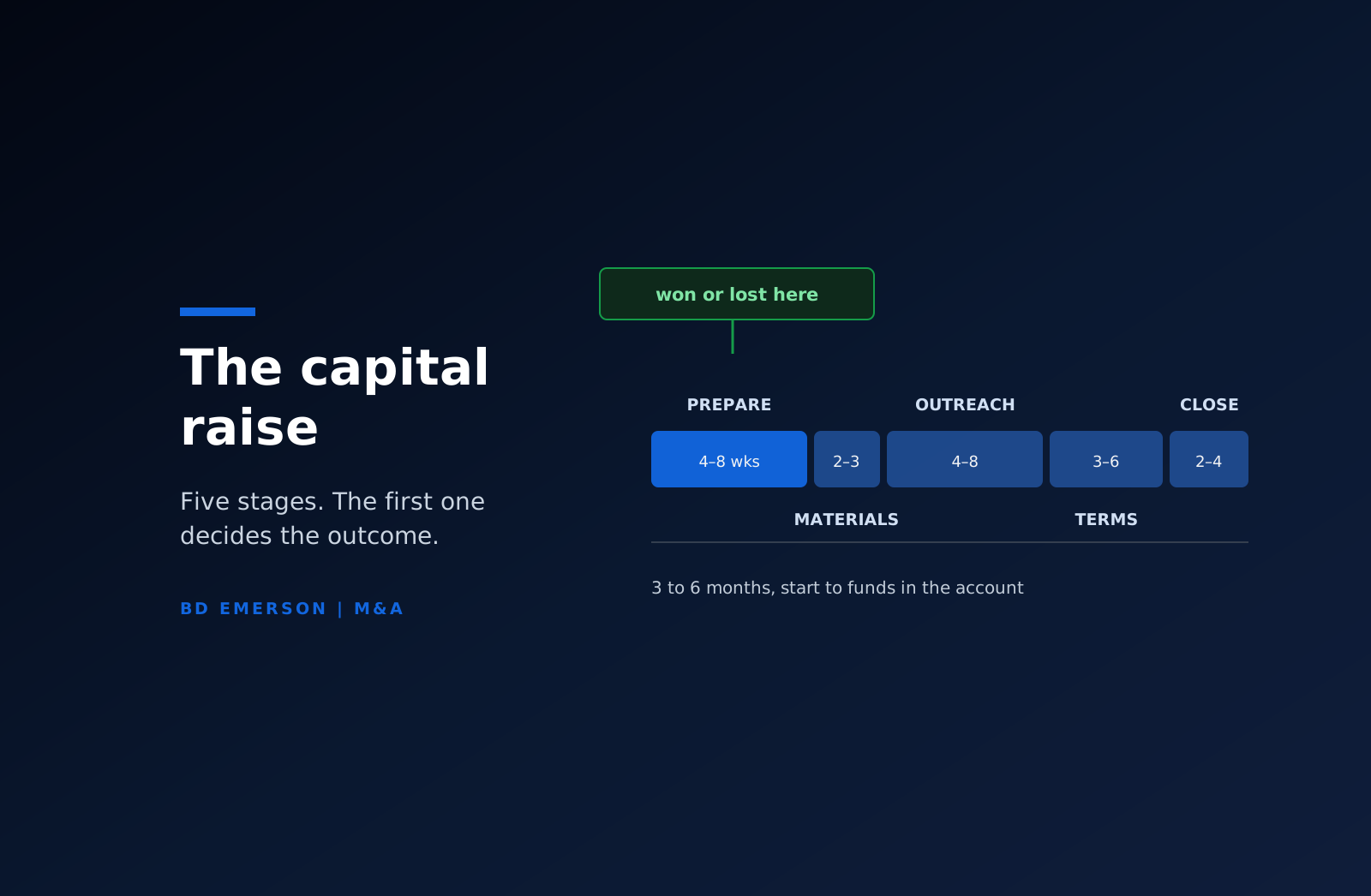
A capital raise is the process of bringing outside money into a company, as equity, debt, or an instrument that converts between them, to fund growth the business cannot finance from its own cash flow. The process runs in five stages: preparation, materials, outreach, diligence and terms, then documentation and close. A well-run raise takes three to six months from first preparation to money in the account, and most of what determines the outcome is decided in the first stage, before any investor sees the company. Investors fund companies that arrive with the evidence already organized, and they discount or pass on companies that assemble it under deadline. This article walks the stages, the timeline, and the preparation that separates the two.
Choose the instrument before you choose the investors
Equity sells ownership: priced rounds with venture or growth investors, or a minority stake sold to private equity. Debt borrows against the business: bank facilities, revenue-based financing, or venture debt layered onto a prior equity round. Convertibles, SAFEs and convertible notes, defer the pricing question and are standard at the earliest stages. The right instrument follows from the math of the business, because equity is the most expensive money a growing company will ever take and debt is cheap only when the cash flows to service it are reliable. A company with predictable recurring revenue and a clear use of funds should price debt options before defaulting to dilution. The instrument decision also sets the audience, the materials, and the diligence you will face, so make it first and deliberately.
The five stages and their timelines
Preparation, four to eight weeks, is where the raise is won. Clean financials on a consistent basis, a defensible model connecting the money to the milestones it buys, a market case built on real arithmetic, and the legal house in order: cap table, contracts, IP assignments. The market case deserves specific attention because every investor reads it the same way, and the standard for a number that survives scrutiny is covered in our guide to TAM, SAM, and SOM.
Materials, two to three weeks: the deck, the model, and a data room populated before outreach rather than after interest. The deck earns a meeting and nothing more, so it should be short and specific. The model is the document sophisticated investors actually work with, and it needs to reconcile with the historicals to the dollar.
Outreach, four to eight weeks: a targeted list of investors who write checks of your size in your sector and stage, run as a coordinated process so conversations reach a decision in the same window. Parallel timing is what creates term competition, and term competition is the only reliable negotiating power a company has in a raise.
Diligence and terms, three to six weeks: term sheets arrive, and the investor examines everything the company has claimed. What that examination covers, and how to be ready for it, is its own discipline, detailed in our guide to investor due diligence. Companies that pass diligence quickly close on the terms they signed. Companies that surface surprises renegotiate from weakness.
Documentation and close, two to four weeks: definitive agreements, final confirmatory checks, and funding. The variance here is almost entirely a function of how clean the legal preparation was in stage one.
What investors are actually deciding
Underneath the meetings, an investor is answering three questions. Can this business get big enough to matter for my fund, which is the market and growth question. Will this team get it there, which is the execution evidence question, answered by the track record visible in the metrics rather than by the narrative. And will I get my money out at a return, which is the exit and capital-efficiency question. The preparation stage maps directly onto those three questions: the market model answers the first, the historical financials and operating metrics answer the second, and the use-of-funds model answers the third. A raise narrative that ignores any of the three forces the investor to answer it themselves, on less favorable assumptions than yours.
The preparation that changes the price
Two pieces of preparation reliably pay for themselves. The first is financial credibility: monthly financials on a consistent accounting basis, revenue recognized defensibly, and metrics defined the way institutional investors define them. Growth-stage companies increasingly commission a light quality of earnings review before a large raise for the same reason sellers do before an acquisition, and the logic is explained in our guide to quality of earnings reports. The second is finding your own problems first. Every company has issues: customer concentration, a contract missing a signature, a security gap. Disclosed early with a remediation plan, each is a discussion. Discovered by the investor in diligence, each is a pricing event, and the pattern of discovery costs more than the issues themselves because it prices in the question of what else was missed.
How much to raise, and what it costs
Size the raise from milestones, not from what the market will give. The amount should fund the company to a set of proof points that reprice the next raise, with 20 to 30 percent of buffer, because raising again before the milestones land means raising on the old story. Then price the dilution: selling 20 percent of the company at each of three rounds leaves founders and early holders with roughly half the ownership they started with, before option pool expansions, which investors typically require pre-money so existing holders absorb them. Model the whole path, not the round in front of you. On the debt side, the cost is covenants and cash service rather than ownership, and the failure mode is borrowing against a forecast: debt sized to plan becomes a forcing function when the plan slips. The instrument math is company-specific, and running it before the process is what lets you negotiate structure instead of accepting it.
Equity, debt, or both: a worked comparison
Put numbers on the instrument choice. A software company at $10 million of recurring revenue needs $4 million to fund two years of sales expansion. Equity path: sell roughly 15 to 20 percent of the company, permanent dilution, no repayment, and a governance seat, with the true cost realized at exit, since the sold stake participates in all future value. Debt path: a facility at $4 million with interest in the low teens all-in, warrants for a fraction of a percent, and covenants tied to revenue or cash minimums, with the true cost being rigidity, because the covenants bind hardest exactly when the plan slips. The blended path most growth companies land on: a smaller equity round for resilience plus a debt facility for the fundable, predictable spend. The decision rule that falls out of the math is that equity should fund uncertainty, the experiments and expansions whose payoff is variable, and debt should fund arithmetic, the spend whose return is already visible in unit economics. Companies that invert the rule, borrowing for experiments and selling equity to fund predictable growth, pay the maximum price for both kinds of capital. Run the comparison with your own numbers before the process starts, because investors and lenders will each argue for their own instrument, and the company is the only party in the room pricing the whole balance sheet.
What kills raises
Processes die in recognizable ways. Metrics that do not survive contact with the ledger, which ends trust before terms. A single-investor process with no competing timeline, which stalls because urgency was never created. A market case the investor rebuilds smaller, which reprices the round. Founder misalignment on price or control that surfaces mid-process. And time itself: raises that drift past four months of active outreach acquire a stale-deal discount, because every investor's first question about an old process is what the others saw. Each failure traces back to preparation or process design, which is the encouraging version of the point, since both are in the company's control.
When to bring in outside help
Founders run early rounds themselves. As checks get larger the process work grows: instrument selection, model construction, data room assembly, diligence management, and the negotiation itself. Advisors earn their fee when they compress the timeline and keep term competition alive, and they are a poor substitute for preparation that only the company can do. BD Emerson's investor relations consulting practice prepares companies for institutional money: the financial evidence, the market model, and the diligence file, built before the first investor meeting so the process runs on your timeline rather than on the problems it finds.

About the author