Positioning Strategy: Choose the Ground You Can Win
A positioning strategy is the set of deliberate choices about which buyers you serve, what those buyers compare you against, and why you win that comparison. Positioning is decided in the market's head, and the strategy work is making sure what lands there is chosen rather than accidental. The mechanics are four decisions made in order: pick the segment where your advantage matters most, name the alternative buyers would use instead of you, claim the differences that are true and provable, and then align pricing, product roadmap, and sales narrative behind those choices. Done well, positioning shows up in the metrics that matter: win rates against named competitors, sales cycles, pricing power, and eventually the multiple a buyer or investor pays for the business.
Positioning is a strategy decision, then a marketing output
The word gets treated as a messaging exercise, which is why so much positioning work produces a tagline and changes nothing. The strategic content of positioning is resource allocation: choosing a segment means declining others, naming a competitive alternative means building the product and the proof to beat that alternative specifically, and claiming a difference means investing until the claim is defensible. A mid-market security firm that positions on audit-and-advisory depth makes different hires, builds different service lines, and prices differently than one positioned on price. The messaging is downstream of those choices and cannot substitute for them. The test of whether you have a positioning strategy rather than a slogan is whether it has ever caused you to say no to revenue.
The four decisions, in order
First, segment. Choose the group of buyers for whom your strengths are decisive rather than nice to have. The inputs are your win-loss record, your retention by segment, and your unit economics by segment, because the segment where you already win unusually often is telling you where you are positioned well, whatever the deck says. Sizing the chosen segment with real arithmetic matters here, and the method for that is covered in our guide to market sizing.
Second, the competitive alternative. Buyers do not compare you against your category, they compare you against the specific thing they would do if you did not exist: a named competitor, an in-house build, a spreadsheet, or doing nothing. Competitive positioning starts from that real alternative. If most of your losses are to "we decided to handle it internally," positioning against your nearest vendor rival is aiming at the wrong target.
Third, differentiation you can prove. List the capabilities that are true of you and materially better than the alternative, then cut the list to the ones the chosen segment pays for. Proof is the filter: a reference customer, a measured outcome, a credential the alternative cannot claim. A differentiation claim without proof is a marketing cost, because buyers now verify claims quickly and a claim that fails verification prices the rest of your story down with it.
Fourth, alignment. Pricing should reflect the value story, the roadmap should widen the claimed difference, and the sales team should be trained to frame every deal against the chosen alternative. Misalignment here is the most common failure: the deck claims premium depth while pricing signals commodity, and the buyer believes the price.
Reading your position from the outside in
A competitive positioning analysis rebuilds how the market actually sees you, and the evidence is external. Win-loss interviews conducted by someone the prospect has no reason to flatter. The words customers use to describe you unprompted, which are frequently not the words in your messaging. Where you appear in analyst and AI-generated recommendation lists, and against whom. Pricing outcomes: discount frequency and depth against each named competitor. The analysis usually surfaces one of two problems, either the market has no clear idea what you are, which suppresses win rates everywhere, or the market has a clear idea that no longer matches what you sell, which caps you at your old reputation. Both are fixable, and both are cheaper to fix than they are to carry.
A worked example
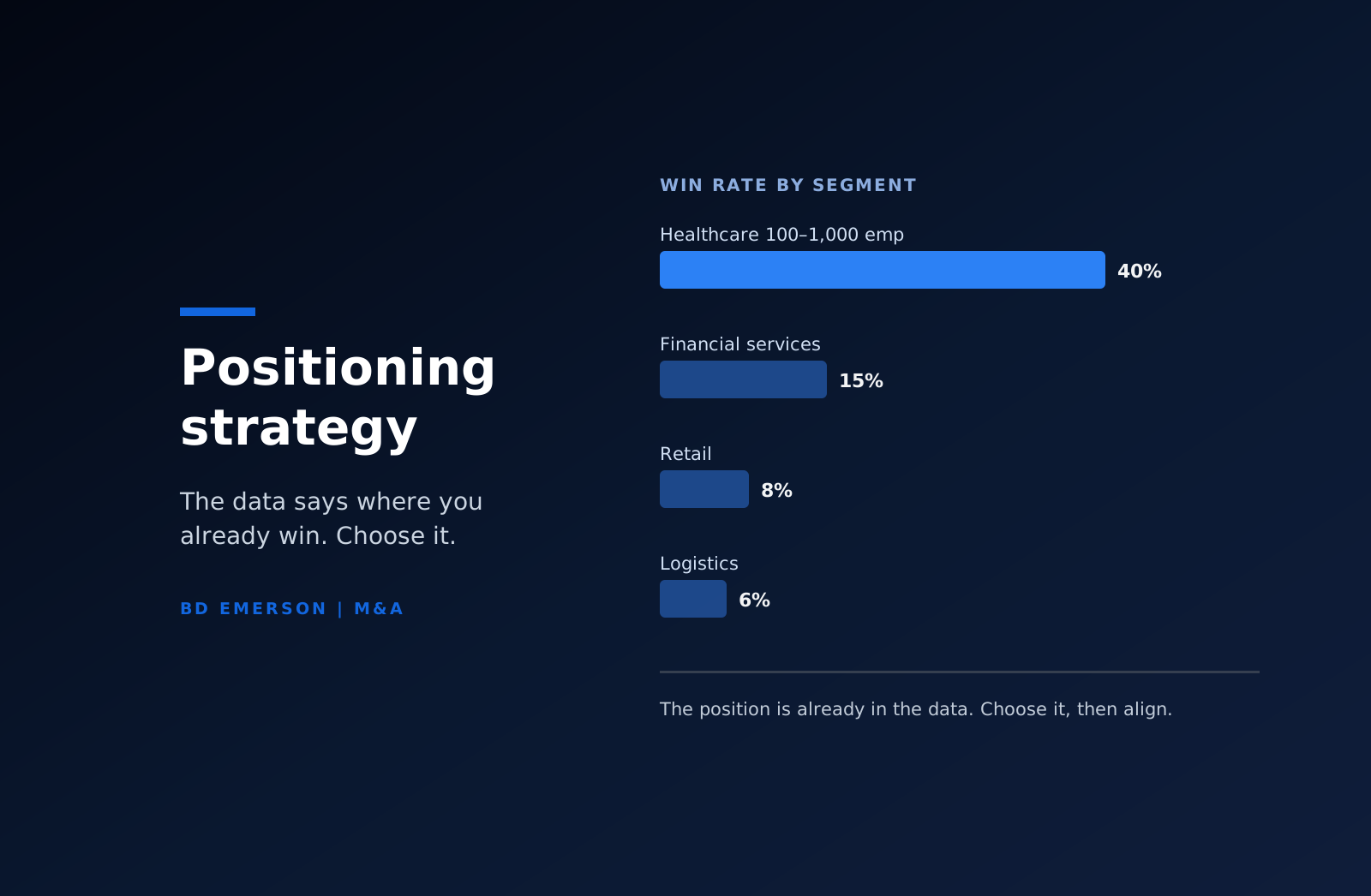
A 60-person managed security provider sells to everyone and wins 18 percent of its deals. The win-loss file says something more specific: against national providers it wins 40 percent of deals with healthcare clinics between 100 and 1,000 employees, because those buyers need HIPAA fluency the national desks staff generically, and it wins almost nothing in retail or logistics. The positioning decision writes itself from the data. Segment: mid-size healthcare providers. Alternative: the national provider's generalist desk. Difference: compliance-fluent security operations, provable through auditor relationships and client references in the segment. Alignment follows: pricing moves from per-device rates to a program price that reads as compliance coverage, the roadmap prioritizes the two EHR integrations the segment keeps requesting, and sales stops chasing the retail pipeline. A year later the honest measure of the strategy is that win rate in segment, deal velocity, and discount depth all moved, and total pipeline got smaller while revenue grew. That last pair is what a real positioning choice looks like in the numbers.
How the work actually runs
Positioning projects fail as offsites and succeed as evidence programs. The working sequence takes eight to twelve weeks: pull the win-loss, retention, and pricing data by segment; run fifteen to twenty externally-conducted interviews across wins, losses, and churns; map the real competitive alternatives per segment; then make the four decisions in a written memo that names what the company will stop doing. The memo matters because positioning decays through small exceptions, the off-segment deal someone wants, the feature request from outside the ideal profile, and a written strategy gives the organization something to enforce. Revisit annually with fresh data, the same cadence as the market model, and re-run the external interviews at least every other cycle, because internal belief about position drifts from market perception faster than most teams expect.
Repositioning: when and how
Reposition when the evidence says the current position is losing: win rates declining in your core segment, deals increasingly decided on price, a competitor claiming your ground with better proof, or your product having outgrown the category buyers file you under. The work runs the four decisions again with current data, then sequences the change, because a reposition announced before product and proof exist burns credibility. Expect the transition to take two to four quarters of consistent execution before external perception moves, and measure it with the same outside-in evidence rather than internal enthusiasm.
Positioning and pricing power
Pricing is where positioning either exists or does not, because price is the one claim a buyer tests with their own money. A company positioned as the specialist for a segment can price against the cost of the buyer's problem, while a company the market reads as interchangeable prices against the nearest quote. The mechanics are visible in the sales data: discount depth and frequency by competitor, win rate at list price, and how often procurement succeeds in turning the evaluation into a spreadsheet comparison. Repositioning work should therefore set pricing expectations early, because the new position is only real when the company holds a price the old position could not. A practical test for whether a claimed position has taken: raise price 10 percent in the chosen segment and watch the win rate. A positioned company sees the rate hold within noise, because the alternative was never the point of comparison. An unpositioned one sees the funnel reprice immediately. Few companies run the test deliberately, and every company runs it eventually, usually during a renewal cycle when a competitor discounts. Position is what you have when that happens and your customers stay.
Positioning shows up in the valuation
Position eventually gets priced. Companies that own a defensible segment show higher win rates, lower customer acquisition costs, better retention, and less discounting, and those are the exact metrics buyers and investors underwrite. In a sale process, commercial diligence tests whether the market position the deck claims is visible in the data, and a company whose numbers demonstrate its positioning gets the benefit of the doubt everywhere else. The connection runs the other direction too: a company preparing for a transaction, whether a raise or an exit, should treat positioning evidence as part of the preparation, alongside the market model in the TAM, SAM, SOM framework. BD Emerson works on positioning as part of executive consulting engagements, where the strategy has to survive contact with the win-loss data, the pricing file, and eventually a buyer's diligence team.

About the author