Market Cap vs Enterprise Value: What Each Measures
Market cap prices a company's equity: share price times shares outstanding. Enterprise value prices the whole business: the equity plus the net debt an owner would inherit, calculated as market cap plus total debt minus cash, with preferred stock and minority interests added where they exist. The difference matters because the two numbers answer different questions. Market cap tells you what the stock market thinks the shareholders' claim is worth. Enterprise value tells you what it would cost to own the business itself, which is why acquirers, lenders, and valuation professionals quote deal prices and multiples in EV, and why comparing companies on market cap alone misranks any pair with different balance sheets.
The formula and what each piece is doing
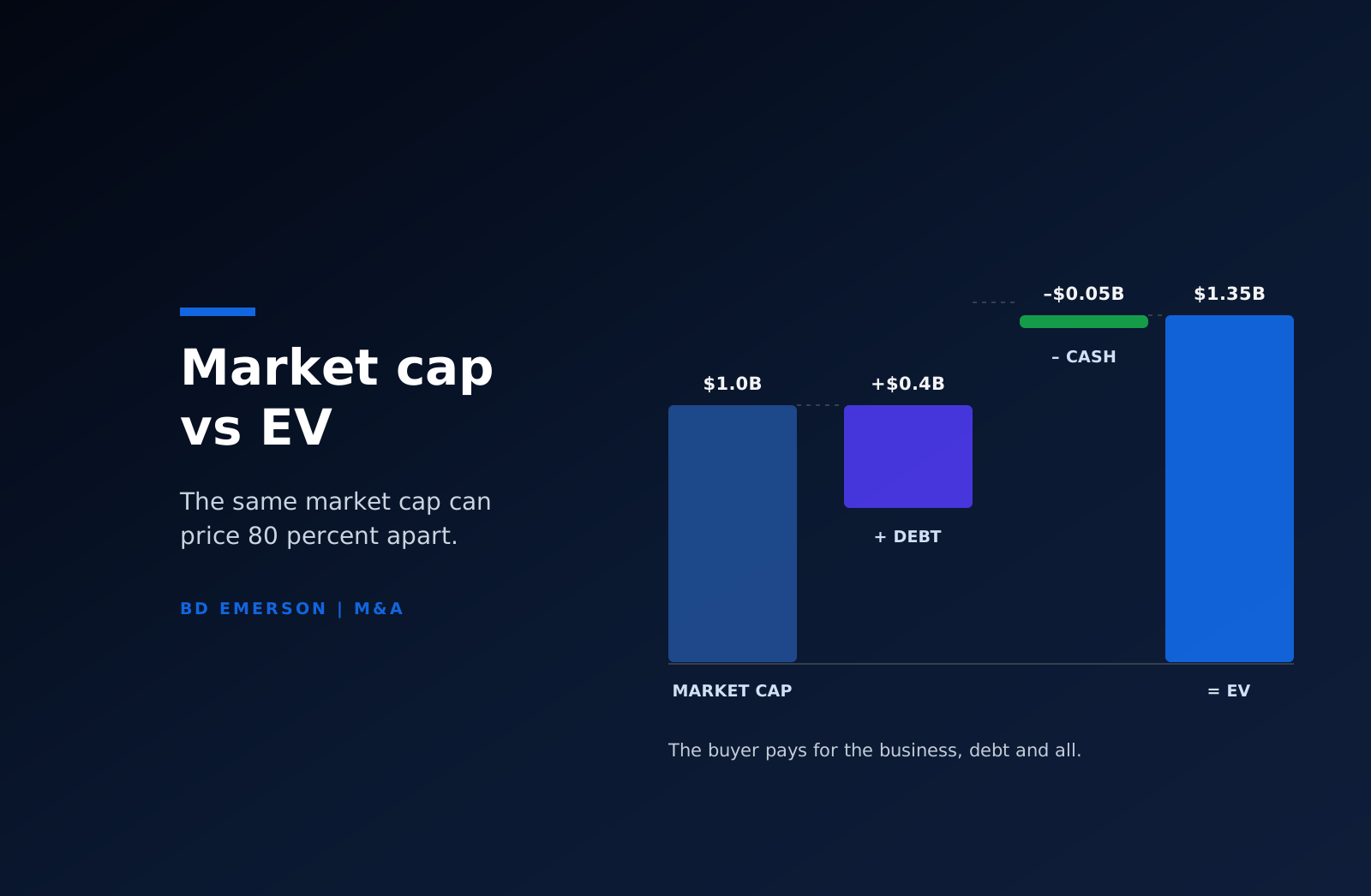
Enterprise value equals market cap, plus total debt, minus cash and cash equivalents, plus preferred equity, plus minority interest. The debt is added because a buyer of the business inherits the obligation: pay $500 million for the equity of a company carrying $300 million of debt and the business has cost you $800 million of claims. The cash is subtracted because it comes with the purchase and can pay debt down the day after close, so it reduces the true cost of ownership. Preferred equity and minority interests are added for the same inheritance logic: they are claims on the business that the common equity price does not capture. The result is a capital-structure-neutral price for the operating business, which is exactly what you need when comparing companies that finance themselves differently.
A worked example
Two software companies each trade at a $1 billion market cap. Company A holds $250 million of cash and no debt, so its enterprise value is $750 million. Company B carries $400 million of debt and $50 million of cash, so its enterprise value is $1.35 billion. Identical market caps, and Company B's operating business is priced 80 percent higher than Company A's. If both generate $100 million of EBITDA, Company A trades at 7.5 times EV/EBITDA and Company B at 13.5 times. An investor screening on market cap alone would call them the same size, and an acquirer modeling either deal would find the affordability, the financing, and the returns completely different. Every takeover model starts from this bridge, because the check the buyer writes has to retire the debt or assume it, and the cash on hand offsets the price.
Why acquirers price in EV, never market cap
An acquisition buys the operating business and its capital structure together, so the offer math runs in enterprise value and then bridges to what shareholders receive. The buyer sets an EV based on the business's cash flows, subtracts net debt as of close, adjusts for the items negotiated in the purchase agreement, and the remainder is the equity value paid to sellers. That bridge is where private deals are won and lost after the headline is agreed: debt-like items the buyer argues belong in net debt, cash the seller argues is trapped or needed, and the working capital adjustment that trues up whether the business arrives normally capitalized. Multiples follow the same logic. EV/EBITDA and EV/Revenue compare the business to its operating earnings, and pairing an equity-only numerator with an operating denominator, market cap over EBITDA, is a category error that flatters companies carrying heavy debt. What counts as the EBITDA in those multiples is its own negotiation, covered in our guide to EBITDA adjustments.
Enterprise value vs equity value in private companies
Private companies have no share price, so the sequence runs in reverse: value the enterprise first, from comparable transaction multiples and discounted cash flows, then bridge down to equity value. A private company marketed at an $80 million enterprise value, carrying $12 million of debt and $3 million of qualifying cash, delivers roughly $71 million of equity value before the purchase agreement's adjustments. Sellers reading an offer letter should check which number is on the page, because "we are offering $80 million" means materially different proceeds depending on whether it is EV or equity value, and the difference is a routine source of late-stage dispute in deals where nobody pinned it down early. Once a deal closes, the price paid gets allocated across the acquired assets for accounting, a process covered in our guide to purchase price allocation.
Which debt and which cash: the judgment calls
The formula is one line, and the disputes live inside its terms. On the debt side, the clear items are borrowings and bonds, and the contested ones are the debt-like obligations: capitalized leases, earnout liabilities from past deals, unfunded pension obligations, deferred revenue in some buyer models, and preferred instruments that behave like debt. In private deals, the definition of indebtedness in the purchase agreement is a negotiated list for exactly this reason, and sellers who first see the buyer's list at signing lose those line items by default. On the cash side, the honest subtraction is cash that is truly free: operating cash the business needs to run is not, cash trapped in foreign subsidiaries with repatriation cost is only partly, and restricted cash backing letters of credit is not at all. A worked bridge with each contested item stated and priced is one page, and producing it early is a cheap way to keep six figures of value from resolving against you by silence.
EV in screening and comparison work
Anyone screening acquisition targets, building comparable sets, or benchmarking valuation should default to EV-based multiples and let market cap describe only the equity. The practical habits: compute EV yourself from the latest balance sheet rather than trusting a data feed's stale net debt, date the debt and cash figures because both move, and when a comparable set mixes companies with different lease or deferred revenue treatments, normalize before comparing. Most bad comps are consistency failures rather than math failures, the same multiple computed two different ways across the set. The inputs are all public for listed companies: shares outstanding from the cover of the latest 10-Q, debt from the balance sheet and its notes, cash from the same page, which makes the one-line bridge a five-minute exercise with no excuse for skipping.
Can enterprise value be lower than market cap?
Yes, whenever cash exceeds debt. A company with a $2 billion market cap, no borrowings, and $600 million of cash has an enterprise value of $1.4 billion, because a buyer of the whole business gets the cash back at close. In rare dislocations, companies have traded with enterprise values near zero or below, meaning the market priced the operating business at less than the cash on its balance sheet. Screens that surface negative-EV companies are hunting exactly that mispricing, with the usual caution that the market sometimes knows something about the cash, pending litigation, a burn rate, trapped jurisdictions, that the balance sheet date does not show.
Size labels are market cap labels
One more place the two numbers get conflated: the size vocabulary of public markets, small cap, mid cap, large cap, is built on market cap thresholds, because those labels describe equity investability, index membership, and liquidity. Deal size vocabulary runs on enterprise value, because a lower-middle-market or mid-market label describes the price of a business. The same company can be a small cap stock and a solidly mid-market acquisition, and reading one label with the other's meaning is how screening lists end up mis-sorted. When a mandate or a fund thesis states a size range, the first clarifying question is which measure the range is denominated in.
When market cap is the right number
Market cap keeps three legitimate jobs. It measures the equity claim, which is what a shareholder actually owns and what index inclusion, float, and trading liquidity are built on. It denominates equity returns: a stock's performance is a market cap story, not an EV story. And it is the observable market input from which EV is built for public companies. The mistake is only in using it to compare business size or deal price across different balance sheets, and the fix costs one line of arithmetic. BD Emerson runs valuation work on both sides of transactions through our transaction valuation and purchase price allocation practice, where the EV-to-equity bridge is negotiated in every deal, and getting it right early is cheaper than disputing it late.

About the author