Value Creation Levers in Private Equity: Nine Levers and the Exit Evidence Each Needs
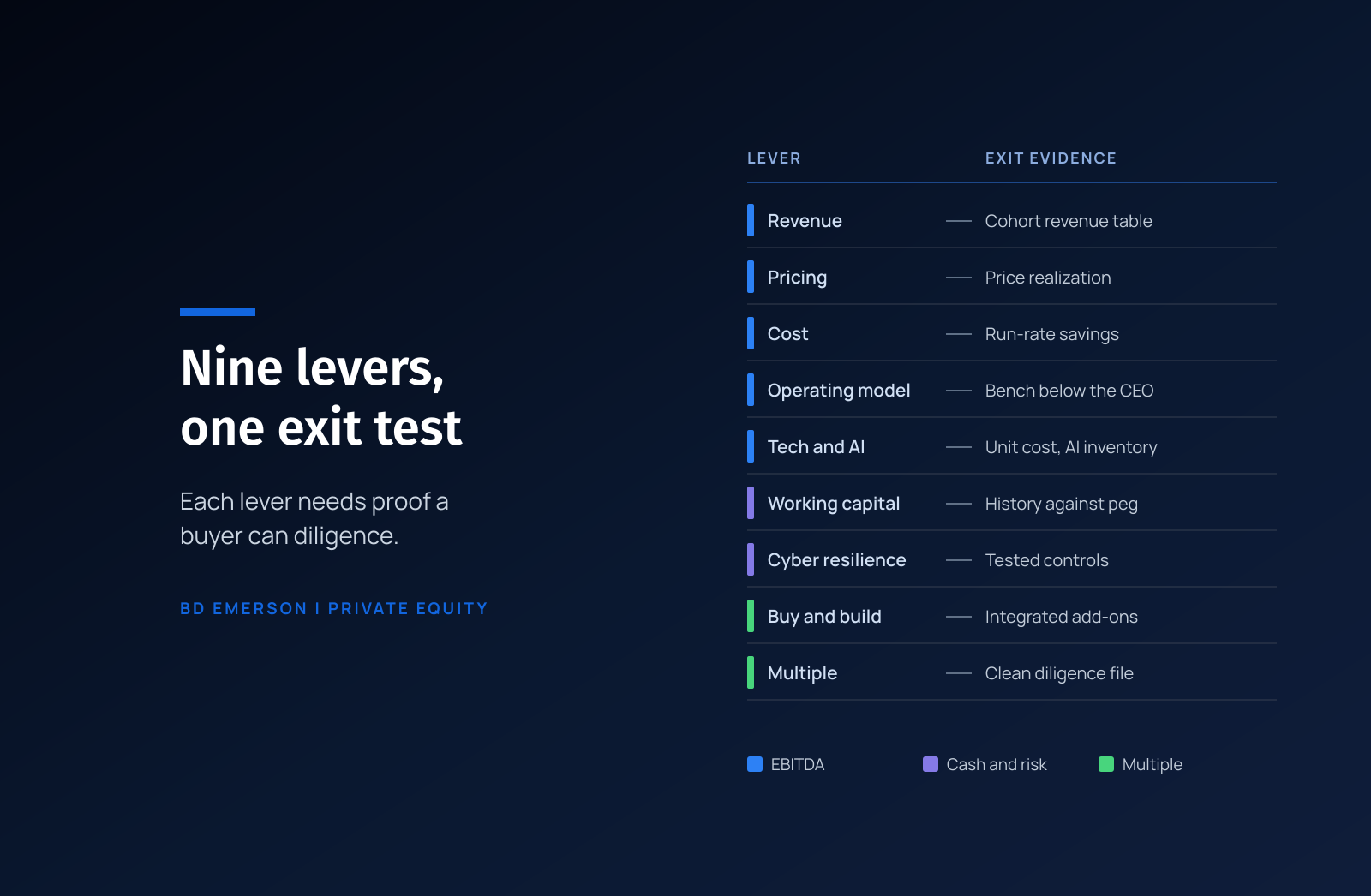
Value creation levers in private equity are the actions a sponsor takes during the hold to raise equity value between entry and exit. Nine levers matter in practice, and they sort into three groups. Revenue, pricing, cost, operating model, and technology and AI grow EBITDA. Working capital and cyber resilience convert earnings into cash and protect them. Buy and build and multiple expansion raise what a buyer pays for each dollar of earnings. A lever counts at exit only when the buyer's diligence team can verify it, so each one needs its own evidence trail from the first quarter of ownership.
How do the levers add up to equity value?
Equity value at exit is EBITDA multiplied by the exit multiple, less net debt. Every lever works through one of those three terms. Steven Kaplan and Per Strömberg's review of buyout research in the Journal of Economic Perspectives groups what sponsors do into financial engineering (management incentives and debt), governance engineering (control of the board), and operational engineering (industry and operating expertise applied to the business). The nine levers here are mostly operational engineering, because that is the part a sponsor still controls once the debt package is set.
Sponsors say growth matters more to them than cost cutting. In a survey of 79 private equity investors with more than $750 billion under management, Gompers, Kaplan, and Mukharlyamov report that the investors anticipate adding value with a greater focus on increasing growth than on reducing costs. Cost work still pays, but a plan built only on cuts gives the next buyer less to pay for.
This article is the lever map. Our article on the value creation plan covers how to turn the levers into an EBITDA bridge with baselines, owners, and quarterly targets. The table below lists each lever, the term it moves, and the evidence a buyer will test.
| Lever | What it moves | Evidence a buyer will test |
|---|---|---|
| Revenue growth | EBITDA, through volume | Revenue by customer and cohort, reconciled to the general ledger |
| Pricing | EBITDA, through margin | Price realization by customer and product, and churn after each increase |
| Cost | EBITDA, through margin | Run-rate savings separated from one-time items and tied to invoices |
| Operating model | EBITDA and multiple | Management depth below the CEO and unit cost trends |
| Technology and AI | EBITDA and multiple | Cost per transaction before and after, and an inventory of AI systems |
| Cyber resilience | Risk and multiple | Tested controls, incident history, and independent test reports |
| Working capital | Cash and net debt | Monthly working capital history against the proposed peg |
| Buy and build | EBITDA and multiple | Integrated financials and retention for each add-on |
| Multiple expansion | Multiple | Recurring revenue share, customer concentration, and data quality |
Revenue and pricing: what buyers test
Revenue growth comes from new customers, higher retention, cross-selling, new channels, and new geographies. Buyers discount growth they cannot trace to a source. The evidence they ask for is monthly revenue by customer and by cohort, reconciled to the general ledger, with retention calculated the same way every period. A company that starts producing that cohort table in the first quarter of the hold arrives at exit with a multi-year record. A company that builds it during the sale process arrives with a reconstruction, and buyers read it that way.
Pricing can move EBITDA within a few quarters, and it is also the lever sellers most easily overstate. The arithmetic explains both. A company with $100 million of revenue and a 10 percent EBITDA margin that raises price 2 percent with no lost volume adds $2 million of EBITDA, a 20 percent increase on the $10 million it started with. If customers leave or trade down in response, the gain shrinks quickly. That is why a buyer's quality of earnings team tests price realization and churn together: list price against invoiced price by customer and product, discount approvals, and the retention curve for customers who received each increase.
Cost and operating model: separating run-rate from one-time
Cost levers cover procurement, facilities, overhead, and third-party spend such as software licenses and cloud consumption. The savings are real when they show up in the monthly P&L and repeat. They are fragile when they exist only as pro forma adjustments, because buyers often strike adjustments that have yet to reach the books. Our guide to EBITDA adjustments shows which kinds survive diligence. The practical rule is to record each saving against a baseline, tie it to invoices or payroll, and keep one-time costs to achieve it in a separate line so the buyer can see both.
The operating model lever changes how the company is organized and led: spans and layers, shared services, a finance function that closes the month on a fixed timetable, and the management team itself. Sponsors act on that last item often. The same Gompers, Kaplan, and Mukharlyamov research, summarized by the authors at the Harvard Law School Forum on Corporate Governance, reports that PE investors regularly replace top management, both before and after they invest. At exit, this lever is evidenced by a second layer of managers who can run the business without the founder, documented processes, and unit costs that improved while the company grew.
Technology and AI: when does it count as a lever?
Technology counts as a value creation lever when it changes unit cost or revenue capacity inside the hold. An ERP replacement, a single customer record, and clean identity management are foundations. They rarely move EBITDA on their own, but the pricing, procurement, and reporting levers depend on them, so they come first. AI belongs in the plan where it targets a named workflow with a measurable cost: quoting, invoice matching, claims intake, collections, or first-line customer service. A general instruction to "use AI" produces pilots and no evidence.
The evidence for this lever has two parts. The first is operational: cost per transaction, cycle time, or capacity per employee before and after the change, measured over enough months to show it held. The second is governance: an inventory of AI systems in production, the owner of each, the data each one uses, and how each was tested. A practical reference for that governance record is NIST's AI Risk Management Framework, released January 26, 2023 for voluntary use and organized around four functions: Govern, Map, Measure, and Manage. A buyer's technology diligence will ask the same questions the framework does, and a company that has answered them during the hold has nothing to reconstruct.
Why is cyber resilience a value lever?
Cyber resilience protects both EBITDA and the multiple. A ransomware event during the hold stops revenue, adds recovery and legal cost, and becomes a finding in the next buyer's diligence. A buyer's cyber review will test multifactor authentication coverage, privileged access, backup restoration, incident history, vendor access, and the results of independent penetration tests. Gaps found at that stage can turn into price reductions, escrows, or exclusions in the representations and warranties insurance policy.
Software and services companies that sell to enterprise customers add a further piece of evidence: a SOC 2 Type 2 report issued by an independent CPA firm, which shortens customer security reviews during the hold and gives the buyer third-party assurance at exit. If the exit is an initial public offering, the bar rises again. The SEC rules adopted on July 26, 2023 require public companies to describe their processes for assessing, identifying, and managing material cybersecurity risks and the board's oversight of those risks in the annual Form 10-K. The same rules require a Form 8-K for a material cybersecurity incident, generally due four business days after the company determines the incident is material. A portfolio company that already runs its program to that standard has the facts for that disclosure documented before the underwriters ask.
Working capital: the cash lever that changes the price
Working capital improvement comes from collecting receivables faster, paying suppliers on agreed terms instead of early, and carrying less inventory per dollar of sales. Cash released during the hold pays down debt, and lower net debt raises equity value dollar for dollar at exit. The lever also matters inside the purchase agreement. Buyer and seller agree a working capital peg, and the price adjusts if the business delivers less working capital than the peg at closing.
That mechanism rewards sustained improvement and punishes a late push. The peg is commonly set from a trailing twelve-month average, so an improvement that has run for several quarters lowers the peg and the seller keeps the benefit. A one-quarter squeeze just before the sale leaves the peg high and the company short of it at closing. Our article on net working capital in M&A covers the peg and the true-up in detail.
Buy and build and multiple expansion
Buy and build grows a platform through add-on acquisitions. Add-ons are often smaller companies bought at lower multiples than the platform, and the combined EBITDA is valued at the platform's multiple at exit. That difference pays only when the add-ons are integrated: one set of books, one customer system, consistent pricing, and the key people still in place. Unintegrated add-ons look like a collection of small companies to a buyer, and the buyer prices them that way. Our buy and build strategy article covers platform selection and integration sequencing.
Multiple expansion has two parts, and only one is a lever. Market multiples move with interest rates and investor demand, and no sponsor controls them. The part a sponsor does control is the set of qualities buyers pay more for: a higher share of recurring revenue, lower customer concentration, management depth, clean and reconciled data, and a diligence file with few technology or cyber findings. Each of the other eight levers feeds this one, which is why the evidence for multiple expansion is the diligence file itself.
How do you choose which levers to pull first?
Start from the investment thesis and the diligence findings, then rank candidate levers on three tests. The first is size: the EBITDA or multiple effect if the lever works. The second is time to evidence: whether the lever can show a sustained result before a sale process starts. The third is dependency: pricing needs clean customer data, AI needs stable systems, and buy and build needs a finance function that can absorb an acquisition. Levers that pass all three go into the first year. A cyber baseline goes into the first 100 days regardless, because an incident in year one can erase the gains from every other lever.
As a BD Emerson planning range, allow four to six quarters between launching a lever and the start of a sale process, so the buyer sees a sustained trend across several quarters. Levers launched later still help the business, but buyers tend to treat them as upside for the next owner and pay less for them.
BD Emerson, an Andersen Consulting company, delivers technology, cyber, and AI diligence and value creation for private equity sponsors and their portfolio companies. Our private equity value creation team builds the lever map from diligence findings, runs the technology, AI, and cyber levers with management, and keeps the exit evidence current every quarter, priced as a fixed fee, as time and materials with a not-to-exceed cap, or on a success basis.

About the author