Private Equity Portfolio Management: How Sponsors Run Each Company Through the Hold

Private equity portfolio management is the work a sponsor does between close and exit to make each portfolio company deliver the return it was underwritten to deliver. It has six parts: a board and governance structure, a monthly KPI pack, quarterly tracking of the value creation plan, operating partner support where the plan needs it, risk oversight that includes cyber, and exit preparation that runs through the whole hold. The term also has a fund-level meaning, where it describes how a general partner builds and balances the fund's set of investments. This article covers the company-level work and starts with a short note on the fund level.
Fund-level and company-level portfolio management
At the fund level, portfolio management means portfolio construction: how many companies a fund owns, how large each position is, and how concentrated the fund is by industry and region. A September 2023 study by Gregory Brown, Celine Yue Fei, and David Robinson, published as NBER Working Paper 31664, examined 5,925 private equity investments made from 1999 to 2016. The authors found that general partners trade off concentrating their skill and effort on fewer investments against spreading capital to reduce risk. The largest investments in a fund tend to have the lowest average returns and the lowest risk, and both returns and risk rise as a fund concentrates in one industry or region. GP-specific factors explain 4 to 6 percent of return variation for a typical investment but about 40 percent at the fund level. Their conclusion is that GPs use portfolio construction, in addition to deal selection, to seek risk-adjusted fund returns.
The two levels meet in reporting. Every number a sponsor gives its limited partners starts as a number a portfolio company reported. The Institutional Limited Partners Association released an updated Reporting Template and a new Performance Template in January 2025, with standardized reporting of IRR and TVPI, and recommended that firms implement them beginning in the first quarter of 2026. Sponsors that collect portfolio company data on consistent definitions find that reporting much easier to produce. The rest of this article covers the company level: how a sponsor runs each business through the hold.
How should a sponsor govern a portfolio company?
Governance starts with the board. Private equity boards are small and active. In research summarized at the Harvard Law School Forum on Corporate Governance, Paul Gompers, Steven Kaplan, and Vladimir Mukharlyamov report that PE investors structure smaller boards with a mix of insiders, PE investors, and outsiders, and that they regularly replace top management, both before and after they invest. Steven Kaplan and Per Strömberg's review in the Journal of Economic Perspectives describes portfolio company boards as smaller than comparable public company boards and meeting more often, citing evidence of twelve formal meetings a year and many more informal contacts.
In practice, many sponsors run that cadence as a formal board meeting each quarter, a monthly operating review between meetings, and an annual session to approve the budget and refresh strategy. Three documents make the cadence work. A delegation of authority matrix states which decisions management can make alone and which need board approval, such as capital spending above a set amount, senior hires, new debt, and large customer contracts. Committee charters set up audit and compensation oversight. A management incentive plan ties the senior team's equity to the same exit value the sponsor is underwriting, so the board and management are working toward the same number.
What belongs in the monthly KPI pack?
The monthly KPI pack is the sponsor's main view into each company between board meetings. It works when every company in the portfolio reports the same core measures on the same definitions, and adds a small number of measures specific to its business model. A practical pack covers five groups:
- Financial: revenue, gross margin, and EBITDA against both budget and the value creation plan, plus cash, covenant headroom, and net working capital.
- Commercial: pipeline, bookings, customer retention, and price realization.
- Operational: three to five measures that drive this company's unit economics, such as on-time delivery, yield, or cost per transaction.
- People: key hires made and open, and regretted attrition among named critical roles.
- Risk: multifactor authentication coverage, age of unpatched critical vulnerabilities, date of the last successful backup restore test, open audit findings, and security incidents.
Timing matters as much as content. As a BD Emerson planning range, a portfolio company should deliver its pack within 10 to 15 business days of month end. A pack that arrives later than that reports on decisions the sponsor can no longer influence. The risk measures deserve the same discipline as the financial ones, and our article on cybersecurity metrics for board reporting covers which security measures belong in front of a board and how to present them.
Sponsors collect these packs in spreadsheets, in a data warehouse, or in a portfolio monitoring platform. The tool matters less than the data dictionary behind it. A one-page definition of each measure, including the source system, the calculation, and the owner at each company, prevents a common reporting failure: two companies reporting "retention" or "EBITDA" on different bases and the sponsor comparing them as if they matched. Where a company's ERP and CRM allow it, pull the core measures directly from those systems so the pack is produced the same way every month and does not depend on one analyst's workbook.
How do sponsors track the value creation plan through the hold?
The value creation plan is the bridge from entry EBITDA to exit EBITDA, broken into initiatives that each have a baseline, an owner, a target, and a quarter. Tracking it is a quarterly discipline. Each quarter, management reports every initiative against its baseline, explains what slipped and why, and states what the exit model now shows. Our article on the private equity value creation plan covers how to build that bridge from diligence findings.
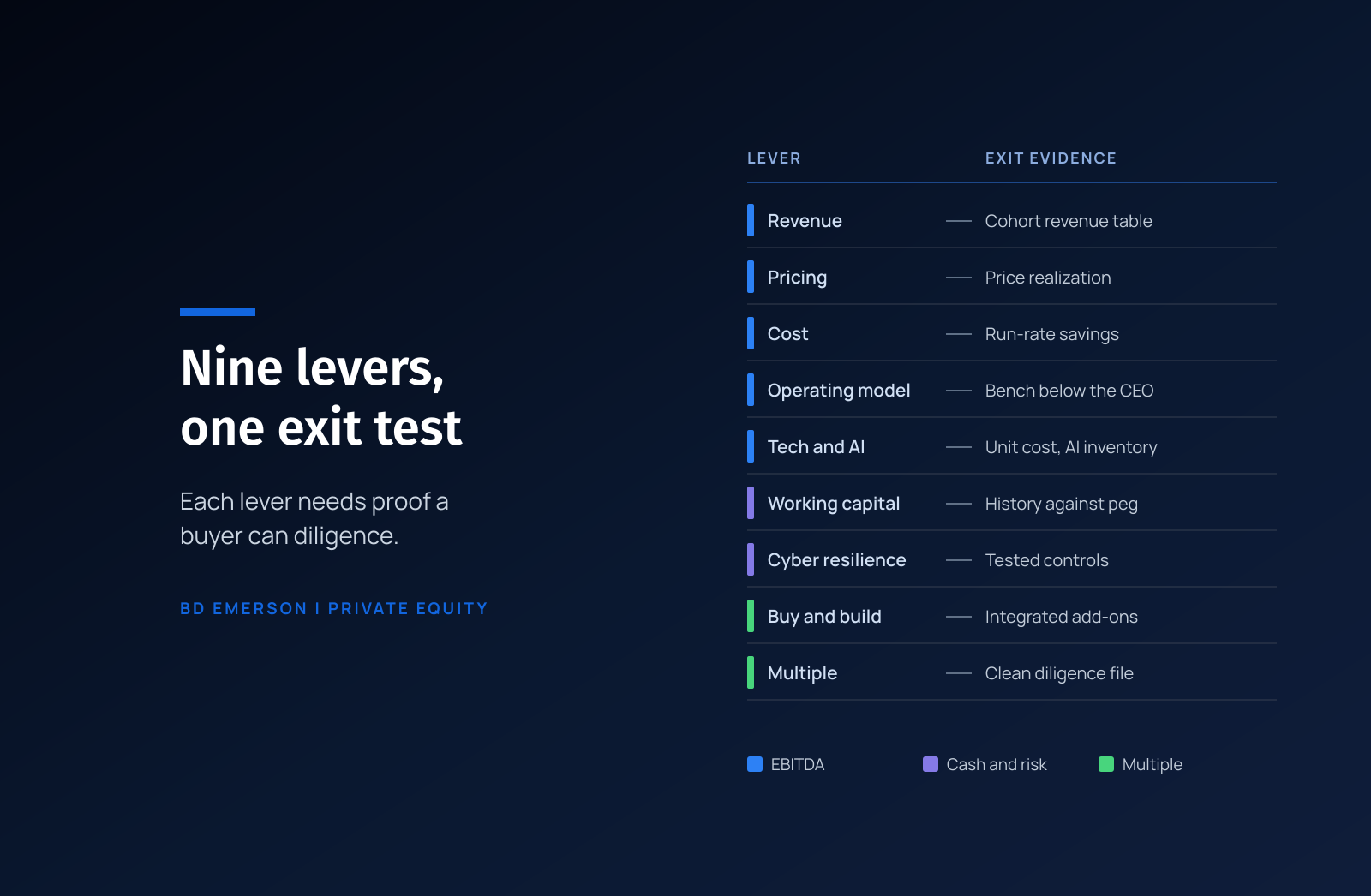
Two habits separate useful tracking from reporting theater. The first is a once-a-year re-underwrite: the board compares the current plan to the original investment case and decides which initiatives to accelerate, replace, or drop. The second is evidence. Every initiative that the exit story will rely on should produce the record a buyer's diligence team will ask for, such as cohort revenue tables for a growth initiative or invoices for a procurement saving, starting in the quarter it launches.
Where do operating partners fit?
Operating partners are senior operators employed by or affiliated with the sponsor who work with portfolio company management on execution. Roles usually divide as follows. The deal team owns the investment thesis and the board seat. Operating partners own the playbooks for pricing, procurement, talent, and technology, coach the CEO, and step in when a company falls behind plan. Outside advisers deliver bounded projects with defined outputs and end dates, such as a pricing study, an ERP selection, a cyber program build, or a carve-out separation.
The Brown, Fei, and Robinson finding about concentrated effort applies here. Sponsor attention is finite, so operating partner time goes where the gap between plan and actual is largest or where an initiative carries the most exit value. A portfolio review that ranks companies on those two measures each quarter is a simple way to allocate it. Specialist work that a company needs only once in the hold is usually cheaper bought from outside than built into the sponsor's own team.
How should a sponsor manage cyber and other risks across the portfolio?
Each portfolio company should keep a short risk register that the board reviews quarterly: customer concentration, key people, regulatory exposure, covenant headroom, and cybersecurity. Cyber deserves a portfolio-wide approach because one incident can stop revenue at a company and expose the sponsor's reputation with its limited partners. A workable approach is one framework, one baseline, and one scoring method across every company.
The NIST Cybersecurity Framework 2.0, released February 26, 2024, works well as that common framework. NIST designed version 2.0 for organizations in any sector, and it added a Govern function alongside Identify, Protect, Detect, Respond, and Recover. A sponsor can score each company against the framework once a year, set a minimum control baseline that every company must meet (multifactor authentication on email, remote access, and administrator accounts, tested backups, an incident response plan, and an annual tabletop exercise), and require each company to notify the sponsor of a material incident within a set number of hours. Comparable scores let the sponsor see which companies need investment first. Our private equity cybersecurity practice runs these portfolio programs.
When should exit preparation start?
Exit preparation starts at close, because the evidence a buyer will want has to accumulate during the hold. The formal workstream starts later. As a BD Emerson planning range, begin formal exit readiness 12 to 18 months before the planned sale. That window covers audited financials if the company lacks them, a sell-side quality of earnings review, a technology and cyber readiness review, management depth below the CEO, and a data room built from records that already exist. The technology and cyber part of that review should produce what a buyer's diligence team will request first: a current system inventory, the last two years of penetration test results with remediation evidence, incident history, the annual framework scores, and the software license position. Our guide to exit readiness covers each workstream and its timing.
BD Emerson, an Andersen Consulting company, delivers technology, cyber, and AI diligence and value creation for private equity sponsors and their portfolio companies. Our private equity value creation team builds KPI packs, tracks value creation plans quarter by quarter, runs portfolio cyber programs, and prepares companies for exit, with sector depth in financial services, insurance, healthcare, retail, and software.

About the author