What Is a Forward Deployed Engineer?

A forward deployed engineer, usually shortened to FDE, is a software engineer who builds inside the customer's environment. An FDE works in the customer's production data, sits with the operators who run the process, and ships software those operators use every day. The scope is one customer's problem rather than the general case, and the measure of the job is whether that customer's operation changes. The title comes from Palantir, which built its entire delivery model around the role. OpenAI, Anthropic, and Salesforce now hire for it too.
The role exists to close a gap every complex platform creates. Product engineers build for every customer at once. Consultants write the plan and hand it over. An FDE is in the data on the day the workflow has to work.
Why forward deployed engineering exists
Some software is finished when it ships. Payroll systems and most SaaS tools arrive working, and the buyer configures a few settings. Other software arrives as capabilities that produce nothing until someone shapes them against a specific operation. Data platforms, AI systems, and decision tools live in that second category, and the shaping is the expensive part.
Demos hide how expensive it is. In a demo the data is clean and the workflow has one path. In production the same part is coded three ways across two ERPs, the ship date is filled in by someone who is guessing, and the decision the software supports gets made in an undocumented spreadsheet. None of that shows up in a proof of concept, and all of it decides whether the deployment works.
Closing that gap takes one person who can do both halves: read an operation well enough to model it, and write code well enough to keep the result running. Splitting the halves across an analyst who documents and an engineer who implements inserts a translation step, and that step is where the detail that mattered gets dropped.
Platforms like Palantir Foundry can support far more than most deployments achieve, and the gating factor is rarely the software. The constraint is the supply of people who know the platform, understand the operation, and can build production-grade work where the two meet. That intersection is the FDE job description.
What forward deployed engineering looks like, week by week
The work is specific, and a first deployment runs on a recognizable clock.
Week one: access and discovery at the same time
The first week runs two tracks. One is credentials: read access to the source systems, a landing zone for extracts, and whatever security review stands between the engineer and production data. The other is discovery, which means sitting with the people who do the work and watching them do it. The target by Friday is a query that runs against real data plus a written list of the three decisions the operator makes most often.
Time to data access is the best early predictor of how an engagement will go. Two or three days is healthy. Six weeks means the deployment is behind before it starts.
Weeks two to four: one working slice against real data
Pick one decision off the discovery list and build the narrowest thing that changes it. In practice that is one or two source systems, a model of the few objects the decision touches, and one screen or one alert. Twelve integrations come later. A scheduler who needs to know which orders will miss tomorrow's dock appointment needs one view, on live data, correct enough to act on.
That slice exists to expose what is wrong with the engineer's understanding, and it usually does so within an hour of an operator opening it. Duplicate records that were assumed unique. An exception path that carries thirty percent of volume. A status field that means something different at the Houston plant than in the system of record. Those findings are the real output of weeks two to four.
Weeks five to twelve: iterate with the operator in the room
From here the cadence is a working session once or twice a week where the operator uses what exists while the engineer watches. Small changes land the same day. The backlog gets written from what happened in the session rather than from a workshop. Scope grows outward from the first slice: the second decision, the second team, the exception handling deferred on purpose.
Governance belongs in this stretch. Access scoping, data markings, audit trails, and change control are cheap to build in at week five and expensive to retrofit at month nine.
Month four onward: hardening and transfer
A deployment only the FDE can maintain is a liability. The last phase is monitoring on the pipelines, a named owner for every object and application, documentation written for whoever inherits it, and paired work with the customer's engineers until they ship changes without asking.
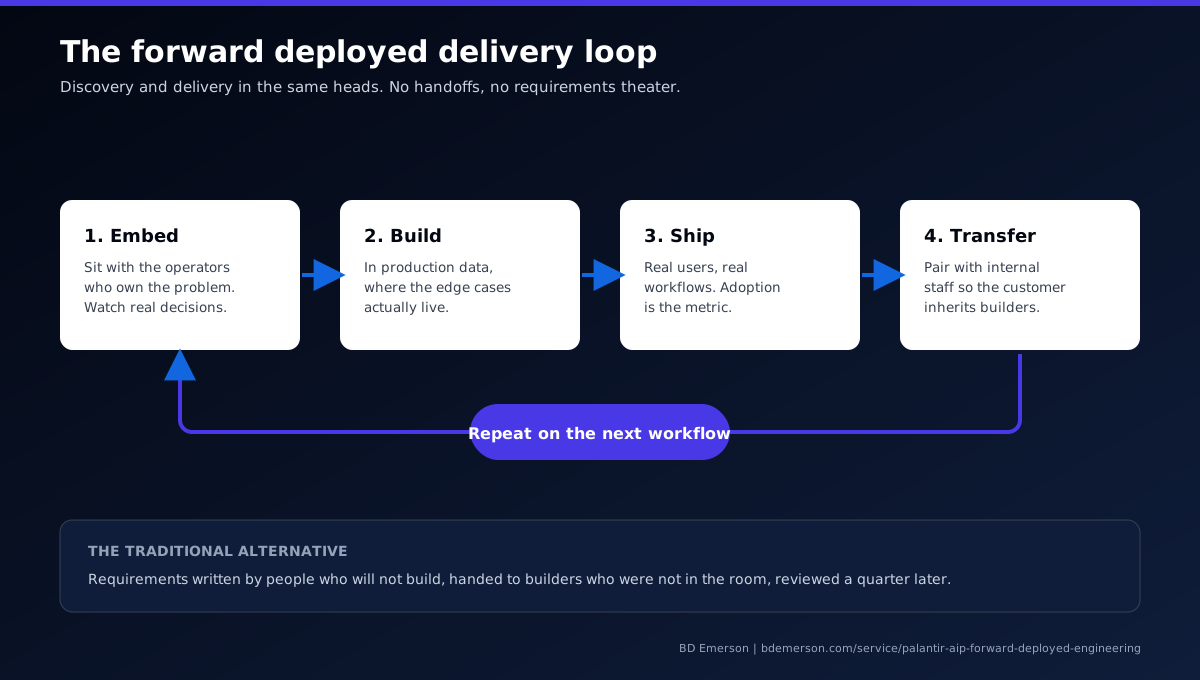
Underneath the calendar the loop is the same every time: embed with the operators who own the problem, build in production data where the edge cases live, ship to real users, then transfer the capability. It moves fast because it removes the two slowest parts of enterprise delivery: requirements documents for work nobody has attempted, and handoffs between deciders and builders.
The forward deployed software engineer at Palantir, OpenAI, Anthropic, and Salesforce
Palantir created the title and organized its delivery business around it. The pattern spread to the AI labs and to large software vendors, and the same two words now cover different jobs. Four things separate them.
Tenure in the field varies most. A Palantir FDE can spend a year or more on one account and know the operation as well as the customer does. At the AI labs, engagements often run six to twelve weeks and one engineer runs several a year, because the work is standing up a first agent or an evaluation harness rather than rebuilding a supply chain.
Quota is the second difference. In the original model the role carries no number and gets measured on deployments that reach production. When the function reports into sales, the same title gets measured on bookings influenced, and the incentive shifts toward the demo that closes the deal over the system that survives month six.
Third is how hard the feedback loop runs back into engineering. Palantir's is the tightest: patterns that recur across accounts become platform capability, and field engineers file the requirements. At the AI labs the loop feeds model behavior and API roadmaps. At a large vendor it travels through product management, and field evidence arrives as one input among many.
Fourth is the ratio of building to configuring. In a Foundry or AIP deployment most of the work is construction: pipelines, an ontology of objects and actions, applications, and AI workflows on top. At the AI labs the build is evaluation sets, retrieval, agent scaffolding, and the glue between a model and a customer's systems. At vendors with heavy declarative tooling, more of the job is configuration inside the product's own framework. All three are real engineering, and the mismatch is the most common reason a strong hire is unhappy ninety days in.
How an FDE differs from a consultant, a solutions engineer, or customer success
Several roles sit next to this one and the titles get used loosely. Three questions separate them: who owns the code, who owns the outcome, and who the customer is inside the account.
A management consultant owns analysis and a recommendation. The deliverable is a document, and the customer inside the account is the executive sponsor. An FDE owns a running system, is on the hook when it breaks at 6am, and answers to the operator using it. The sponsor pays. The operator decides whether it was worth paying for.
A solutions engineer or sales engineer owns the technical win. The code is a prototype built to prove a point and usually discarded after signature. The customer is the buying committee, and the measure is pipeline and win rate. An FDE starts where the signature lands.
Professional services owns scoped delivery against a signed statement of work. The scope document is the boundary and change requests are the mechanism. That works when requirements are knowable up front. It struggles when the first working slice invalidates half of them, so FDE engagements get funded as capacity against a prioritized backlog instead.
A customer success engineer owns adoption and renewal of software that already exists. The work is training, troubleshooting, and configuration, measured on usage and retention. Production code sits outside the scope. An FDE writes it.
Hire an FDE or buy the capacity
Start with the loaded cost of hiring one. In major US markets, base salary for a capable forward deployed engineer runs roughly $160,000 to $230,000, with senior and platform-specialist hires above that. Add 25 to 35 percent for payroll taxes, benefits, equipment, and tooling, and the fully loaded figure lands between $210,000 and $310,000 a year.
Then price the ramp, which is where hire-versus-buy math usually goes wrong. An engineer who knows the platform and the industry reaches useful output in four to six weeks. One who knows the platform but not the domain takes two to three months. One who knows neither takes four to six months, and a senior person on your side spends real hours unblocking them. Year one returns eight to ten productive months out of twelve.
Contracted capacity in the US prices around $30,000 to $45,000 per engineer-month, moving with seniority, security requirements, and platform scarcity. That is more per month than a loaded hire. It also produces in week one, carries a ramp you do not pay for, and stops when the backlog stops.
Break-even is a question of utilization, so count use cases rather than headcount. A well-scoped use case consumes six to ten engineer-weeks from first data access to production. A full-time hire needs roughly forty productive engineer-weeks a year, which works out to four to seven queued and funded use cases to stay busy. Below that line the hire idles and buying wins. Above it, hiring wins on cost inside the first year.
Platform scarcity moves the line hardest. It raises the salary and the time to fill, and a role that sits open five months has already cost a deployment.
What to test in a forward deployed engineer interview loop
Standard software loops select for the wrong things here. Algorithm screens say little about whether someone can put a working slice in front of a skeptical operator in three weeks. Four exercises do most of the work.
- A build exercise on dirty data. Hand over a real extract with duplicates, inconsistent codes, and missing values, and ask for a working answer to a business question in three hours. Strong candidates ask two questions, state their assumptions, and ship.
- A discovery role-play. Have an interviewer play an operator who is busy and cannot articulate what they need. Score the questions, not the solution. The signal is whether the candidate reaches the real decision and the data behind it inside twenty minutes.
- A written memo. Ask for one page on a past deployment: what shipped, what they got wrong, and how they found out. The failure they choose tells you how they handle being wrong in front of a customer.
- A governance question. Ask how they would approach day one with production data containing restricted records. Candidates who have done this name access scoping, markings, and an audit trail without prompting.
The signals that predict success hold across loops. Candidates who have shipped something other people depended on daily. Fast time to running code in the build exercise. Tolerance for unglamorous data work, because most of the first month is that. Willingness to refuse scope and explain the refusal to a sponsor.
The anti-signals are just as steady. A candidate who needs a specification will stall in week one. One who wants to redesign the customer's process before shipping will spend a quarter on a design document. One who describes past work only as team output cannot say what they built.
Where BD Emerson fields forward deployed engineering
BD Emerson supplies this capacity as a consultancy. We are not Palantir. Our engineers work alongside Palantir's teams, or pick up the backlog after those teams roll off. They build in Foundry and AIP, paired with the security and compliance practitioners the firm is known for, so access scoping, markings, and audit evidence get handled in the first sprint instead of the week before an assessment.
Three situations account for most of the work: launching a new deployment with momentum, restarting one that stalled after the proof of concept, and building an internal bench by pairing our engineers with your staff until they can carry it. The last one matters most. A good engagement leaves behind builders.
If you run Foundry or AIP and the backlog of use cases is growing faster than your bench, our forward deployed engineering team is the shortest path through it. Our Palantir consulting practice fields it as a standing service, and the same engineers handle upstream work through our data engineering consulting practice when the pipelines have to exist first.

About the author